Growth vs inflation: A case for recalibration of policy
Retail inflation as measured by the Consumer Price Index (CPI) grew 7.01% in the month of June, making it the sixth consecutive month of inflation staying above the 6% upper limit of the Reserve Bank of India’s tolerance band.
Retail inflation as measured by the Consumer Price Index (CPI) grew 7.01% in the month of June, making it the sixth consecutive month of inflation staying above the 6% upper limit of the Reserve Bank of India’s tolerance band. To be sure, the headline CPI reading came down for the second consecutive month in June, and the June quarter inflation has ended up lower than RBI’s forecast of 7.5%. Most forecasters, including RBI’s Monetary Policy Committee (MPC) expect inflation to stay above the 6% mark in this year. Even as economic policy continues to focus on inflation management – finance minister Nirmala Sitharaman reiterated the government’s commitment to maintain vigilance on inflation on July 12 – an argument can be made that there is merit in recalibrating the economic policy focus away from inflation management towards growth. Here are three charts which explain this argument in detail.
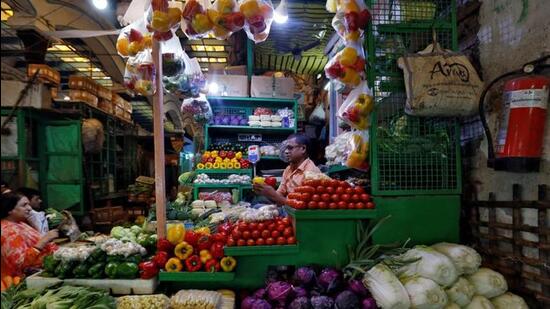
(REUTERS)
Global commodity prices seem to have started cooling
There is a widespread agreement on the fact that international commodity prices have played a large role in stoking India’s inflation fires. If there is one commodity which determines inflation trajectory in not just India but most parts of the world, it is crude petroleum prices. When the government presented its Budget on February 1, it was based on the assumption that average crude price for 2022-23 would stay in the range of $70-75 per barrel. Petroleum ministry data shows that the average price of India’s crude oil basket (COB) increased from $84.67 in January to $94.07 and $112.87 in February and March. Oil prices cooled to $102.97 in April before increasing to $109.51 and $116.01 in May and June. Now, they seem to be coming down once again, with the July 12 value being $103.8. In fact, petroleum isn’t the only commodity which is experiencing a downward movement in prices. The Bloomberg Commodity Index, which measures prices of a wider basket of commodities has also been on a declining trajectory since June. “One explanation for tanking commodity prices is that worries about a recession are taking hold…Moreover, some of the supply constraints that contributed to price rises earlier in the year have eased,” The Economist wrote in its July 9-15 issue.
But advanced country recession also means headwinds for domestic growth
One of the silver linings in India’s post-pandemic recovery has been its export performance. The purchasing power boost in advanced economies, thanks to the large fiscal stimulus given by their governments, has played a large role in India’s export boost. Rising export earnings have also provided a cushion against India’s increasing import bill due to the commodity price spike. However, as advanced economies run into recessionary territory, India’s export performance seems to be taking a hit. Monthly export numbers fell in both May and June even as imports increased. “Diminishing global growth prospects could start weighing on India’s exports performance in the coming months, in our view. The June PMI manufacturing sub-indices showed sharp declines in exports orders, and media reports suggest that companies are seeing a sharp pullback in export volumes,” Rahul Bajoria, MD & chief India economist, Barclays, said in a research note dated July 4. This means that recessionary fears in advanced economies are both a blessing and curse for India. It will help because the fall in global prices will ease the inflation pressure, but it will hurt via the slowdown in exports.
This is why supporting domestic recovery becomes even more important
GDP data for the quarter ending June will only be released in August. Until then, questions on the nature and magnitude of economic recovery have to be answered by looking at high frequency data. It is here that different indicators tell us different stories. For example, if one looks at the Purchasing Managers’ Index (PMI) for manufacturing, domestic manufacturing activity has been in expansion mode – this is what the PMI value staying above 50 signifies – for quite some time, even though there has been some loss of momentum in the last month. PMI data, however, mostly looks at the formal sector. When one looks at the Index of Industrial Production (IIP) numbers, the story appears to be a not-so-happy one. While the May IIP number shows an annual growth of 19.6% , the growth over pre-pandemic value (May 2019) is just 1.7%. The bump in annual growth numbers is because of a favourable base effect due to the second wave of the pandemic which peaked on May 9, 2021. These numbers, when read with the continuing weakness in consumer confidence numbers underline the persistence of demand side weakness in the economy. Another alarming aspect of the ongoing economic recovery is that it seems to have been accompanied by growing distress in the informal sector.
While it is nobody’s case that the Indian economy is out of the woods as far as its inflation troubles are concerned, it is important to not lose track of the fact that a large part of the economy is still struggling to regain even pre-pandemic levels which themselves were subdued thanks to the economic slowdown since 2017-18. Given this context, there is some merit in the argument that economic policy needs recalibration to cushion growth now that the inflation problem is not as bad as what seemed to be the case a couple of months ago. Ignoring these concerns might lead to irreversible damage to India’s informal sector which sustains livelihoods of an overwhelming share of our workforce.

 E-Paper