E-Paper



‘If some Salim posing as a Suresh…’: In new marriage rules, Gujarat to make informing parents compulsory
Applicants must attach a declaration stating whether the bride and groom have informed their parents about the marriage.

 Prefer HTon Google


Ahmedabad: Gujarat is preparing to overhaul its marriage registration system and make parental involvement central to the process, especially in cases where the couple has eloped, deputy chief minister Harsh Sanghvi told the state assembly on Friday.
The state is planning to amend the Gujarat Registration of Marriages Act, 2006 to protect women, prevent fraud and restore transparency amid rising misuse, particularly in “love marriages and elopements”, the minister said, adding that the government has no objection to “genuine love marriages” but will act against deception and exploitation.
“There is no objection to love. But if some Salim posing as a Suresh, traps a girl, we will not spare them,” he said.
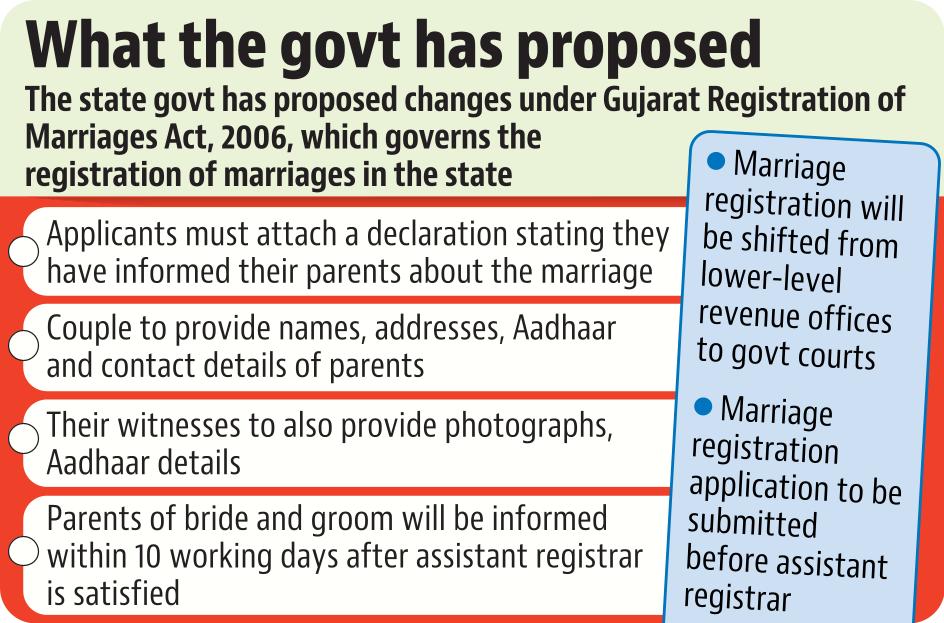
According to the proposed rules, every marriage registration application will need to be submitted before the assistant registrar, while applicants must attach a declaration stating whether the bride and groom have informed their parents about the marriage.
Also Read | SC's extraordinary order on Bengal SIR amid ‘unfortunate blame game’: District judges to aid process
Moreover, the bride and groom will have to provide the names, addresses, Aadhaar and contact details of their parents in the application. The parents of the bride and groom will be informed within 10 working days as soon as the assistant registrar is satisfied, according to the proposed rules.
The assistant registrar will forward the application to the registrar of the district or taluka concerned. The marriage will be registered 30 days after the registrar is satisfied that the requirements specified in sub-rules have been met. The registrar will upload all these details to an online portal to be created by the government, according to the proposed rules.
“The marriage certificate will be issued only after 40 days from the date of application, allowing time for verification, consultation or objections,” Sanghvi told the House. Applicants will be required to submit Aadhaar cards, birth certificates and school-leaving certificates of both bride and groom, along with photographs and, wherever available, the marriage invitation card.
Witnesses from both sides will have to provide photographs and Aadhaar details. Marriage registrations will be shifted from lower-level revenue offices to government courts.
The proposed changes are to the rules under the Gujarat Registration of Marriages Act, 2006, which is a state-specific law governing the registration of marriages in Gujarat. This Act applies to the registration process for marriages across faiths.
To be noted, the changes are about how marriages are registered (paperwork, notices, deadlines) — not what makes a marriage valid under personal laws.
Under the existing rules, notified in 2006, couples who elope can register their marriage quickly by submitting basic documents and witnesses to talati-cum-mantri (or assistant registrar/local registrar), without informing parents.
The Special Marriage Act, 1954 applies in Gujarat for interfaith or civil marriages. As per the guidelines, notice of intended marriage must be given to the Marriage Officer (usually a district-level official) at least 30 days in advance. The notice is publicly displayed for 30 days to allow objections. If no objections (or if resolved), the marriage can be solemnized. No parental consent is required for adults, groom minimum age 21 and bride minimum age 18.
The government has opened a 30-day window for public feedback on the draft amendments. A committee will review the inputs before finalising the rules. The changes remain proposals and will come into force only after the consultation process is completed and the final notification is issued.
If the rules are passed, Gujarat will become the first state in the country to mandate official parental notification for every marriage registration.
Sanghvi said the changes were intended to act as a safety mechanism for women by preventing identity concealment, coercion and practices that, according to him, undermine Sanatan traditions and Indian wedding customs. He also raised concern over what he described as love jihad -- a term used by right-wing groups to describe interfaith relationships involving a Hindu woman and a Muslim man -- and said strict police action will be taken in cases where women are harassed after marriage over dowry or property issues.
“Anti-social elements hide their real identity and lure or deceive daughters of the state into relationships. Shocking details of several bogus marriages in Panchmahal district have emerged,” he said.
Banaskantha MP and senior Congress leader Geniben Thakor welcomed amendments, calling them the need of the current times. “I am not against love marriages, but deception and exploitation in the name of love must be stopped. I have been demanding stricter norms for years to protect our daughters,” she said.
She praised the government’s move as a positive step following public and community demands, including from the Thakor community.
The proposals follow consultations held over the past three months under law and justice minister Kaushik Vekeriya, during which around 30 meetings were conducted with community representatives.
Gujarat already has a stringent anti-conversion law, which punishes unlawful conversion by marriage or aiding such conversion with imprisonment of not less than three years, but which may extend to five years and a fine of not less than ₹2 lakh.
Higher penalties apply if the victim is a minor, woman, or a person from Scheduled Castes or Scheduled Tribes.