
 E-Paper



Hasina flees Bangladesh
Bangladesh's longest-serving PM Sheikh Hasina resigned amid massive protests, fleeing to India as army chief announced an interim government formation.


Sheikh Hasina, Bangladesh’s longest-serving prime minister, resigned in the face of massive public protests and fled to India, even as army chief General Waker-uz-Zaman announced an interim government would be formed to run the country.
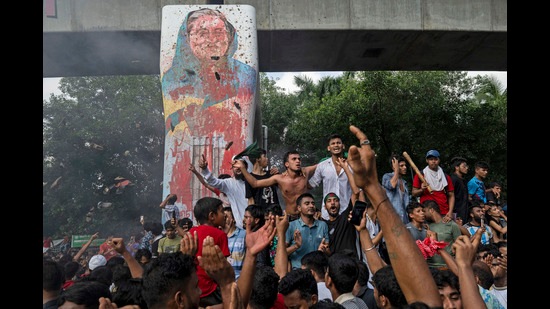
Hasina, 76, was left with no option but to quit as public anger grew over the death of more than 300 people in a crackdown by her administration on a movement that began as protests against a controversial quota in government jobs and transformed into a mass mobilisation demanding her resignation.
Her flight came a little more than six months after she began a fourth consecutive term — and the fifth overall since 1996 — by winning general elections in January that were boycotted by the main opposition Bangladesh Nationalist Party. The elections were marred by a low turnout of 40% and her last few years in power were marked by a crackdown on the Opposition, including the jailing of leaders, stifling of dissent, and muzzling of media.
Hasina and a small entourage that included her sister Sheikh Rehana were flown in a military helicopter from her official residence to a military airbase, where the group boarded a C-130 transport aircraft of the Bangladesh Air Force, people familiar with the matter said on condition of anonymity.
The Indian side agreed to a request from Bangladesh for the aircraft to use Indian airspace and the C-130 arrived at Hindon airbase late on Monday afternoon. National Security Adviser Ajit Doval and senior Indian air force officers met Hasina at the airbase and she would be kept at a safe location, possibly at Hindon itself, the people said.
Hasina is expected to travel to London though it was unclear how long her stopover in the Indian capital would be, the people said. There were also indications of her travel plans being affected because of certain assurances that the former premier has sought from British authorities, they said.
There was no immediate word on the developments from the Indian government, which has maintained in recent weeks that the protests in Bangladesh were an “internal matter” of that country. Hasina was seen as one of the closest partners of Prime Minister Narendra Modi in the neighbourhood and Bangladesh was the main beneficiary of India’s “Neighbourhood First” policy, with billions of dollars poured into creating physical and energy connectivity between the two sides.
Modi chaired a meeting of the Cabinet Committee on Security, which including home minister Amit Shah, defence minister Rajnath Singh and external affairs minister S Jaishankar, among other senior officials, at his residence on Monday evening to take stock of the situation in Bangladesh. Earlier in the day, Modi was briefed on developments by Jaishankar.
Jaishankar is expected to make a statement in Parliament on Tuesday that will outline the government’s position on the situation in Bangladesh, the people said.
Bangladesh under Hasina had fostered close ties with India and maintained a balance in relations with New Delhi and Beijing, especially at a time when China has sought to increase its influence in the neighbourhood. Soon after beginning her second term as premier in 2008, Hasina had cracked down on anti-India militant groups from the northeastern states that had established bases inside Bangladesh.
The dramatic turn of events followed the death of more than 100 people in clashes during nationwide protests on Sunday. More than 200 people were killed and thousands injured in the first round of protests by students last month against the quota in government jobs for kin of veterans of the 1971 war of liberation.
The Anti-Discrimination Student Movement, which is leading the protests, had called on people across Bangladesh to join a “March to Dhaka” on Monday to press for the ouster of the government led by Hasina’s Awami League party. Protesters occupied Ganabhavan, the premier’s official residence, and the Prime Minister’s Office after Hasina fled the country.
Protesters vandalised large parts of the sprawling Ganabhavan complex. Visuals showed people sleeping on her bed, ripping out artwork, stealing clothing and even animals, as well as eating food presumably laid out for the PM and her family. The protesters also vandalised statues and murals of Sheikh Mujibur Rahman, Hasina’s father, and torched the Bangabandhu Memorial Museum. They also attacked the police headquarters in Dhaka.
Separately, vandals in several parts of the country destroyed objects and buildings, including a Kali temple, an ISKCON temple as well as the Indira Gandhi Cultural Centre (IGCC) in Dhaka.
“The honourable prime minister has resigned, and we will form an interim government to do our work. Please have patience, give us some time,” army chief Gen Waker-uz-Zaman told the media after holding consultations with leaders of various political parties, excluding the Awami League.
“God willing, we will be successful in solving all the problems by working together. Don’t go on the path of confrontation and return to the path of peace and order,” he said, speaking in Bengali.
Zaman said the military will ensure that all deaths and acts of injustice during the recent protests will be investigated by authorities. “I give you my word that there will be justice for all killings and acts of injustice. Please have faith in the military. I am taking all the responsibility for your lives and property, and I give you my word that you should not give up hope,” he said.
The military has faced pressure from retired officials and other influential groups to step back from security duties following the death of scores of students in the recent protests. Though it remains a behind-the-scenes player, the Bangladesh Army continues to exercise considerable influence in politics.
Hasina was one of the dominant figures in Bangladeshi politics following the assassination of her father, Sheikh Mujibur Rahman, in a military coup in August 1975. In 1981, she returned to Bangladesh from India, where she lived in exile, and was elected head of the Awami League.
She joined hands with Khaleda Zia, head of the rival BNP, to lead a movement for democracy that ousted military ruler Hossain Mohammad Ershad in 1990. But Hasina and Zia soon became bitter rivals — often referred to as the “battling begums” — and Zia was jailed in 2018 on graft charges that the BNP said were trumped up. Zia was also barred from political activity.
Hasina’s family has had long-standing ties with India’s political establishment. Former premier Indira Gandhi backed Bangladeshi leaders in the war of independence in 1971, and Hasina assiduously maintained the bonds she developed with Indian political leaders while living in New Delhi. Indian leaders also backed her government in the belief that Hasina would keep radical Islamic groups out of power.
Her daughter, Saima Wazed, the South Asia regional director of the World Health Organization, was based in New Delhi but vacated her residence in Jor Bagh last month.
Despite facing criticism for becoming autocratic and mass arrests of opposition workers and rights activists, Hasina also received praise for turning around the economy, for sheltering Rohingya Muslims fleeing persecution in Myanmar, and for progress in human development indicators, with Bangladesh set to graduate from least developed country status in 2026.
But the economy slowed down sharply, hit first by the Covid-19 pandemic and then the rise in food and fuel prices following Russia’s invasion of Ukraine, forcing the Awami League government to turn to the International Monetary Fund (IMF) last year for a $4.7-billion bailout.
Hasina’s son Sajeeb Wazed Joy, who served as an official adviser to the premier, said his mother has no plans to make a political comeback. He told BBC that Hasina had been considering resigning since Sunday and had left the country for her safety after her family insisted.
Defending his mother’s career, he said: “She has turned Bangladesh around. When she took over power it was considered a failing state. It was a poor country. Until today it was considered one of the rising tigers of Asia. She’s very disappointed.”


