
 E-Paper



House hails ‘living document’ to mark 75 years of Constitution
President Murmu marked Constitution Day, emphasizing its role in democracy and urging collaboration among government branches to improve citizens' lives.


New Delhi President Droupadi Murmu on Tuesday described the Constitution as a “living and progressive document” that forms the bedrock of India’s democratic republic and emphasised that its true strength lies in the coordinated efforts of all constitutional bodies to improve citizens’ lives.
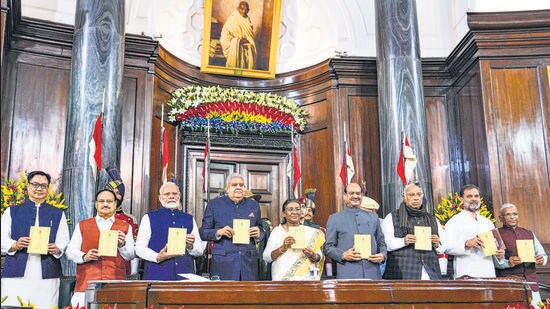
The President was addressing parliamentarians at the Central Hall for the Constitution Day on Tuesday, which commemorates the day in 1949 when the Constituent Assembly adopted the document. This was the culmination of a nearly three-year process by the Constituent Assembly — a feat of democratic nation-building that many see as without parallel in history. At the time a little under 1.5 million-words long, the Constitution was sculpted out of sweeping philosophical and political discourse. It came into effect exactly two months later, on January 26, 1950, marking India’s birth as a Republic.
“In accordance with the spirit of the Constitution, it is the responsibility of the executive, legislature, and the judiciary to work together to make the lives of common people better,” Murmu said, addressing lawmakers in the Central Hall of Samvidhan Sadan on the occasion of Constitution Day.
The President highlighted how the document has today enabled India’s transformation. “Our farsighted Constitution-makers had provided for a system of adopting new ideas, according to the needs of the changing times. We have achieved many ambitious goals related to social justice and inclusive development through the Constitution. With a new approach, we are earning for India a new identity in the comity of nations,” she said.
The Chief Justice of India, the Prime Minister and Opposition leaders separately held events to mark the day.
At the Supreme Court, Prime Minister Narendra Modi emphasized that the spirit of “Nation First” would ensure the Constitution’s enduring relevance. “Our Constitution is not just a lawyer’s document; it is a spirit—a spirit of the age,” Modi said, addressing a gathering that included Chief Justice Sanjeev Khanna.
He described the Constitution as a “living, continuously flowing stream” that adapts to the nation’s changing needs while remaining true to its foundational principles. “Our Constitution is a guide to our present and our future...it has met every need and expectation of the Country,” he said.
At another event at Talkatora Stadium, Opposition leaders offered contrasting perspectives. Congress leader Rahul Gandhi described the Constitution as the book of “truth and non-violence.”
“The idea of social empowerment of Dr Ambedkar, Jyotirao Phule, Lord Buddha and Gandhi ji is inside this,” Gandhi said. “I want to ask you, does this have the voice of Savarkar ji? Is it written somewhere in it that violence should be used, people should be killed or that the government should be run by using lies?”
In Parliament, in the Central Hall of the old Parliament building now known as the Samvidhan Sadan, President Murmu emphasised the Constitution’s deep connection to India’s freedom struggle. “The ideals of that incomparable national movement came to be enshrined in the Constitution. Those ideals have been captured succinctly in the Preamble to the Constitution. They are justice, liberty, equality and fraternity. These ideals have defined India since the ages. The ideals highlighted in the Preamble complement each other. Together, they create an environment in which every single citizen finds an opportunity to flourish, contribute to society, and help fellow citizens,” she said.
Today, the President added, the trajectory that the Constitution gave India has helped the country “play an important role in promotion of international peace and security. Today, besides being a leading economy, our country is playing this role very well as the ‘Vishwa Bandhu’.”
Vice President and Rajya Sabha chairman Jagdeep Dhankhar struck a cautionary note about parliamentary conduct. “In contemporaneous times, with decorum and discipline cliff hanging in parliamentary discourse, this day we need to resolve by reiterating pristine glory of our Constituent Assembly embellished functioning. Disturbance as a strategy threatens democratic institutions,” he warned.
Quoting BR Ambedkar’s last address to the Constituent Assembly, Dhankhar recalled: “What perturbs me greatly is the fact that not only India has once before lost her independence, but she lost it by the infidelity and treachery of some of her own people. Will history repeat itself?”
Lok Sabha Speaker Om Birla called for emulating the Constituent Assembly’s standards of debate. “The Constituent Assembly had members with varied ideologies, and they discussed and deliberated upon each article and expressed their acceptance or unacceptance of them with utmost modesty in composing the Constitution,” he said, describing the document as “the result of our people’s penance, sacrifice, potential and capacity.”
Earlier at the Supreme Court, Chief Justice Sanjeev Khanna highlighted India’s constitutional journey. “India has had a transformative journey from a nation, which under the aftermath and horrors of partition saw widespread illiteracy, poverty, lack of a robust democratic system of checks and balances, to one which has now become a self-assured country,” he said at an event organised by the Supreme Court Bar Association.
In her address, President Murmu said that celebrating milestones such as the 75 years of Independence, Azadi Ka Amrit Mahotsav or the upcoming 75th anniversary of India becoming a Republic “provides us with opportunities to take stock of the journey and plan better for the journey ahead”.
“Such celebrations strengthen our unity and show that we are all together in our efforts to achieve the national goals,” she said.
Murmu emphasised that fundamental duties too are clearly defined. “Protecting the unity and integrity of India, promoting harmony in society, ensuring the dignity of women, protecting the environment, developing a scientific temper, safeguarding public property and taking the nation to higher levels of achievement are included among the fundamental duties of citizens,” she said.
The President noted that constitutional ideals gain strength through active participation. “The aspirations of the people found expression in the many legislations enacted by Parliament,” she said, adding that recent government initiatives have “improved the lives of the people and are providing them new opportunities for development.”
Paying tributes to BR Ambedkar, regarded as the architect of the Constitution, and Dr Rajendra Prasad, the first President of India, Murmu recalled how Prasad, as chairman of the Constituent Assembly, had emphasised that keeping the Constitution alive depended on those who operate it. “He had also said that many things which cannot be written in the Constitution are done by the conventions. He had hoped that our country would acquire those capacities and develop those conventions,” she said.
She said the “imprint of Babasaheb Ambedkar’s progressive and inclusive thinking can be found in our Constitution” and his historic addresses in the Constituent Assembly “make it clear that India is the mother of democracy.”
The event in the House had some notable absences. Samajwadi Party lawmaker Javed Ali explained his party’s boycott: “We read the preamble in our party office, because we did not feel it was right to commemorate Samvidhan Divas with the BJP. In recent times efforts have been made to erode the maulik adhikar (fundamental rights) enshrined in the Constitution.”
The President concluded the main ceremony by unveiling a commemorative coin, a postage stamp, and Sanskrit and Maithili copies of the Constitution, along with two books documenting its making and journey. She urged citizens to “inculcate the constitutional ideals in their conduct; follow the Fundamental Duties and move forward with dedication towards the national goal of building a Viksit Bharat by 2047.”


