
 E-Paper



House panel pushes for law to provide security to unorganised sector
The Centre’s Industrial Relations Code bill has specified compensation on retrenchments and prohibits establishments that employ at least 100 people from laying off workers without permission from the government.


Hundreds, maybe thousands of workers may have lost their jobs already on account of the Covid-19 crisis and the ongoing 21-day lockdown to combat its spread, but if the government manages to pass a law currently in the works, it could, in the future, provide such workers with much-needed social security and financial benefits.
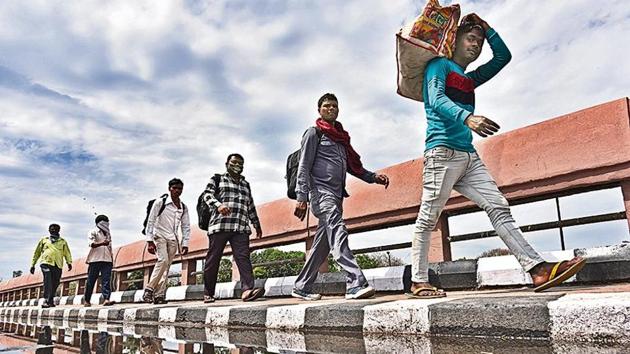
The Centre’s Industrial Relations Code bill has specified compensation on retrenchments and prohibits establishments that employ at least 100 people from laying off workers without permission from the government.
A parliamentary panel’s upcoming report has widened the safety net. The standing committee on labour, headed by BJD leader Bhartruhari Mahtab, suggested that unorganized sector workers, comprising 95% of India’s 458 million workforce, should also come under the act. This is aimed to help agricultural workers, private security guards, even domestic help provided by an agency.
CK Saji Narayanan, president of the Bharatiya Mazdoor Sangh welcomed the moved and said there is a need for government intervention. “Ease of doing business should not be ease of dismissing (workers) or shutting down. There has to be a system in place to see that wages are being paid,” he added.
Narayanan said that the bill leaves out specific worker groups such as domestic help. “The government must ensure these groups are also offered social security and are protected by laws.”
The bill states that if a worker enrolled in an industrial establishment is laid-off after a year of service, whether continuously or intermittently, “he shall be paid by the employer for all days during which he is so laid-off, except for weekly holidays.”
The bill also specifies compensation amounts.
Another provision says that “no worker shall be laid off by his employer except with the prior permission of the appropriate Government or such authority as specified by that Government.”
Only if the work is stopped due to “shortage of power, natural calamity, and in the case of a mine, such layoff is due to fire, flood, excess of inflammable gas or explosion” the worker will not be entitled to any compensation, the bill says.
The standing committee will submit its report in the next session of Parliament. The panel has expressed its firm view that the unorganized sector needs a specific mention in the code and also recommended the applicability of different provisions of the code including the redressal mechanisms for the daily wage earners. The panel believes that exclusion of the unorganized sector in the Industrial Relations Code will not do “justice” to the vast sector.
The panel may also ask the government to take a cue from the recommendation of National Commission of Enterprises and make separate provisions for agricultural workers.
Himanshu, Associate professor at the Centre for Economic Studies and Planning,, Jawaharlal Nehru University said the move to allow retrenchment only after securing permission from the government will work on the ground only when the government makes provisions for establishments to be able to meet the financial burden.
“For this to truly work, the government must ensure that it takes care of the wage bill of these establishments for at least three months (in a crisis). If there is no support these business will be at a disadvantage,” he said.
He also recommended expanding scope of the law to include establishments that have fewer than 100 employees.


