E-Paper



How a 30-yr-old zoology professor has taken to saving dying folk art in Odisha
Typically, while Panigrahi does the research and finds ways to reach out to the artists in a remote village, Satya does the videography, and Ganesh edits the videos. So far, the trio have put up over 50 videos on their YouTube page, as well as a Facebook page, containing both the art forms and interviews.

 Prefer HTon Google


Bhubaneswar: When Kalahandi was a princely state before its merger with the province of Odisha in 1948, it was known for a band of drummers that used a folk instrument called the “Ghumura”, a drum that produced a unique, deep sound. Believed to lift the spirits of soldiers, the drum was a favourite for Kalahandi’s generals during battle, and a dance based on the drums was often used for religious festivals as well. But with the princely states and their rituals non- existent now, and the official patronage that dance forms like the Ghumura enjoyed long gone, Odiya folk culture was well on the path to oblivion. Seventy years later, a 30-year-old zoology lecturer from Western Odisha’s Nuapada district has taken it upon himself to keep the folk art form alive, travelling across the state two days a week to document the state’s unique folk practices, and popularising them via a dedicated YouTube channel.
Growing up in the small village of Rajkomna in Nuapada district, Rajat Kumar Panigrahi grew up watching the “Bael Jatra” every Dussehra where local artistes would perform folk forms of song and dance known as the Paala, Dand and Rahans. Then there was a Chhatar Jatra of Bijaygarh where people would dress up as traditional Kandha tribal warriors and take out a procession. But as years passed, Panigrahi watched as these rituals began to wither before his eyes.
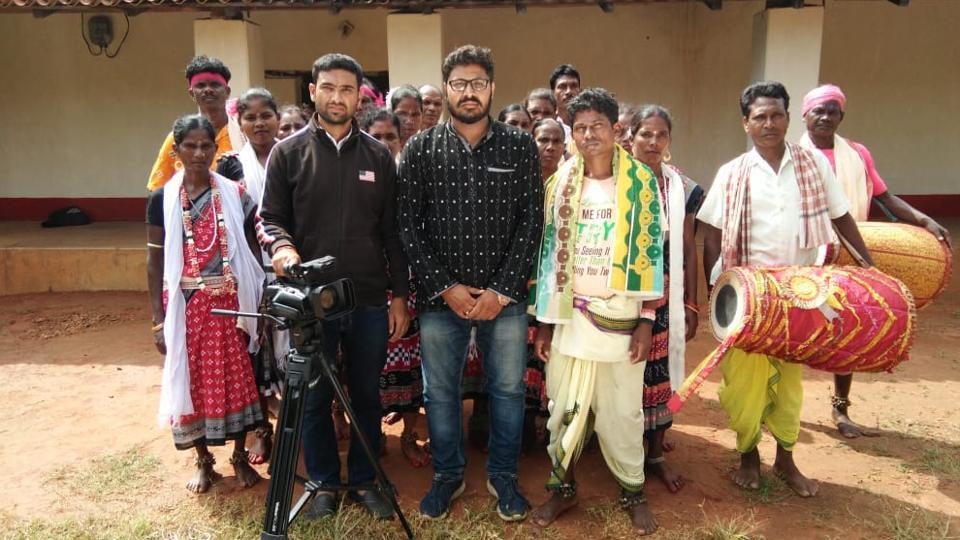
Since 2017, Panigrahi, now a professor of Zoology at the Yuvodaya College in Bolangir, hops on his motorcycle two days a week, and travels to remote villages throughout Odisha armed with a trusty Sony handycam, and two other men, his cousin Satya Panigrahi and friend Ganesh Pradhan. Over the last few months, if on one day they have documented the folk art of the Chakutia Bhunjia primitive tribe in Nuapada, they spent other days in Bolangir documenting the Debguru folk tradition.
“These art forms can only be preserved if they are documented through research. In an age where video is considered the best medium to understand something, I decided on a YouTube channel called Matir Kala (Art of the soil) so that more and more people can watch the videos and see our glorious traditions themselves. The artistes live in such remote villages that many are out of cell phone coverage area and the only way to reach out to them is by visiting them,” said Panigrahi.
Typically, while Panigrahi does the research and finds ways to reach out to the artists in a remote village, Satya does the videography, and Ganesh edits the videos. Thus far, the trio have put up over 50 videos on their YouTube page, as well as a Facebook page, containing both the art forms and interviews. In time, they also found that many artistes had given up on their traditional professions, unable to cope with the absence of any commercial prospects. Those that remained could not afford to maintain or purchase original instruments, and had taken to using plastic.
“In western Odisha there are various folk forms and instruments like the Sankirtan, Paala, Ganabaja, Dulduli, Danda, Ghumura, Sarmangla, Dhol, Nisan, Tasa, Mahuri, Jhan, and Jhunjuni. Most of these are either string or drum instruments, and are traditionally made of cowhide, wood or bamboo. Each tribal community has a tradition, dance and music of their own. I realised that though these folk arts have survived for centuries, having been passed on to younger generations, they have not been documented. We collected various traditional instruments such as bamboo crafts from Nuapada, old wood carvings from Kalahandi, and other handicraft and terracotta art pieces. Other folk arts that we have documented are Chini folk dance performed by the primitive tribal group of Chakotia Bhunjia who live in Sunabeda sanctuary of Nuapada district. We also found that many of these artistes have given up these art forms as they could not earn anything from them,” said Panigrahi, who has so far travelled over 50,000 km with Satya and Ganesh to over 1000 villages in Sonepur, Kalahandi, Nuapara, Bargarh, Sambalpur and Bolangir.
But if these art forms were already dying out, Panigrahi said that the Covid-19 pandemic only exacerbated an already critical situation. “Thousands of families depend on these folk arts to survive. For instance, during marriages, Ganabaja is performed by Dalit artistes in which five indigenous instruments are played. As weddings celebrations were cancelled due to the pandemic, these artistes suffered a great deal”
Panigrahi has taken to buying traditional instruments with his own money to help artists in times of financial distress. “So far I must have spent ₹3 lakh in helping out the artistes through buying the original instruments and another 4 lakh on the handycam and other video accessories. I don’t know if it would be financially sustainable, but I intend on continuing as long as I can,” he said.
Panigrahi says he often faces questions about his work from family and colleagues alike. “They often tell me that I am mad to spend so much money in what they see as a fruitless exercise. I tell them that if the YouTube videos inspire artistes to continue their craft, and prevent them from turning extinct, I will be happy. Next, I want to start a museum in my village which will house traditional instruments, ornaments and tribal jewellery,” he said.
Secretary of Odisha’s culture and Odia language department, Madhu Sudan Padhi said that since 2018 the state government has been providing a monthly pension of ₹1200 to indigent artists under the Mukhyamantri Kalakar Sahayata Yojana. “We send them to different festivals that are being organised in the state so that they can earn more. We are also developing a web application where the details of all such artists would be available for people to see and help them. Both private and government help is necessary if we want to save what is a dying culture,” said Padhi.