
 E-Paper



‘How can you take risk’: Supreme Court raps Delhi govt over rise in pollution
The apex court has directed the Delhi government to explain the steps it has taken to address the alarming rise in pollution levels.

 Prefer HTon Google


Supreme Court on Monday questioned the Delhi government over the delay in enforcing Stage 4 of the Graded Response Action Plan (GRAP) despite the alarming rise in pollution levels in the national capital.
A bench comprising Justices Abhay S Oka and Augustine George Masih highlighted the delay in enforcing stage 4 measures of the GRAP despite the Air Quality Index (AQI) reaching critical levels in the national capital.
The counsel for the Delhi government informed the bench that stage 4 of GRAP had been enforced starting Monday, which includes a ban on heavy vehicles entering the national capital.
The apex court stated that it would not permit any reduction in preventive measures under stage 4 of GRAP, even if the AQI drops below 450.
“The moment the AQI reaches between 300 and 400, stage 4 has to be invoked. How can you take risk in these matters by delaying applicability of stage 4 of GRAP,” the bench told the counsel.
The court directed the state government to explain the steps it has taken to address the alarming rise in pollution levels.
Follow all Delhi Pollution Live updates
The implementation of GRAP Stage 4, the strictest level of anti-pollution measures under the Graded Response Action Plan, has drawn significant attention.
The Delhi government introduced these measures on Monday at 8 am. following a sharp decline in air quality to the “severe plus” category.
Delhi chief minister Atishi announced on X (formerly Twitter) that starting Monday, all schools will shift to online classes, except for students in Classes 10 and 12.
“With the imposition of GRAP-4, physical classes will remain suspended until further notice,” she added.
The GRAP-4 action plan outlines eight measures, including a ban on the entry of BS-IV and below diesel-powered medium and heavy vehicles into Delhi, except for those carrying essential goods or offering emergency services.
Read: Alarming AQI in Delhi, CM Atishi blames BJP for farm fire crisis
It also prohibits construction and demolition activities, with exceptions for critical infrastructure projects like metro rail, hospitals, railways, and defense.
An AQI between 0 and 50 is considered “good”, 51 and 100 “satisfactory”, 101 and 200 “moderate”, 201 and 300 “poor”, 301 and 400 “very poor”, 401 and 450 “severe” and above 450 “severe plus.”
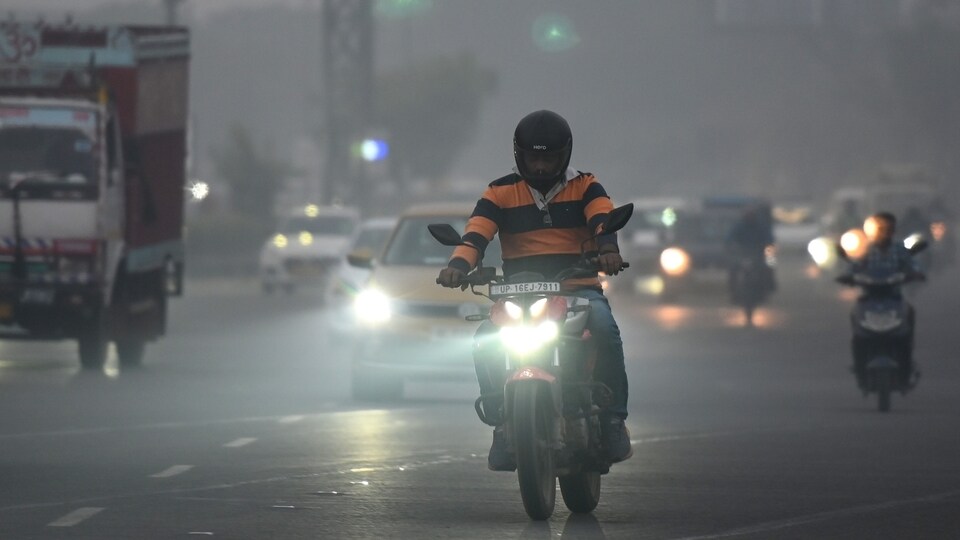
Delhi's air quality deteriorated sharply on Monday morning, with AQI readings exceeding 1,500 in several areas, as the city remained engulfed in toxic smog.
The AQI at all monitoring stations stood between 1300 and 1600 - ‘hazardous’ category - at the time of last update in this report, as per Swiss air technology company IQAir.
Mundka, Dwarka-Sector 8 and and Rohini were the stations with the worst AQI - 1591, 1497 and 1427, respectively, as per readings of IQAir , which calculates the Air Quality Index using measurements from a global network of government monitoring stations and its own sensors.


