This year will see a continued conversation and argument on the interplay of caste, religion and reservation that the 2024 Lok Sabha campaign and results placed on the national political stage. This argument will take place during the Delhi and Bihar elections, in Parliament, on the streets, in the media and on social media, and among politically affiliated diaspora groups.
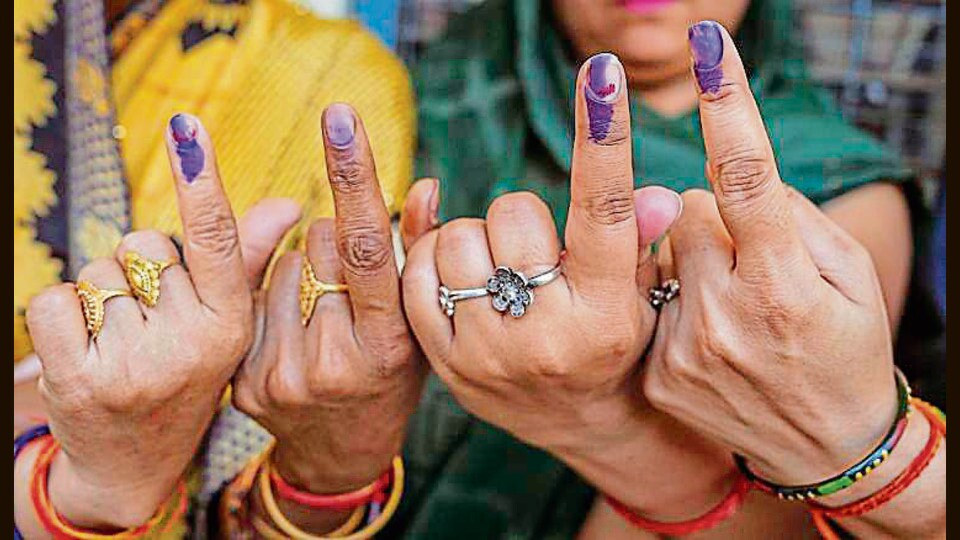
Voters show their fingers marked with indelible ink after casting votes for the third phase of Lok Sabha elections, in Hathras, Uttar Pradesh, in May 7, 2024. (PTI)
The relative success of the Indian National Developmental Inclusive Alliance (INDIA) bloc of parties in the general elections stemmed from fracturing the broader and more inclusive Hindutva tent that the National Democratic Alliance (NDA) had created over the past decade.
Just as in the 2015 Bihar elections, the non-Bharatiya Janata Party (BJP) forces relied on statements emanating from the saffron camp to suggest that a Narendra Modi-led government, in its third term, wanted 400 seats to change the Constitution and scrap reservations. The Opposition supplemented this narrative with the promise of a caste census, indicating it was in favour of a proportionate distribution of resources on caste lines.
The aim was to wean the other backward classes (OBCs) and Dalits off the BJP, and frame “upper castes” as the other. The BJP first denied that it had any intent to revoke reservations. It then went on the offensive and claimed that the Congress, if elected, would take reservations away from OBCs and Dalits and give them to Muslims. The aim here was to consolidate the Hindu vote, keep the broader multi-caste coalition intact, and frame Muslims as the other.
Which side won? The election results offered mixed answers. Which is why this conversation, which has been ongoing in different forms since the implementation of the Mandal Commission recommendations and has seen different sides prevail at different junctures in the past three decades, will extend through the new year.
The Opposition’s relative success, especially in Uttar Pradesh, stemmed partly from a shift in Dalits. And so the Congress and others in the INDIA bloc now believe this is a winning formula: Sow doubts about the BJP’s commitment to the Constitution, BR Ambedkar and reservations, and double down on the caste census demand. If the BJP accepts the demand, the Opposition can claim it won, and the BJP will be under pressure to increase reservations for OBCs further, since their share in the population is certainly much higher than their current share in the reservation pie. This in turn will alienate upper castes.
If the BJP doesn’t accept the caste census demand, project the party as anti-OBC and anti-Dalit. Shattering the project of inclusive Hindutva and projecting the BJP as an upper caste outfit is now seen as essential for the Opposition to return to power.
The BJP believes the narrative that it was anti-reservations hurt it electorally. But the party leadership attributes it to misinformation and historical baggage rather than reality; it also remains uncomfortable with making caste the basis of the political distribution of power. And so it has neither embraced the caste census demand nor changed course from its decade-long effort to incrementally expand the Hindutva tent.
The BJP has responded, though, in three broad ways.
One, it has reaffirmed its commitment to the Constitution in innumerable symbolic ways and made an effort to overtly embrace Ambedkar.
Two, the BJP has gone micro. It is examining and playing on caste contradictions at a granular level, distilled to polling booths and constituencies and states (think, the Jat versus non-Jat equation in Haryana). And it is maintaining its focus on welfare.
Three, it is continuing to push its communal narrative that the Congress is actually anti-reservations and is seeking to institute policies only to help Muslims. The results in Haryana and Maharashtra have given the BJP hope that this threefold strategy can succeed.
But the final word has neither been written on this, nor can it be. This debate will continue as long as Indian society is marked by deep inequities and inequality, with caste often serving as a relatively reliable metric of deprivation. It will continue until the Indian economy finds a way to create jobs at a mass level.
It will continue as long as Indian politics is so structured that mobilising voters through group identities is the easiest way to aggregate grievances, and increasing quotas is the easiest way to superficially attempt to address those grievances.
Prashant Jha was formerly the US correspondent and editor of HT Premium at Hindustan Times, and has also served as the newspaper's editor-views and national political chief. He is the author of 'How the BJP Wins: Inside India's Greatest Election Machine' and 'Battles of the New Republic: A Contemporary History of Nepal'.Read More
Get the latest India News, breaking headlines and real-time updates from across the country. Stay informed about politics, government policies, crime, weather and major national developments.
Home/India News/How Caste, Religion And Opportunity Will Shape 2025

 E-Paper