A GAME OF I-spy involving only objects you can find in the middle of a road in London would be rather short. The little eye would spy motorised vehicles, cyclists and the occasional pedestrian (striding briskly to the other side). The same game in Mumbai, however, could take hours. Its carriageways are home not just to pedestrians and parked cars but to utility boxes, construction debris, abandoned roadworks, piles of garbage, makeshift shops, itinerant vendors, trees, cows, dogs and even places of worship. The Indian street is an egalitarian place. It is also filthy, cacophonous and gridlocked.
The Indian street is an egalitarian place. It is also filthy, cacophonous and gridlocked.
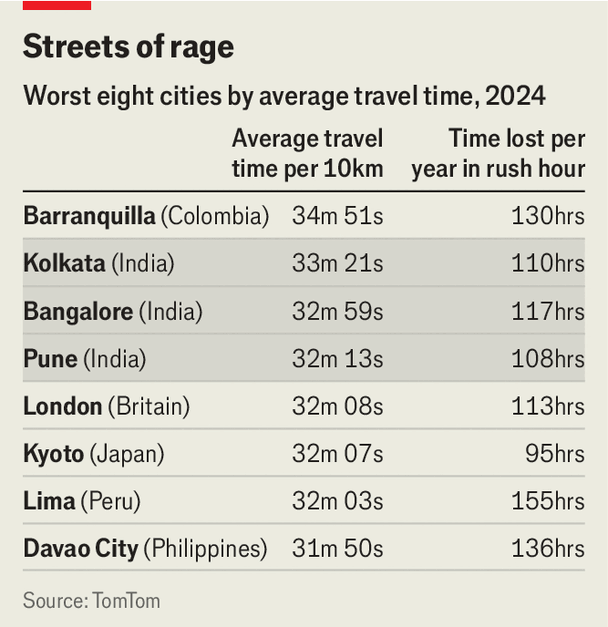
The cost of this is high. Last year, three Indian cities—Kolkata, Bangalore and Pune—made it to the top five in a global index of congestion compiled by TomTom, a maker of navigation software (see table). London ranked fifth, but it is deliberately making its streets less friendly to cars.
Average speeds that make glaciers look fast are only part of the problem. India’s roads are dangerous, especially to pedestrians. Lots of stopping and starting increases pollution: the contribution of vehicles to Mumbai’s emissions doubled in the three years to 2020, according to SAFAR, a government agency, in part because of congestion. Improving roads would speed up travel, reduce noise pollution, cut emissions and increase productivity.
Urban authorities know this. The problem is that they have tended to respond by building more roads or by widening existing ones—and these strategies have made things worse. New flyovers land at bottlenecks. Pavements get torn up to create more road space, but the trees and utility boxes that sit on them are often left in place, turning carriageways into obstacle courses. Despite extensive road widening, speeds in Mumbai fell by half between 2006 and 2016, according to one study. “In any Indian city, what is marked as a three-lane road is two lanes at best,” says Pritika Hingorani of Artha Global, a policy shop.
Officials in a few places are finally forging a new path. Andhra Pradesh, a southern state, is running a pilot programme in a pair of its cities that involves setting up “clean-air zones” along the most clogged and polluted arteries. It is building bypasses, but it is also targeting congestion by rationalising parking and by prohibiting heavy vehicles from using the roads at the busiest times of day. Increasing speeds on just a few very busy roads can have a big effect on how long it takes to get around a city, as well as on pollution, says Ms Hingorani, whose outfit is working with the state on the project.
Authorities in Bangalore have gone bigger. A decade ago India’s tech capital had few pavements, little signage and no lane markings. Since then, the city has overhauled many kilometres of inner-city roads. It has buried pipes and wires in neat conduits; installed wide, smooth pavements; and clearly marked out parking spots and lanes. The number of people choosing to travel on foot in these areas has soared. So has satisfaction among drivers, surveys suggest. Several other cities are planning to replicate the model, says Srikanth Viswanathan of Janaagraha, a non-profit that designed Bangalore’s standards.
Why is this not yet widespread? Money is part of the problem: for the next phase of its overhaul, Bangalore is considering a cheaper programme more focused on improving pavements. But politics is key. India’s cities are run by unelected bureaucrats who serve for just a few years. The real power resides at the state level. And those politicians tend to be more focused on pleasing rural voters than urban ones.
In addition, a small number of ornery road users wield outsize power. India has only 34 cars for every 1,000 people; their owners are unusually rich and privileged. These drivers tend not to favour stricter rules or more parking fines. They reflexively oppose schemes, such as bus lanes and cycle paths, that look like they might cause inconvenience—even though these will eventually speed things up. Authorities have to get motoring, regardless. If India wants to get rich, it must fix the engines of its economic growth.

 E-Paper