E-Paper



Haryana sex ratio at birth in 2024 slips to 910 girls/1k boys — worst in 8 years
Haryana has consistently recorded the lowest sex ratio, the consequence of a mix of social hostility towards girl children and lax implementation of laws

 Prefer HTon Google


Haryana recorded its lowest sex ratio at birth in eight years in 2024 and registered a six-point drop from figures a year ago, data showed on Friday — a troubling statistic that highlighted dogged social biases may be hurting the government’s mission to stop female foeticide.

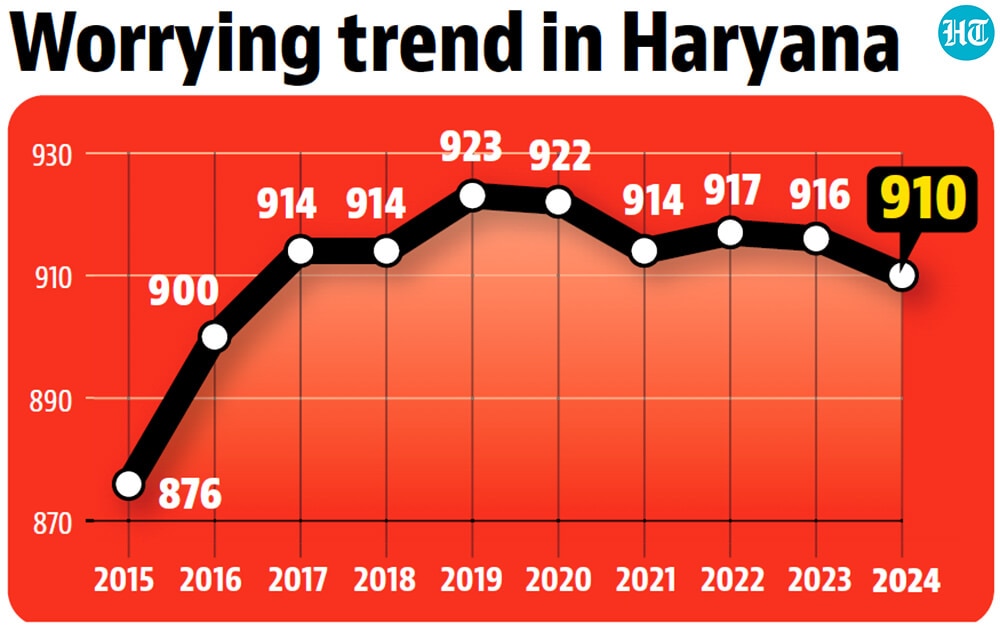
Data from the Civil Registration System (CRS) up to December 2024 showed that the sex ratio at birth, a critical indicator of gender equality, had dipped to 910 female births per 1,000 male births in 2024, a six-points drop from 916 in 2023 and the lowest after 2016, when it stood at 900.
According to a Union government reply in Parliament, India’s average sex ratio at birth was 933 in 2022-23. According to the 2011 census, the figure at birth stood at 943. According to the fifth round of the National Family Health Survey between 2019 and 2021, the number stood at 929.
Haryana has consistently recorded the lowest sex ratio in India, the unfortunate consequence of a mix of social hostility towards girl children and lax implementation of laws banning female infanticide.
Also Read | Haryana assembly: State elected only 87 women MLAs since 1966
HT reached out to Haryana director general of health services, Dr Manish Bansal, who did not immediately respond to queries seeking comments.
Experts associated with the government’s “Beti Bachao Beti Padhao” programme said that the latest dip in 2024 was alarming as Haryana showed notable improvements after the launch of the campaign in 2015.
For instance, sex ratio at birth was 832 in 2012, 868 in 2013 and 871 in 2014. It rose to 876 in 2015, 900 in 2016 and was stagnant at 914 in 2017, 2018 and 2021. The highest sex ratio at birth, 923, was recorded in 2019, followed by 922 in 2020. It dropped to 917 in 2022 and 916 in 2023.
CRS data from 2024 showed that the sex ratio at birth in five Haryana districts – Charkhi Dadri (869), Faridabad (899), Gurugram (899), Rewari (873) and Rohtak (888) – dipped below 900.
Also Read | Five Haryana districts have less than 900 females per 1,000 males
“The SRB (sex ratio at birth) of Gurugram coming down to 899 from 928 in 2023 and Faridabad recording seven points dip — to 899 from 906 in 2023 — is a matter of concern. Similarly, worrisome is Panchkula district where SRB dropped to 915 from 942 in 2023. Nuh district was always a bright spot. But there too SRB has dipped for the first time by four points. This is a wake up call. These trends are not good for Haryana,” said one of the experts associated with the programme, on condition of anonymity.
Amneet P Kumar, commissioner and secretary (women and child development), defended the government programmes, saying Haryana achieved its targets of improving the sex ratio at birth. “The sex ratio at birth has improved by 39 points after Beti Bachao Beti Padhao was launched,” said Kumar, claiming that Haryana was leading neighbouring states such as Himachal Pradesh, Punjab, and Rajasthan in registering cases against violators.
“A total of 1,208 FIRs have been registered under the Pre-Conception and Pre-Natal Diagnostic Techniques (PCPNDT) Act, 1994, while 386 FIRs have been filed through inter-state raids, leading to over 4,000 arrests targeting illegal practices by doctors, quacks, and touts. Haryana has made significant progress in improving its sex ratio at birth,” Kumar added.
But activists painted a gloomier picture.
“Rich people are largely flouting the law because it is very tough to do a gender determination test. Resourceful people are primarily responsible for female foeticide as they go out of the state where facilities are illegally available and huge money is charged. Poor people cannot afford the test and take risks involved in female foeticide,” said Sunil Jaglan, activist and the founder of Selfie with Daughter.
Officials associated with the programme said that the number of FIRs under PCPNDT and Medical Termination of Pregnancy Acts dipped in 2024 to 47, from 85 the previous year. “In sharp contrast, 100 cases were registered in 2020 and 142 in 2021 despite the Covid-19 pandemic,” said an official, asking not to be named.
Jaglan said strict monitoring and raising awareness was required. “We need to make people accept and change their mindset not to discriminate. There should be an independent cell of the government to monitor this programme,” he added.
The data showed that the most FIRs, 10, were lodged in Sonepat in 2024, followed by nine in Gurugram, and five in Jhajjar. No FIRs were registered in 10 districts – Bhiwani, Charkhi Dadri, Faridabad, Hisar, Karnal, Mewat, Palwal, Panipat , Rewari and Jind.
According to official data, 127 cases were registered in 2015 under the PNDT and MTP Acts, 271 cases in 2016, 144 cases in 2017, 121 in 2018, 78 cases in 2019, 100 cases in 2020, 142 in 2021, and 105 in 2022 and 85 in 2023.
Yamunanagar led the state with a sex ratio at birth of 939, followed by Sirsa (936) and Fatehabad (925). The highest drop in SRB between 2023 and 2024 came from Charkhi Dadri (28), Palwal (37) and Gurugram (29).
Yamunanagar and Karnal improved by 18 points, Sirsa by 11 points, and Bhiwani by 12 points.