
 E-Paper



HT This Day: August 17, 1953 -- Mohammed Ali receives tumultuous welcome
Tumultuous welcome was given to Mr Mohammed Ali, Pakistan Prime Minister, when, accompanied by Begum Mohammed Ali and his Foreign Minister, he arrived at Palam from Karachi tonight.


Tumultuous welcome was given to Mr Mohammed Ali, Pakistan Prime Minister, when, accompanied by Begum Mohammed Ali and his Foreign Minister, he arrived at Palam from Karachi tonight.
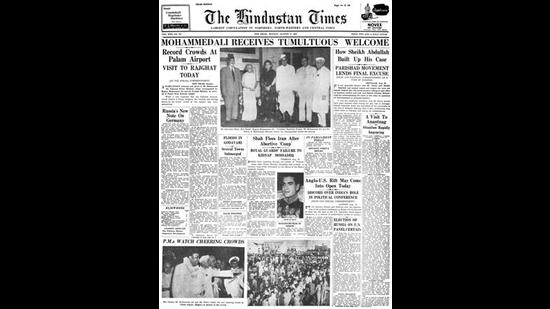
While it was expected that the Pakistan Premier would receive a fitting reception the warmth and feeling shown by the record crowd at the airport was truly astonishing.
As the plane taxied to a halt, the crowd thronged the vast tarmac breaking the police cordon and there were repeated shouts of “ Mohammed Ali Zindabad “ and “ Nehru Zindabad.”
A large number of M.P.s, Cabinet Ministers, members of the Diplomatic Corps, representatives and workers of several political parties, including Congress and the P.-S.P., were at the airport to welcome Mr Mohammed Ali.
As Mr Mohammed Ali, accompanied by Begum Ali, came down the gangway he was greeted by Mr Nehru who presented him a bouquet. Mrs Pandit gave a bouquet to Begum Ali. Maj.-Gen. Chatterjee offered a bouquet of roses on behalf of the President. Mr Brahm Perkash, Chief Minister of Delhi, garlanded Mr and Begum Mohammed All. The Doyen of the Diplomatic Corps also gave a bouquet to Mr Ali.
Then Mr Nehru took Mr Mohammed All by the arms, and making his-way through the pressing crowd took him to the carpeted stand where the Pakistan Prime 1Winister stood to take the salute as units of the Indian Army, Air Force and the Navy presented a guard of honour. The Air Force band played the National Anthem of Pakistan.
After Mr Mohammed Ali had inspected the guard, he was besieged by the crowds which kept milling around him and Mr Nehru. There were repeated shouts of Pakistan Zindabad and Bharat Mata Ki Jai.
The crowds continued pressing forward until they were all over the airport apron. Mr Nehru, Mr Mohammed Ali and Begum Ah then mounted a jeep which went round and round, Mr Ali standing and waving to the cheering throng. Many showered rose petals on him and many who could not approach him threw garlands at him from a distance. One garland hit Mr Mohammed Ali in the head and swept off his fur cap which, however, was restored to him.
Mr Mohammed Ali, who seemed to enjoy the tumultuous scene, kept on smiling throughout. With difficulty he boarded a car with Mr Nehru and drove to Rashtrapati Bhavan where he and party are staying as the President’s guests.
Press correspondents who had been waiting patiently for Mr Mohammed Ali in a corner were rather disappointed. According to arrangements, the Pakistan Prime Minister was to have met them but in the great rush no contact was possible.
Bouquets and garlands were presented to Mr Mohammed Ali on behalf of several organizations, including the Delhi Provincial and District Congress Committees and several Ward Congress Committees.
At Rashtrapati Bhavan Mr Mohammed Ali was received by Dr Rajendra Prasad. Mr Mohammed Ali and Begum Ali had dinner-with Mr Nehru at the Prime Minister’s house.
VISIT TO RAJGHAT
Tomorrow at 8-30 a.m. Mr Mohammed Ali is visiting Rajghat to place a wreath at Mahatma Gandhi’s samadhi. At 10-30 p.m. he is having a meeting with the President. He and Began Ali will lunch . with Maulana Azad tomorrow.
The warmth and heartiness of ‘ today’s reception to the Pakistan Prime Minister was an index of his great personal popularity. The people responded magnificently to Mr Nehru’s appeal yesterday to give a big welcome to the Pakistan leader and show that they were friends with Pakistan.
The 44-year-old Prime Minister of Pakistan belongs to a well-known Bogra family of Bengal. He graduated from Calcutta University and entered public life. He became Mayor of Bogra and Chairman of the District Board. He was keenly interested in education and founded some schools. He was elected to the Bengal Assembly in 1937 and in 1943 he became Parliamentary Secretary to the Premier of undivided Bengal. Later he became Finance and Health Minister and often deputized for the Premier.
After the partition of India, Mr Mohammed Ali was elected to the Constituent Assembly of Pakistan. In 1948, he was sent to Burma as Pakistan’s Ambassador. In 1949, he became Pakistan’s High Commissioner in Canada and in February, 1952, moved to Washington as Pakistan’s Ambassador.
In whatever sphere he worked, Mr Mohammed Ali left the impress of his charm and personality. With cherubic face and gentle smile, he looks younger for his years.
Mr Nehru has known Mr Mohammed Ali only since they met in London this summer. And this first acquaintance developed into friendship at Karachi last month.
Mr Mohammed Ali takes serious interest in social and economic betterment of the masses. He said on one occasion recently in Karachi that in Pakistan they had to evolve a new order. He was the first to declare within six years of Pakistan’s creation that Pakistan’s interests lay in friendship with India.
So today’s reception in a great a measure mirrored the Indian people’s sincere admiration for Mr Mohammed Ali and their desire for friendship with Pakistan, in consonance with their declared national policy to live in peace and friendship with all nations. “
ALI HOPEFUL
“ Mr Ali, before boarding the plane for Delhi at Karachi airport, said he was “ full of hope “ that the Kashmir dispute would be solved, says a P.T.I. message.
He said that the recent events in Srinagar had “ not clouded my mind.”
When asked what was the brief to him from his Government, he said he was going to Delhi with the “earnest desire “ for a speedy, honourable, just and peaceful solution “ of the Kashmir dispute. He added: “ I have the same determination, same earnestness and same sincerity as I had when I assumed office.”
When asked if he would specifically discuss with Mr Nehru the recent events in Kashmir, Mr Ali parried the question by saying “my determination is to remove , all difficulties in the way of settlement of the Kashmir dispute.’
When asked if he would discuss any other question with Mr Nehru, he said: “ No. not unless Mr Nehru wishes it.”
He said he would stay for four days in Delhi “ but I shall extend my stay if any fruitful purpose would be served thereby.”


