
 E-Paper



HT This Day: September 2, 1972 — Bobby Fischer wins world chess title
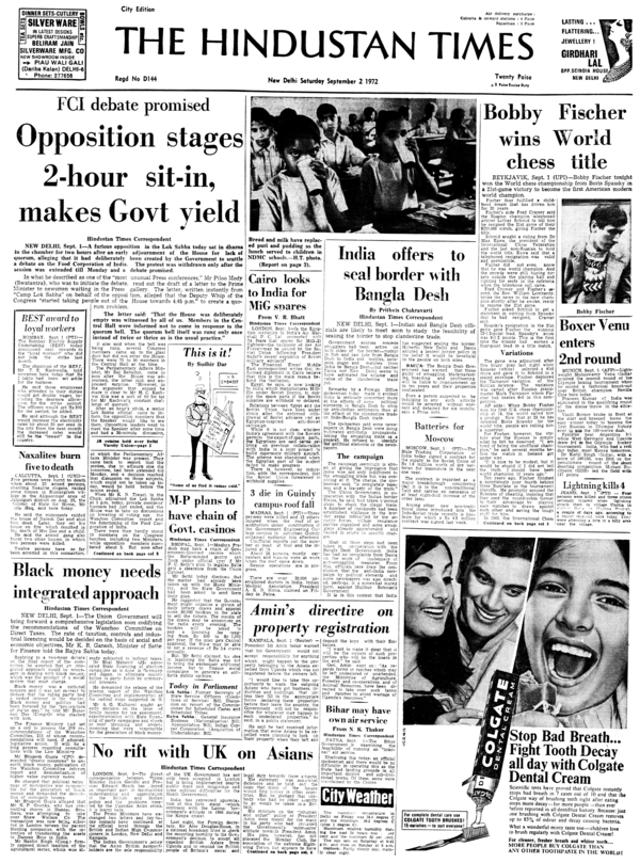
Reykjavik Bobby Fischer tonight won the World chess championship from Boris Spassky in a 21st-game victory to become the first American modern world champion


Reykjavik
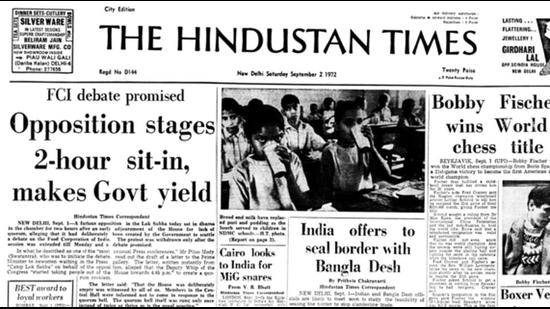
Bobby Fischer tonight won the World chess championship from Boris Spassky in a 21st-game victory to become the first American modern world champion.
Fischer thus fulfilled a childhood dream that has driven him for 20 years.
Fischer’s aide Fred Cramer said the Russian champion telephoned arbiter Lothar Schmid to tell him he resigned the 21st game of their $250,000 match, giving Fischer the title.
Schmid sought a ruling from Dr Max Euwe, the president of the International Chess Federation and the last non-Russian to hold the world title. Euwe said that a telephoned resignation was valid and permissible.
Fischer did not even know that he was world champion. And the crowds were still buying tickets outside the playing hall and fighting for seats in the cafeteria when the telephone call came.
Fred Cramer and Fischer’s second, the Rev. William Lombardy, broke the news to the new champion shortly after he awoke, ready to resume the 21st game.
Fischer asked Schmid to get a statement in writing from Spassky that he had resigned, Cramer said.
Spassky’s resignation in the 21st game gave Fischer the winning 12-1l2-point lead. Spassky’s score was 8-1/2 points. This is the first time the winner had earned a four-point lead in a title match.
Variations
The game was adjourned after five hours’ play last night when Spassky (white) selected a 41st move and gave it to Schmid in a sealed envelope. Fischer deployed the Taimanov variation of the Sicilian defence. The variation was named after Russian grandmaster Mark Taimanov whom Fischer had beaten 6-0 in this competition.
AP adds: When Bobby Fischer won his first U.S. chess championship at 14, the world called him a prodigy. Now that at 29 he has defeated Boris Spassky for the world title, people are calling him a superstar.
For Fischer, however, the victory over the Russian is simply what he felt he deserved. “I am tired of being the unofficial champion,” he said several months before the match in Iceland got under way.
“It is nice to be modest, but it would be stupid if I did not tell the truth. I should have been world champion 10 years ago.”
Ten years ago, Fischer finished a surprisingly poor fourth behind three Russians in the tournament playoffs. He promptly accused the Russians of cheating, insisting that the used the round-robin format to their advantage by playing easy matches to draws against each other and saving the tough stuff for him.
In 1965, the International Chess Federation scrapped the round-robin in favour of the player to player eliminations of the kind that led Fisher to the Reykjavik match.
The American challenger began with a victory at the inter-zonal finals in Palma de Mallorca and went on to amass an unprecedented 20 straight wins. The Soviet Union’s Tigran Petrosyan had checked Fischer’s winning streak in the second game of their semifinal match in Argentina last November, but the U.S. grandmaster ultimately defeated the Russian 6-1l2 to 2-1l2, to earn the right to meet Spassky.
The boy, who in 1958 became the youngest U.S. chess champion, was crew-cut and skinny, clad in T-shirt, dungarees and sneakers. The man who just brought the United States its first world chess title is tall, broad-shouldered and handsome, clad in a knight-patterned sweater and suede jacket.
Between the boy and the man have been a series of spectacular victories and equally spectacular losses-usually when Fischer stalked off, complaining about the rules or the judges or the playing conditions. That was what he did in Iceland, forfeiting the second game by refusing to show up in an argument over playing conditions.
No one ever disputed Fischer’s chess prowess. Grandmaster Robert Byrne, defeated twice by Fischer, said: “Bobby pursues the idea of the game in the platonic sense. All of us players have that ideal. But Bobby knows how to embody it.”
Fischer, true to his capricious form arrived in the hall 16 minutes late. The crowd went wild with for and shouted “Bobby Bobby” when the announcement was made. Fischer looked at the crowd ‘hen down at his feet, walked over to sign his score sheet and almost ran out.


