
 E-Paper



HT Archives: Mujibur declares autonomy, birth of ‘Bangla Desh’
President Yahya Khan arrived in Dacca amid tensions as Sheikh Mujibur Rahman declared autonomy for East Pakistan, prompting strikes and civil disobedience.

 Prefer HTon Google


President Yahya Khan flew into Dacca, capital of East Pakistan, on March 15, 1971, shortly after Awami League leader Sheikh Mujibur Rahman issued a set of 35 directives that amounted to a unilateral declaration of the autonomy his party had been seeking for the province.
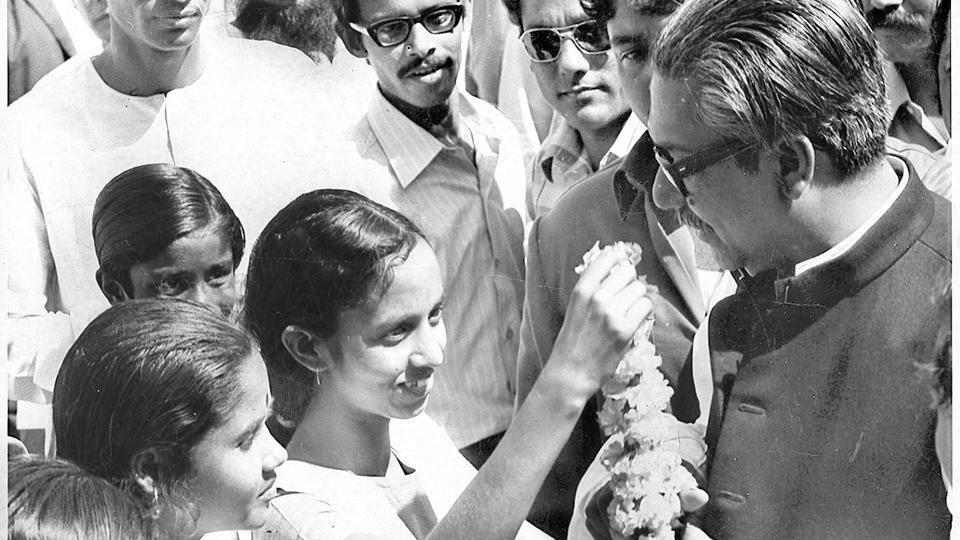
The directives came at the hour the Martial Law authorities fixed for civilian employees of the defence services to return to work or face dismissal and court martial. On Rahman’s advice, the employees ignored the ultimatum.
Rahman, in issuing the directives, said he was assuming control of Bangla Desh (as the East Pakistanis have been calling their homeland) and declared it would be “in consonance with the declared wishes of the people of Bangla Desh that no one should interfere with the exercise of authority by the elected representatives of the people”.
Non-Bengali refugees fired on a crowd of Bengalis, including Awami League peacekeeping volunteers, about half-a-kilometre from Dacca airport shortly before Gen. Yahya Khan arrived, an AP report from Dacca said.
The refugees, who were trying to get to the airport, shot a rickshaw-runner and the crowd badly beat up one of the refugees.
Thousands of East Pakistanis stood silently and unmoved behind a cordon of troops on the route from the airport to the city as Gen Yahya Khan drove past, on his way to an expected meeting with Sheikh Mujibur Rahman.
Thousands of civilian defence workers defied the order to go back to work. The Pakistanis were even supported by Chinese technicians at an ordnance factory in their determination to stay off the job.
For the first time in a week, troops and East Pakistan Militia, in battle dress and armed with automatic weapons, appeared on the route from the airport.
Machine gun emplacements were mounted on the gate of the President’s House in mid-town Dacca in anticipation of Gen Yahya Khan’s arrival.
The Awami Leader’s directives included orders to East Pakistanis to continue their strike of the Federal Government’s Secretariat, provincial and semi-government offices and the courts.
Deputy district commissioner and subdivisional officers were told to handle what work they could without reopening their offices.
Port authorities were directed to function in all respects relating to incoming and outgoing ships except that “no co-operation shall be extended for mobilisation of forces or materials which may be utilised for repression against the people”, the directives said.
Post and telegraph offices were directed to function only for the purpose of letters, telegrams and money orders within “Bangla Desh”. Mail and cables could be sent direct to foreign countries.
The teleprinter channels with West Pakistan were ordered to be opened for one hour between 2.30pm and 3.30pm on Monday, Tuesday, Wednesday and Thursday for the purpose of exchanging messages between the banks.
Radio and television stations and newspapers were told to operate and “to give a complete version of all statements and news about the people’s movement”. The directives said “otherwise those working in these establishments shall not co-operate” — a threat to proprietors who opposed autonomy for East Pakistan.
The importation, distribution, storage and movement of food grains were ordered to be continued on “top priority”.
All provincial and local taxes were to be collected and credited to the account of the “Government of Bangla Desh”. Indirect taxes collected for the central government were to be deposited in two Bengali banks, the Eastern Mercantile and the Eastern Banking corporation.
Income tax was not to be collected until further directives were issued. Banks were ordered to be open for three hours daily.
All private commercial and industrial organisations were told to function as usual but schools were ordered to remain closed. The directives also ordered the flying of black flags atop buildings would continue.
Rahman’s announcement excluded three cantonments (military stations) where armed forces are deployed. These cantonments include those in Dacca, Comilla, eight miles north of this city, and Jessore, 270 miles southwest of Dacca.
Rahman urged all East Pakistanis to remain prepared for sacrifice and to resist “by all means possible” any force unleashed against them.
His announcement followed a martial law directive on Sunday ordering all civilian workers in Pakistan to return to work in defence installations or face possible 10 years’ imprisonment for desertion.
Rahman based his takeover of the administration on the basis of the Awami League’s dominant political position in East Pakistan where it won 288 seats in the 310-member Provincial Assembly and 167 seats in the 313-member National Assembly during last December’s elections.
Rahman appealed for support from “all those who cherish freedom and are struggling for it the world over”.
“Our people have proved how a determined and united people can be a bulwark of freedom against those who conspire to rule by force. The spirit of freedom a Bangla Desh cannot be extinguished,” he said.
“We cannot be conquered because each of us is determined to die if need be to ensure that our further generations can live in freedom and with dignity as free citizens of a free country... Every man, woman and child in Bangla Desh can hold their heads high today. They have decisively overcome those who thought they could intimidate them by the naked use of force. The people of Bangla Desh in all walks of life - Government servants, office and factory workers, peasants and student have demonstrated in no uncertain terms that they are determined to die rather than surrender. Today, the entire people are united in their determination not to submit to martial law, I therefore urge those to whom the latest order has been directed not to yield to the threat that has been levelled against them. The 75 million people of Bangla Desh are behind them and their families,” he said.
At the moment, all civil servants, including judges, are on strike. Under the Sheikh’s directives, no taxes are being paid. All external bank transactions are forbidden by what some observers call “Mujibur’s de facto Government,” and no money is flowing between East and West Pakistan.
In Karachi, Zulfikar All Bhutto, chairman of the Left-wing People’s Party, said that if power was to be transferred to the representatives of the people before any constitutional settlement, as demanded by Sheikh Mujib, it should be given to the Awami League in East Pakistan and his own People’s Party in the western wing.


