
 E-Paper



HT Interview: India, Aus ties have moved to a higher level, says Marles
In a conversation with HT, Marles, who is also defence minister, spoke about China’s backing of Pakistan during recent clashes with India


Australia backs India’s efforts to combat terrorism and the halting of military actions with Pakistan last month was “an act of Indian leadership”, Australian deputy prime minister Richard Marles said on Wednesday, while outlining Canberra’s plans to foster closer defence and security ties with New Delhi.
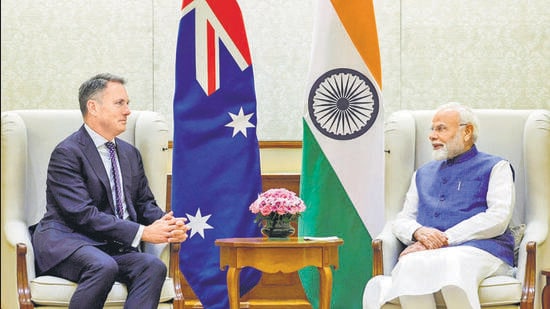
In a conversation with HT, Marles, who is also defence minister, spoke about China’s backing of Pakistan during recent clashes with India, saying both Delhi and Canberra feel China’s massive military build-up has had “an impact on the strategic landscape of the Indo-Pacific”, and expressed hope that am India-Australia comprehensive economic cooperation agreement (CECA) will be concluded soon. Edited excepts:
Q: As India and Australia mark five years of their comprehensive strategic partnership, you’ve said the re-elected Albanese government is going to be more ambitious. How do you look back at these five years and what’s next?
Marles: India’s place in Australia’s worldview has grown dramatically under Prime Minister [Narendra] Modi’s leadership. The bilateral relationship has gone to a greater level - we’re doing more economically together and have never been more strategically aligned. This is reflected in our much greater security and defence relationship, which is not just in terms of how we engage in forums that we meet in, the way in which we speak, but actually at a practical level, we’re doing more. [Something] as specific as maritime domain awareness, what we’re doing with our Boeing P-8 surveillance aircraft that both countries use.
When you’re sharing that kind of information, you’re only doing that with the closest of friends. This collaboration enormously enhances our ability to see the ocean for both India and Australia.
Q: One focus area for Australia is ensuring the Indo-Pacific remains free, open and secure, and you are looking very closely at the Indian Ocean. Australia gifted a patrol boat to the Maldives during your visit. What more would you like do with India in the Indian Ocean?
Marles: We want to see a free and open Indian Ocean and work with India as the major player here. From Australia’s perspective, 50% of our trade goes past the front door here. We’ve got a deep national interest in the rules of the road applying in the Indian Ocean, freedom of navigation, the UN Convention on the Law of the Sea, freedom of trade.
The Maldives patrol boat gift builds on our Pacific Island programme experience. It presents an opportunity for us to cooperate with India in supporting smaller nations’ maritime capabilities.
Q: There’s been a fundamental shift in India-Australia defence ties, including the signing of a logistics support agreement and an air-to-air refuelling agreement. How do you plan to expand interoperability and exercises?
Marles: There is a whole lot of ambition that we have. The world’s complexity and our strategic alignment make closer cooperation increasingly attractive.
There’s more we can do in maritime domain awareness and expanding exercises - bilaterally and potentially with other countries. We see opportunities in intelligence-sharing. But the biggest area is maritime domain awareness and activity.
We want progress on key agreements and roadmaps leading to this year’s 2+2 meeting [of defence and foreign ministers] and leaders’ summit. This is a crucial year for advancement.
Q: China’s military activities across the region are a concern for many countries and there are clear signs China backed Pakistan, in terms of equipment and surveillance, during the recent clashes with India. In that context, how does Australia view the hostilities between India and Pakistan?
Marles: Though there’s two points [here]. We condemn the Pahalgam terrorist attack. Our sympathies are with the families who lost loved ones. We stand with India and all countries combating terrorism. We acknowledge and welcome the stoppage of military activity - we see that as an act of Indian leadership. We’ll continue working with India to combat terrorism in all forms.
Regarding China - our relationship is complex. It’s our largest trading partner, but we have security concerns we’ve expressed to China directly. We’re watching the world’s biggest conventional military buildup since WWII, done without strategic reassurance. China’s intent remains unclear, and this impacts the Indo-Pacific’s strategic landscape. We feel that, India feels that.
Since our last 2+2 meeting in November 2023, these issues have become more complex. The reasons for India-Australia cooperation have only grown.
Q: The Economic Cooperation and Trade Agreement (ECTA) changed the economic landscape between India and Australia. How far are we on the path towards the comprehensive economic cooperation agreement (CECA)?
Marles: We’ve seen real progress across the four economic roadmap areas PM Albanese outlined - education, green energy, agriculture and tourism.
CECA negotiations continue. We’re hopeful for a conclusion in the not-too-distant future, which would elevate our trading arrangements.
Over the last five years, India’s trade with Australia has grown at double the rate of its trade with the rest of the world. The India-Australia trading relationship, measured against all of India’s trading relationships, is a standout.
What we’ve achieved has made a huge difference, and we’re excited about the next level. It’s a huge opportunity - our economies are complementary.
Q: Is there anything in particular holding up negotiations on CECA?
Marles: No, negotiations are going well. It’s natural that people bring different positions that need working through. We’re pleased with progress and hopeful for a near-future conclusion.
Q: India is set to host the Quad Summit at a time when the US administration appears to be more inward-looking. What would Australia like to see on the agenda of the Quad Summit?
Marles: I don’t necessarily accept that assertion. We all want American leadership, but the Quad has always been an opportunity for four like-minded democracies with shared values to cooperate for the Indo-Pacific’s benefit.
This meeting is important for continuing Quad momentum across current engagement areas. We want to see that expanded.
As the first Quad Summit of the Trump administration, it has significance. The Quad is important for our countries’ Indo-Pacific leadership, making this meeting crucial.
Q: Do you think the Indian government’s concerns about activities of Khalistani separatists in Australia have been addressed? Are there still concerns about their activities?
Marles: I hope not. People in Australia have the right to their views, but there’s no sympathy for the Khalistani movement from the Australian government - none at all. We take our obligations to provide security for India’s missions very seriously.
Q: How do you plan on building on the role of the Indian diaspora in Australia to further strengthen bilateral relations?
Marles: The Indian diaspora is a wonderful asset for Australia. It’s our fastest growing community, bringing energy and industry to the Australian economy. We are huge recipients of their contributions.
 ABOUT THE AUTHORRezaul H Laskar
Rezaul H Laskar is the Foreign Affairs Editor at Hindustan Times. His interests include movies and music.


