
 E-Paper



HT THIS DAY: Sept 13, 1965 — Jawans advance in Lahore sector, Pak loses 55 tanks in fierce battle
With the latest toll, the number of the Pakistani tanks accounted for so far has risen to 246-212 destroyed or damaged and 34 captured


New Delhi – In their onward march in the Lahore and Sialkot sectors in the last 24 hours, Indian troops continued to batter Pakistan’s armour capturing 15 more tanks and destroying 40.
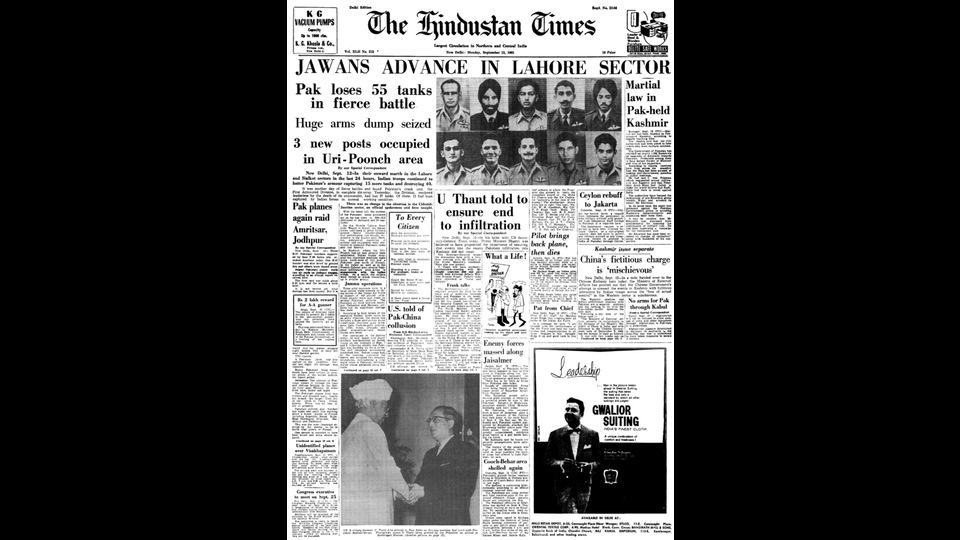
It was another day of fierce battles and found Pakistan’s crack unit, the First Armoured Division, in complete disarray. Yesterday, the Division, rendered leaderless by the death of its commander, had lost 27 tanks. Of these, 15 had been captured by Indian forces in normal working condition.
There was no change in the situation in the Chhamb-Jaurian sector, an official spokesman said here tonight.
With the latest toll, the number of the Pakistani tanks accounted for so far has risen to 246-212 destroyed or damaged and 34 captured.
On the 50-mile Lahore front from Wagah to Kasur, the Indian forces continued to press forward, despite heavy counter-attacks. Our performance was equally impressive in the Sialkot area. Here too, substantial quantities of armour and equipment were destroyed or captured. Pakistani ranks also lost heavily.
In Kashmir, where the Uri-Poonch link-up had already been established, Indian troops occupied two important positions, eight miles north-west of Uri, and a Pakistani post north of Poonch. In the valley as well as in the Poonch-Rajouri area, several Pakistani infiltrators were killed in engagements with the Indian troops. As a result, the raiders were forced to break themselves up in smaller groups.
Jammu operations
These solid successes were, to a large extent, made possible by flying sorties of the Indian Air Force in support of the ground units. Fresh attacks were also made on several Pakistani airfields. The Pakistani air force bombed Adampur, Pathankot and Halwara airports but no significant damage was done.
According to first details of the operation Sialkot, given today by an army observer, the Indian bag included a huge ammunition dump -anti-tank recoilless guns, Bren guns, light machine-guns, automatic rifles, mines, grenades and other ammunition-and heavy trucks and jeeps.
The operations in the Jammu sector, he said, began with heavy artillery bombardment by Indian troops on the midnight of Sept. 7 and 8, following reports that Pakistan was building up for a strike. The stiff resistance encountered confirmed this. Indian troops had, by the morning overcome the enemy and occupied two strategic strongholds, commanding a vital trunk route in Pakistani territory. Indian troops advanced along this route.
Indian Army engineers quickly built roads in the face of enemy fire so that our vehicles and guns could move. The signals played their part a laying communication lines, while the personnel of the Medical Corps rendered assistance to the wounded right under enemy fire. The ASC kept the wheels moving so that supplies were carried to the frontline.
Officers and jawans of the Indian Army, the observer said, were at their best and performed acts of gallantry in utter disregard of their personal safety.
Jawans approached the enemy machine-gun positions which were belching fire and silenced them. A jawan, who was severely wounded himself, refused to be evacuated b and killed four of the enemy at close quarters.
A junior commissioned officer, leading a platoon, found his advance blocked by machine-gun positions. The entire platoon crawled under the enemy’s wilting fire, hurled grenades at the machine-guns and in a final assault, took the position.
The troops combed the villages for weapons, arms and ammunition, while ensuring that the civilian population did not suffer.
Indian troops gave food to many Pakistani villagers who did not have anything to eat, An old lady told the observer: “We have no doubt that you are not to blame for what is happening to us. The trouble was started by our Government.”
The two-pronged drive from Uri and Poonch to straighten the loop on the ceasefire line was completed on Friday night with the capture of three more Pakistani posts in the area.
The loop covers an area of about 150 sq. miles with high mountain ranges rising from 8,000 ft. to 13,000 ft. The mountain heights in the area have been used by the Pakistanis for repeated attacks on both the Kashmir valley and the Poonch area of Jammu. They were also used as bases by Pakistani infiltrators.


