
 E-Paper



Coronavirus update: ICMR nod to 3 more private testing labs, total 29 now
On Wednesday, ICMR asked for bids for procurement of antibody (blood test) kits to scale up their testing of coronavirus. Through the day, sample collection and testing was slow because kits were in short supply and traffic movement was restricted due to a nationwide lockdown.


New Delhi The Indian Council of Medical Research (ICMR), the country’s apex biomedical research body, on Wednesday approved three more private laboratories to test for the coronavirus disease (Covid-19), taking to 29 the number of private facilities that can collect samples at 16,000 centres.
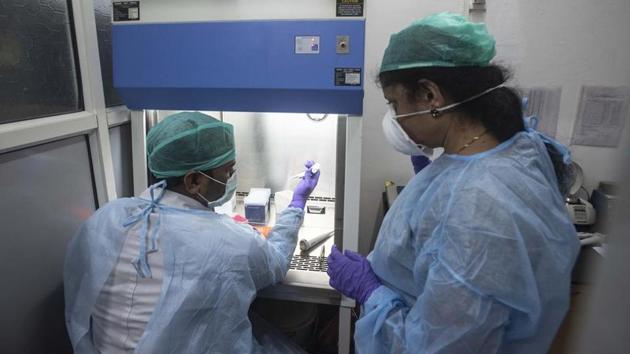
ICMR, however, has not expanded its criteria for people to be able to take the test. Experts have raised concerns over tests not being carried out aggressively or randomly enough, saying that a ramped up approach could stop a silent spread of the highly contagious pathogen SARS-CoV-2.
“These 29 lab chains will add to the testing capacity as they have 16,000 collection sites across India,” said Lav Aggarwal, joint secretary, Union health ministry.
On Wednesday, ICMR asked for bids for procurement of antibody (blood test) kits to scale up their testing. Through the day, sample collection and testing was slow because kits were in short supply and traffic movement was restricted due to a nationwide lockdown.
“We’ve got the government approval and have the infrastructure and trained manpower in place. All we need now is an uninterrupted supply of diagnostic kits for us to begin testing,” said Dr Navin Dang, founder Dr Dangs Lab.
Arindam Haldar, CEO, SRL Diagnostics, said: “…ICMR has chosen two SRL clinical reference labs, based at Mumbai and Gurgaon, to conduct these tests… We have initiated testing, but currently there is a shortage situation for approved commercial kits for testing and PPE for sample collection, and we are trying our level best to bring the supply situation to match possible demand... The commercial kits are in short supply...”
However, ICMR has so far approved of three commercial testing kits that should be available in market in a few days.
Neuberg Diagnostics Private Limited, a start-up in the segment, has also been approved for testing. “…Neuberg will be scaling up its capacity up to 2,000 to 2,500 tests per day as per ICMR guidelines by next week,” said GSK Velu, chairman and managing director.
ICMR is in the process of fast-tracking approvals for commercial testing kits. “Our nodal laboratory in National Institute of Virology (NIV) in Pune is looking at the quality of kits… Apart from FDA and European CE approved kits, ICMR-certified kits will also be eligible to be used for testing in labs across India,” Dr Balram Bhargava, director general, ICMR, said recently.
ICMR on Sunday had confirmed that close to 60 private laboratories had approached them for registration that is mandatory for being able to conduct Covid-19 tests.
The primary criteria for the labs that will be approved is for them to have National Accreditation Board for Testing and Calibration accreditation, at least biosafety level-2 laboratory, sharing real-time testing data with the government and testing done only after there is a prescription signed by a qualified physician who has followed testing criteria laid down by the ICMR.
There are about 116 government laboratories that ICMR has earmarked for Covid-19 testing, including 72 of ICMR’s own viral research and diagnostic laboratories (VRDLs). Thirty-one of the government laboratories have so far been approved for both preliminary and confirmatory testing across India.
The base price should not exceed Rs 4,500, including 1,500 for preliminary testing and 3,000 was confirmatory testing, even though the government has asked the labs to offer the test for free of cost.


