
 E-Paper



In Bengaluru, ghosts of Christmases past
Once again, the old Cantonment churches will draw legions of the faithful to midnight mass to celebrate the birth of the Christ Child.

 Prefer HTon Google


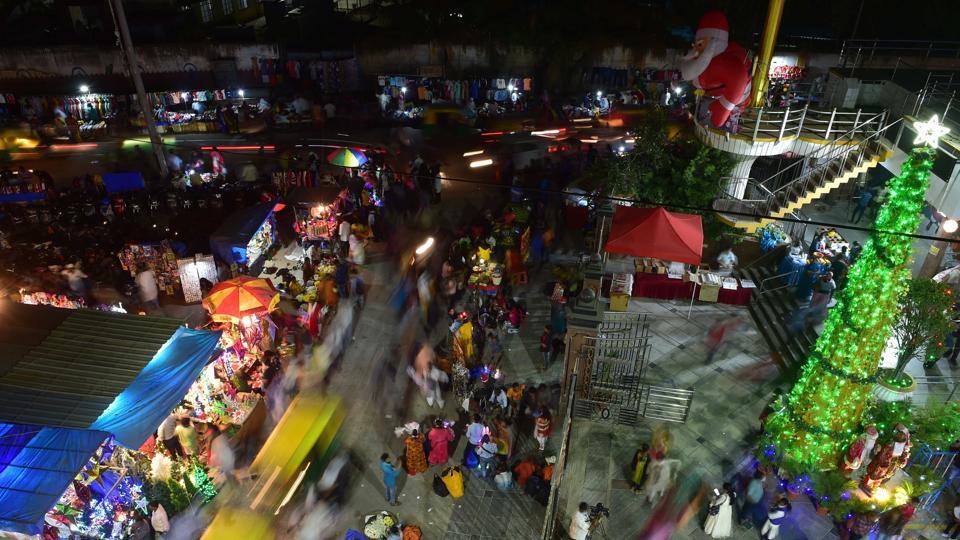
In less than a week, it will be Christmas, the season when the erstwhile Bangalore Cantonment comes into its own. Once again, the old Cantonment churches will draw legions of the faithful to midnight mass to celebrate the birth of the Christ Child, as they have done for well-nigh two hundred years. In missionary-run schools in the Cantonment and beyond, children of all religions will sing Christmas carols, partaking joyfully in an old, time-honoured Bengaluru tradition.
Which begs the question, how old? The records of the St Thomas Christians, or the Syrian Christians, attest that Christianity was introduced to the subcontinent, specifically Kerala, by ‘Doubting’ Thomas, one of the 12 handpicked apostles of Jesus himself, who sailed to the Malabar coast in 52 AD. Remarkably, Christianity would take another 1500 years to make landfall in neighbouring Karnataka. That happened when Goan Catholics migrated down the coast to Mangalore in Dakshina Kannada (South Canara) in three waves, from the 16th century onwards.
The first wave of refugees came in 1560, fleeing the Goan Inquisition imposed by the Portuguese, who persecuted ‘New Christians’ (mostly Hindus who had been forcibly converted) suspected to be secretly practising their old religions. The second came between 1570 and 1575, when a pan-Asian alliance comprising, among others, the Sultanate of Bijapur and the Sultanate of Aceh (in faraway Indonesia), launched a combined assault against the Portuguese in Goa. The third wave arrived in 1683, during the Maratha-Portuguese War, which broke out after the death of Shivaji.
Well before this, however, Christianity had ventured inland. In 1649, an Italian Jesuit called Leonardo Cinnami established the Mysore Mission in Srirangapatna, the then-capital of the Wadiyars of Mysore, setting the stage for a century-long relationship, mostly rocky, between the Wadiyar court and the Catholic church. In 1763, Hyder Ali, who had established himself de facto ruler of Mysore, captured Mangalore, which put him in the crosshairs of a formidable new enemy in the peninsula, the British. The British took Mangalore in 1767, and hung on to it until 1784, when Hyder’s son, Tipu Sultan, won it back. Furious with the Mangalorean Catholics, who he believed had aided the British during the war, Tipu marched 60,000 of them to Srirangapatna, converted them to Islam, and kept them in captivity for over 15 years, until his defeat and death in May 1799.
With a new Wadiyar king on the throne of Mysore, whose actions had to be approved by a British Resident, peace returned to the Christians. By 1803, Bengaluru had got its first thatched-roof chapel, in an area that the British called Blackpally (today’s Shivajinagar). Set up by the French Catholic missionary Jean-Antoine Dubois, whose adoption of local manners and customs earned him the affectionate moniker ‘Dodda Swami-avaru,’ it was a chapel to the Virgin Mary. In 1813, expanded with British help, it became the Church of the Purification of Our Lady. Today, further enhanced, it stands where it has always stood, rechristened the St Mary’s Basilica. Taking inspiration from Abbe Dubois, Mother Mary is always draped in a saree here.
By 1807, Bengaluru’s first Protestant church, the Drummers’ Chapel (later the Fort Church), came up next to Tipu’s Summer Palace for the use of the British troops. Today, the Vani Vilas Maternity Hospital stands in its place. In 1808, with the Maharaja of Mysore granting 900 acres east of Bengaluru Pete for the construction of a British Cantonment, a brand-new garrison church – the St Mark’s Cathedral – was commissioned at the western end of South Parade (MG Road) in the heart of the Cantonment.
The rest is history, but that needn’t keep us. For tis the season, folks – get out there and have yourselves a very merry Bengaluru Christmas!
(Roopa Pai is a writer who has carried on a longtime love affair with her hometown Bengaluru)


