
 E-Paper



In Maharashtra, the political story isn’t over yet
Uddhav Thackeray’s support for Murmu doesn’t indicate a detente. From BMC polls to EC and court battles, the fight for Bal Thackeray’s legacy will continue


The Shiv Sena’s unilateral support of the National Democratic Alliance (NDA) candidate, Droupadi Murmu, in the July 18 Presidential elections has come to be perceived as an overture to revive ties with the Bharatiya Janata Party (BJP).
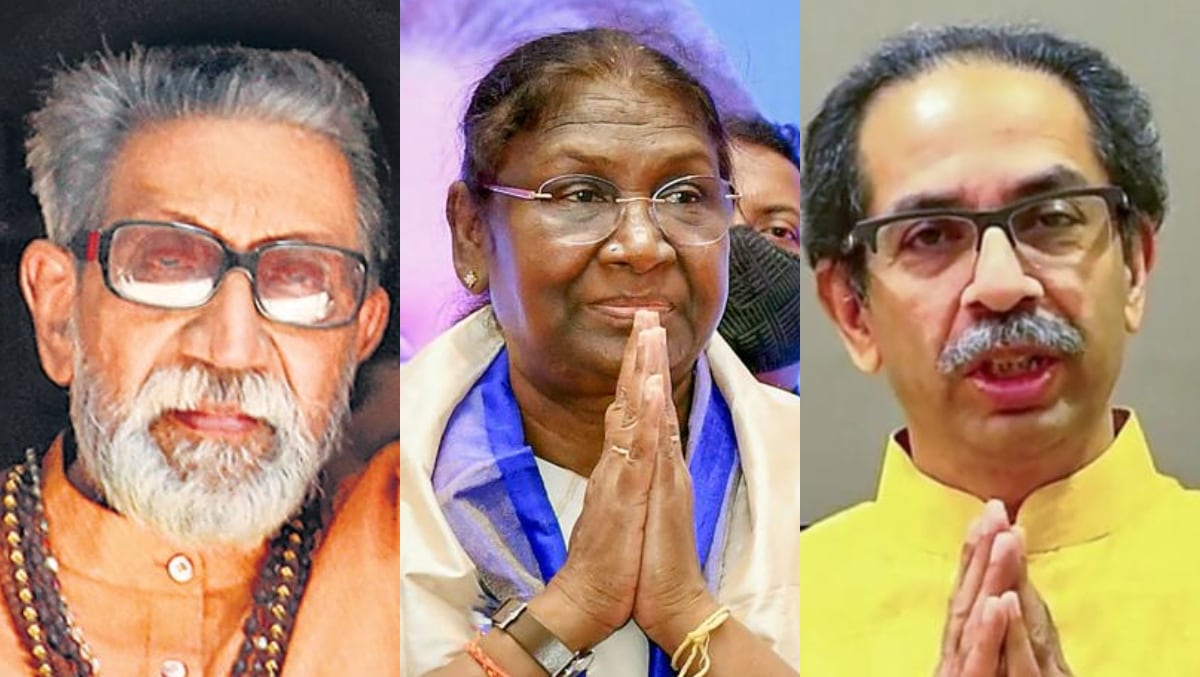
But from all available indications, the move is tactical. It’s not a strategic shift to restore status quo ante between the principal claimants to the Hindutva turf in the key western State.
The detente that’s not a detente
This is not to suggest the Sena chief, Uddhav Thackeray, wasn’t under pressure from party colleagues, including members of parliament to side with the NDA’s choice of a tribal woman for the highest constitutional office. Her social profile forced the hand of not just the Sena but several other non-BJP parties which lined-up behind her candidature. Depending on individual predilections, the trend can be variously described as compulsion, expediency or the electoral necessity to be on the side of social justice.
That the famous Thackeray home, Matoshree, wasn’t among Murmu’s pit-stops during a campaign visit to Mumbai after Uddhav’s declaration of support, showed the hiatus between the Sena and the BJP wasn’t easily bridgeable. The no-show can be differently interpreted in the obtaining scramble for political relevance.
The Sena’s Sanjay Raut sought to play it down, insisting that his party wasn’t expecting the call as the support it announced wasn’t political. From the standpoint of other Sena leaders, it was a clear snub, a denial of protocol to a destination having a milestone status for being the abode of the late Balasaheb Thackeray, who built the party on Marathi pride. If Mumbai was an orchestra, he was at his prime, its undisputed conductor.
“Such denial of courtesy is the writing on the wall we can’t miss. The BJP wants sole ownership of the state’s Hindutva constituency,” surmised a pro-Uddhav Sena functionary who did not want to be named. “Having ousted us from the government, they are working to oust us from the state’s political map. We won’t let that happen. We will fight in the people’s court to prove that we are the real Sena.”
While acceding to the wishes of his MPs, Uddhav himself did not present the move as a hand of friendship to the BJP, recalling in the same breath his father’s support to the Congress’s Pratibha Patil and Pranab Mukherjee for the high office despite its then NDA partner, the BJP’s threats to sever political ties. “Even then we thought beyond politics and did what’s best for the country,” he argued.
The centrality of the civic polls
As opposed to the Sena’s presence in the NDA, the Maharashtra Vikas Aghadi (MVA) wasn’t, in a strict sense of the term, a coalition or an alliance. It was a post-poll power sharing front with the singular agenda of keeping the BJP out.
The three-way adjustment of ideologies came with attendant risks for all stakeholders — the Sena, the Nationalist Congress Party (NCP) and the Congress. If Uddhav was accused of deviating from his Hindutva moorings, the NCP-Congress faced flak for going against the secular grain to cozy up to a communal-parochial force.
Neither of these parties have yet parted company or abandoned the front. The NCP and the Congress, in fact, have expressed support for Uddhav in his fight against the BJP-inspired rebellion. “They in all probability will independently fight the BMC election but could come together if their aggregate numbers are more than the BJP-Shinde combine,” said Anant Bagaitkar, a Pune-based veteran journalist.
In fact, a day before Murmu visited Mumbai the NCP’s Sharad Pawar was closeted with senior party colleagues and district-level leaders. “The discussions were focused on civic polls,” said Rajya Sabha MP Majeed Memon who attended the meeting.
The Congress with 31 seats in the BMC is on the decline and the NCP (9 seats) is a marginal force in greater Mumbai. Independently or together, they will have to work hard to add to the MVA’s numbers to gain control of the rich and influential municipal body where, at least on paper, the BJP-Shinde combine seem to have a distinct edge.
This analysis presupposes that the new regime will stay firewalled from dissidence when Shinde and his deputy from the BJP, Devendra Fadnavis expand their two-member cabinet.
“The Sena cannot be wished away. It won’t vanish and will be a factor in the state’s politics even if the municipal results are different,” said Kumar Ketkar, noted political commentator and the Congress’s Rajya Sabha member. He said the party’s grass-root workers are largely with the Thackerays with Shinde’s clout confined to Konkan and parts of Marathwada. In comparison, Uddhav remains relevant and continues to be a draw in Mumbai, Nasik, Marathwada, Konkan and pockets of Vidharbha.
Shinde’s battle for political identity
The political game will open up after the presidential polls when Shinde forms his council of ministers and the tussle to inherit the Sena and its symbols moves from the legislature to the Election Commission and the Supreme Court. Petitions filed by both sides for disqualification of MLAs who voted against their whips are pending in the apex court where a new bench is likely to hear them in the coming days.
The political fallout from the view the court takes will be hard to miss. For the judgments will decide the fate of those who voted against the government and others who hitched on the bandwagon of Shinde, a Maratha whom the BJP propped up as the CM at Devendra Fadnavis’s expense to take on Uddhav within the party organisation and on the ground in the municipal polls.
Regardless of having two-thirds of the Sena legislators, the breakaway group runs the risk of disqualification on the EC front under the 10th schedule (relating to defections) if it does not merge with another party. On the face of it, the merger option is not exercisable as the defectors’ real objective is to emerge as the de facto and de jure Sena.
Joining the BJP will mean the Maratha CM has surrendered and sullied the community’s history of not bowing before Delhi. A big climb down it will be from the days of Balasaheb Thackeray, whose legacy Shinde claims to safeguard against Uddhav’s digressions.
Even otherwise, it’ll be a political suicide for Shinde. The party of Balasaheb which first aligned with the BJP in 1989 progressively lost its senior partner status to end up a distant second in the 2019 assembly polls which marked the emergence of MVA. The senior Thackeray was a high caste Chandraseniya Kayastha Prabhu who played on the omnibus Marathi identity. As a relatively moderate centre-Right outfit, Uddhav’s Sena is a pale version of his father’s muscular, vociferous politics. Having walked out with the promise of reversing that, the Shinde faction cannot subsume its entity in the BJP.
Long-haul legal hurdles
To prove themselves as the real Sena, both factions have to measure up to two yardsticks — the test of majority (in the legislature and party organisation) and the test of (adherence to the party’s) aims and objectives. In the latter case, the Shinde groups accuses Uddhav of abandoning Balasaheb’s line by joining hands with ideological rivals, the NCP and the Congress in the MVA scheme.
Both these questions are bound to end up in protracted court battles even after the EC takes a position and pronounces an order. In the interregnum, the SC judgment on disqualification petitions could empower or enfeeble the warring groups.
These factors limit the short-run options of Uddhav and Shinde to fighting it out in the BMC polls. In tandem with the BJP, the new CM, given his traditional base in the Thane suburb, will be a formidable challenger to Uddhav. That’s because the undivided Sena was ahead of the BJP by only a wafer-thin margin in the 227-member body in the previous elections.
The MVA’s and the Sena’s hope is in disputes arising over shares in the spoils of power in the freshly minted regime where the tail’s wagging the dog. The Shinde group’s legislative presence in the house is half of the BJP’s, the demotion of Fadnavis, the former CM making the marriage seem odder.
vinodsharma@hindustantimes.com


