
 E-Paper



India 1st in Asia Pacific to achieve feat as IndiGO uses new tech to land plane
Jointly developed by the AAI and the Indian Space Research Organisation (ISRO), GAGAN is the first indigenous satellite based augmentation system developed for India and the neighbouring countries in the equatorial region.

 Prefer HTon Google


India on Thursday achieved a major milestone in the field of air navigation services. The Airports Authority of India successfully conducted a light trial using an indigenous satellite based augmentation system (SBAS) called GAGAN (GPS Aided GEO Augmented Navigation) at the Kishangarh airport in Rajasthan.
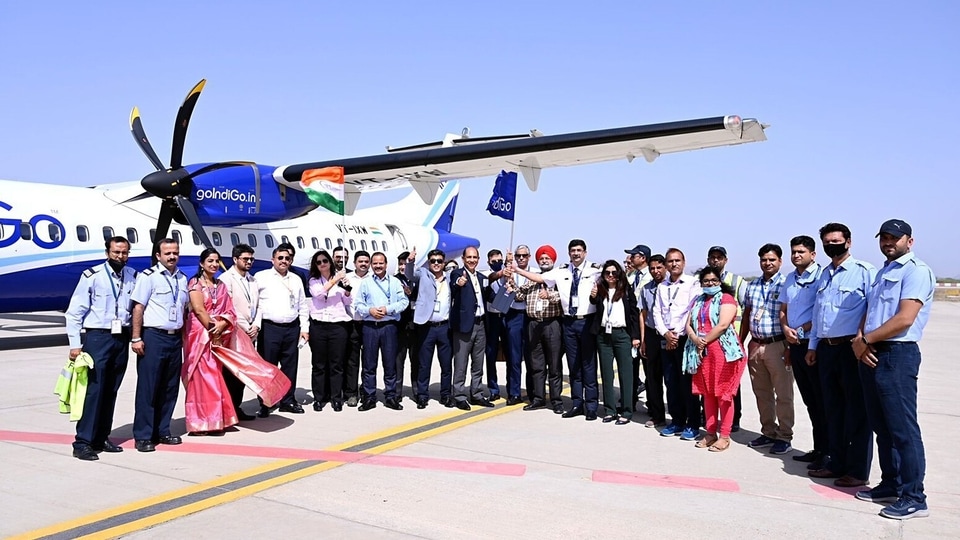
Jointly developed by the AAI and the Indian Space Research Organisation (ISRO), GAGAN is the first system developed for India and the neighbouring countries in the equatorial region, the ministry of civil aviation said.
The system was certified by the Director General of Civil Aviation in 2015 for Approach with Vertical Guidance (APV 1) and en-route (RNP 0.1) operations. Including GAGAN, there are only four Space-based augmentation systems available in the world, the others being US (WAAS), Europe (EGNOS) and Japan (MSAS).
An Indigo Airlines aircraft flew an Instrument Approach Procedure (IAP) with LPV minima of 250ft, using GAGAN Service, the ministry of civil aviation said.
A Localizer Performance with Vertical Guidance (LPV) allows aircraft guided approaches that are operationally nearly equivalent to Cat-IILS, without any need for ground-based navigation infrastructure. The service relies on the availability of GPS and GAGAN Geo Stationary Satellites (GSAT-8, GSAT-10 and GSAT-15), launched by ISRO.
The tests at Kishangarh Airport were performed as part of initial GAGAN LPV flight trials along with DGCA team on- board. After the final approval by DGCA, the procedure will be available for usage of commercial flights. The LPVs will enable aircraft to land at airports which are not equipped with expensive instrument landing systems, including several small airports.
Lowering the decision height up to 250 ft provides a substantial operational benefit in poor weather and low visibility conditions. Thus, any airport which hitherto would require higher visibility minima, will be able to accept aircraft benefitting remote airports which are devoid of precision approach capability equipment, the government statement said.
A number of airports including those under Regional Connectivity Scheme (RCS) are being surveyed for development of GAGAN based LPV Instrument Approach Procedures so that suitably equipped aircraft can derive maximum benefit in terms of improved safety during landing, reduction in fuel consumption, reduction in delays, diversions and cancellations etc.
AAI in coordination with Indian National Centre for Ocean Information Services (INCOIS) has implemented GAGAN Message Service (GMS) through which alert messages to fishermen, formers, and disaster affected people will be sent on the occurrence of natural disasters, calamities, such as flood, earthquake etc, the ministry said.


