
 E-Paper



India abstains from votes on Ukraine humanitarian crisis
While 140 member states backed a Ukraine-presented resolution, which categorically blamed Russian aggression for the crisis, 38 states abstained and five states opposed it


Washington: While acknowledging the gravity of the humanitarian crisis confronting Ukraine, but also emphasising the need to prevent the politicisation of humanitarian assistance, India on Thursday continued its policy of abstaining from Ukraine-related votes at the United Nations (UN). It abstained on votes on two separate humanitarian resolutions in the UN General Assembly on Thursday, after abstaining from a vote on a Russia-sponsored humanitarian resolution in the UN Security Council on Wednesday.
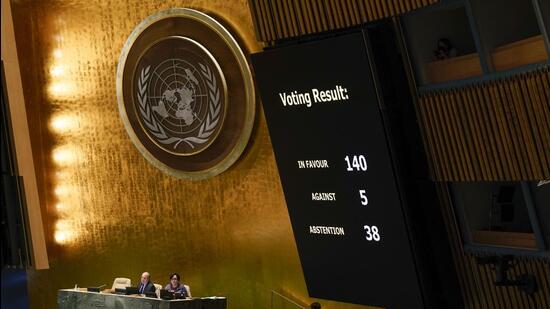
While 140 member states backed a Ukraine-presented resolution, which categorically blamed Russian aggression for the crisis, 38 states abstained and five states opposed it. A second resolution in the UNGA, proposed by South Africa, which included the elements to address the humanitarian crisis but did not name Russia, got only 50 votes, with 67 countries opposing it, and 36 abstaining. Russia’s resolution in the Council on Wednesday got only one two votes – its own and that of China, while the 13 other members abstained.
Explaining the significance of the UNGA vote, Ashish Pradhan, a UN analyst at the research and advocacy outfit International Crisis Group said: “The UNGA once again highlighted Russia’s diplomatic isolation with a resounding vote on a strongly worded resolution presented by Ukraine demanding an immediate cessation of hostilities, full protection of civilians and humanitarian personnel and condemning violations of international humanitarian law.” He added that Russia had hoped that South Africa’s tabling of an alternative draft would erode the support for the Ukrainian text. “But European and American diplomats lobbied African and Asian counterparts hard to secure nearly the same support by the March 2 UNGA resolution.” On March 2, 141 countries had backed a resolution condemning Russian actions.
In its explanation of the vote, Indian permanent representative to the UN TS Tirumurti said that India continued to be “deeply concerned” about the ongoing situation, the conflict had led to civilian deaths and displacement of nearly ten million people, and reiterated New Delhi’s call for cessation of hostilities and an immediate ceasefire. “The humanitarian situation continues to worsen, particularly in the conflict zones in urban centres. Women, children and the elderly are disproportionately affected by the prolonging of the conflict.”
India said that there was an “urgent need” to address humanitarian needs of the affected population, supported UN initiatives in this regard, and pointed out that New Delhi had sent over 90 tonne of humanitarian supplies to Ukraine and its neighbouring countries as part of nine separate tranches of assistance, and was planning to send more. It also pointed to the successful evacuation of 22,500 Indian students as well as those from 18 other countries.
“Allow me to underscore that it is important that humanitarian action is always guided by the principles of humanitarian assistance, i.e. humanity, neutrality, impartiality, independence. These principles should not be politicised.” While reiterating India’s support for the UN charter, international law, territorial integrity and sovereignty of states, and its support for all UN efforts for de-escalation of conflict and dialogue and diplomacy, Tirumurti said: “India abstained from the resolution because what we require now is to focus on cessation of hostilities and on urgent humanitarian assistance. The draft resolution did not fully reflect our expected focus on these challenges.”
Pradhan, the Crisis Group analyst, said that India’s vote was in line with its consistent view that “finger-pointing through UN statements and texts can be counterproductive to the resolution of this war”.
Among South Asian countries, there was a shift in Bangladesh’s position. It had abstained from the UNGA resolution on March 2, but backed the Ukraine on Thursday.
The politics over humanitarian relief intensified in the wake of Russia’s invasion of Ukraine last month. France and Mexico first worked on a draft resolution in the UNSC, but the US nudged them to explicitly attribute the crisis to Russian actions. This drew Russian ire and with the certainty of a Russian veto in the UNSC, France and Mexico decided to take it to the UNGA. This text was finally presented by Ukraine at an emergency special session of the UNGA that resumed on Wednesday.
This resolution recognised that Russia’s military offensive “inside the sovereign territory” and its humanitarian consequences “were on a scale that the international community had not seen in Europe in decades”; reiterated the UN Secretary General’s call to Russia to “stop its military offensive”; recalled its demand that Russia “immediately, completely and unconditionally withdraw all of its military forces” from Ukraine “within its internationally recognised borders”; deplored the dire humanitarian consequences of Russian hostilities “including the besiegement of, shelling and airstrikes in densely populated cities…as well as attacks striking civilians”; expressed concerns at the impact of the conflict on increased food insecurity; and recalled the need for all parties to respect principles of international humanitarian law.
The resolution also demanded an “immediate cessation of hostilities by the Russian Federation”; full protection of civilians, humanitarian personnel, journalists, among others; respect for and protection of objects indispensable for the survival of civilian population; safe and unhindered access for humanitarian personnel; end of the siege of cities such as Mariupol; and voluntary, safe and unhindered passage for civilians fleeing the armed conflict.
The South Africa-backed resolution, for its part, recognised the “independence, meaning the autonomy of humanitarian objectives from the political, economic, military or other objectives that any actor may hold”. Like the Ukraine-presented text though, it called for an immediate cessation of hostilities, endorsed the UNSG’s call to return to the path of dialogue and diplomacy, demanded the full protection of civilians, and respect for international humanitarian law.


