
 E-Paper



Amid Israel-Hamas war, India backs ceasefire in Gaza at UNGA
India abstained on a similar resolution that didn't categorically name Hamas and held it responsible for the terrorist attack of Oct 7.

 Prefer HTon Google


In a shift from its earlier position, India joined 152 other countries on Monday in voting for a United Nations General Assembly (UNGA) resolution that called for an immediate humanitarian ceasefire in Gaza, asked all parties to comply with international humanitarian law with a focus on protection of civilians, and demanded the release of all hostages as well as humanitarian access.
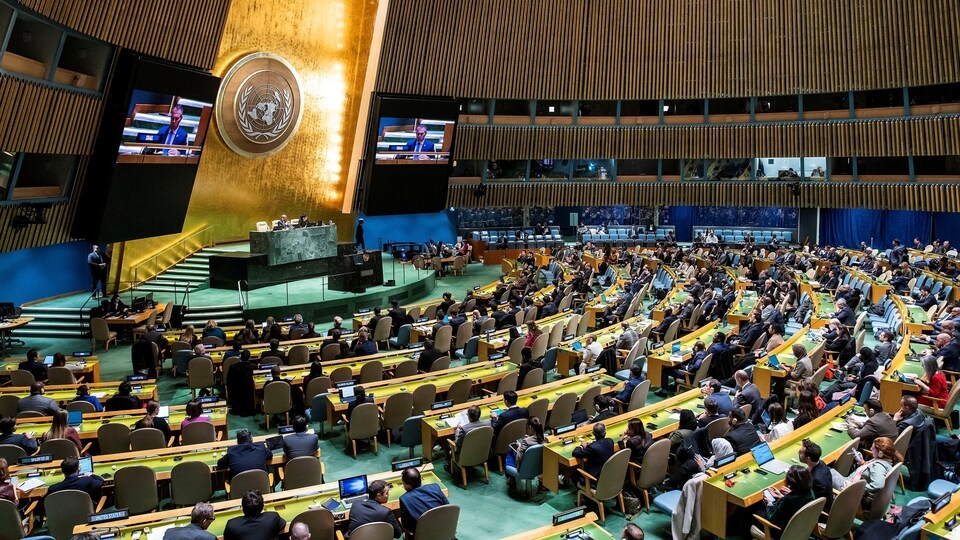
While 23 countries abstained from voting on the UNGA resolution, ten countries, including the US and Israel, voted against the motion titled “Protection of civilians and upholding legal and humanitarian obligations”.
India had abstained on a similar resolution that hadn’t categorically named Hamas and held it responsible for the terrorist attack of October 7 that triggered the Israeli offensive. But in an explanation of the vote on Monday, India’s permanent representative to the UN, Ruchira Kamboj said India was voting for the resolution and that there are many dimensions of the issue.
“There is the terrorist attack on Israel on 7 October and the concern for the hostages taken at that time. There is an enormous humanitarian crisis and large scale loss of civilian lives, especially of women and children. There is the issue of observing international humanitarian law in all circumstances. And there is the endeavour to find a peaceful and lasting two-state solution to the long-standing Palestine question,” Kamboj said. The statement weaves in the Hamas attack without explicitly referring to the group, Israeli response without specifically holding it responsible for violating international law, and India’s long standing commitment to the two-state solution.
Kamboj then said that the “gravity and complexity” of what the international community faced was underlined by the UN secretary-general Antonio Guterres invoking Article 99 of the UN Charter. “Therefore, we welcome the fact that the international community has been able to find a common ground to address the multiple challenges facing the region right now.”
Read Here: India abstains on UNGA resolution on Russia, says decision ‘consistent’
India also voted for two amendments, one introduced by Austria that categorically mentioned Hamas as having abducted the hostages, and one introduced by the US that specifically condemned Hamas’s terrorist attack on October 7 as the first operative paragraph of the resolution. But the two amendments failed to muster a majority in the assembly.
Linking India’s shift in position and Monday’s vote with the changes on the ground, TS Tirumurti, a former Indian permanent representative to UN and Kamboj’s immediate predecessor, told HT, “India’s vote is a clear acknowledgement that the situation in Gaza has gone well beyond Israeli retaliation for Hamas terrorist attack and has now become a human tragedy of immense proportion where, inter alia, Palestinian civilians are being killed indiscriminately, 70% of whom are women and children, in violation of international law, especially pertaining to protection of civilians.”
The overwhelming global sentiment on the issue is a reflection of the outrage at Israel’s actions in response to Hamas’s terrorist strikes that killed 1,200 civilians and resulted in 250 hostages being abducted. Tel Aviv has responded with a blockade and a ground invasion of Gaza that, till last week, according to Guterres, resulted in the killing of 15,000 people, over 40% of whom are children.
The SG, for the first time in his tenure, invoked Article 99, a provision that allows him to bring to the attention of the UN Security Council an issue that may “aggravate existing threats to international peace and security”.
In his note to the UNSC president, Guterres said that, besides those killed, thousands have been injured; more than half the homes (in Gaza) destroyed; 80% of the 2.2 million strong population of Gaza have been forcibly displaced, with more than 1.1 million seeking refuge in UN Relief and Works Agency (UNRWA) facilities; the health care system in Gaza is collapsing with hospitals turned into battlegrounds and only 14 of the 36 hospitals even partially functional; and there is no effective protection of civilians.
Read Here: UN General Assembly votes overwhelmingly to demand a humanitarian cease-fire in Gaza
“Nowhere is safe in Gaza,” Guterres said, warning that current conditions are making any meaningful humanitarian assistance impossible. “We are simply unable to reach those in need inside Gaza. The capacity of the UN and its humanitarian partners has been decimated by supply shortages, lack of fuel, interrupted communications and growing insecurity,” the UNSG said. At least 130 UNRWA employees had been killed too. I
n a passionate appeal, Guterres then asked UNSC to press to avert a humanitarian catastrophe and called for a ceasefire. “This is urgent. The civilian population must be spared from greater harm. With a humanitarian ceasefire, the means of survival can be restored, and humanitarian assistance can be delivered in a safe and timely manner across the Gaza Strip.”
Guterres’s plea led to a discussion on a resolution calling for a ceasefire in the UNSC last week, but this was vetoed by the US, a permanent member, with the UK abstaining. The other 13 members of the Council voted for the resolution. Once it failed to pass in the Council, under the Uniting for Peace resolution that allows the UNGA to take up an issue regarding international peace and security after the UNSC has failed in its task, the tenth emergency special session of the UNGA was reconvened on Monday.
The UNGA last met in this emergency session on the issue on October 26. At that point, 121 countries had voted for a resolution calling for a humanitarian truce; 44, including India, had abstained; and 14 countries had opposed the resolution. Monday’s vote indicates the shift in international mood on Israel’s actions where it is left with diminished support after its prolonged offensive has extracted unprecedented toll in terms of human lives and suffering.


