
 E-Paper



INDIA bloc on life support, says Omar Abdullah at HTLS 2025
Jammu and Kashmir chief minister Omar Abdullah praised the BJP for its work ethic, pointing out that the party fights elections like its life depends on them


New Delhi: The Indian National Developmental Inclusive Alliance (INDIA) is sort of on life support and has to decide if it is a political bloc or a state-specific coalition, Jammu and Kashmir chief minister Omar Abdullah said on Saturday, adding that the Opposition will need to be cohesive and take decisions together to challenge the Bharatiya Janata Party (BJP).
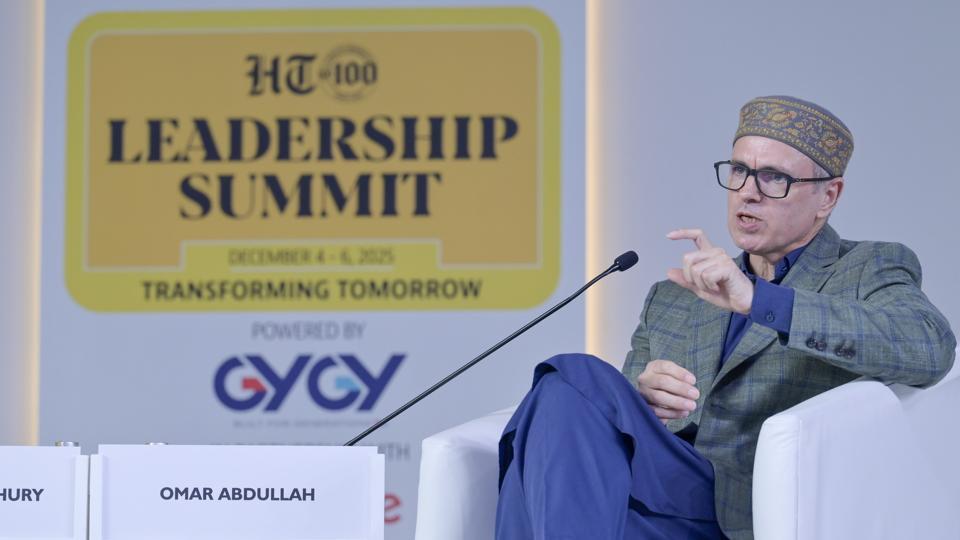
At the 23rd Hindustan Times Leadership Summit, Abdullah also spoke about how the Opposition’s indecision pushed Bihar chief minister Nitish Kumar into the arms of the NDA, criticised the power structure in the Union Territory of Jammu and Kashmir, asserted that Muslim voters can’t be taken for granted, and said that he found out about the recent bomb blast near the Red Fort from the media, and not from the chief minister’s official intelligence channels.
“Either we are a bloc in which case decisions should be taken together, or we are not. Look at Bihar, you pushed one constituent out, you chose to exclude him from the seat sharing arrangement. Hypothetically if tomorrow he were to up and leave, who is at fault?” Abdullah told HT’s national political editor Sunetra Choudhury.
He appeared to be referring to the Jharkhand Mukti Morcha, which was left out of the seat talks of the Opposition Mahagathbandhan in the recently concluded Bihar polls.
“I believe we pushed Nitish Kumar back into the arms of the NDA. I was sitting in the meeting when it was being discussed that he should be made the convenor of the INDIA bloc and we effectively suggested with him sitting in the meeting that another leader would have the power of veto,” he added.
Abdullah was referring to a period of political churn before Kumar returned to the NDA in early 2024.
When asked if the INDIA bloc is dead, Abdullah said, “We are sort of on life support…every once in a while, someone gives us a shock and we get up again and then results like Bihar happen and we slump down again.”
Abdullah, who won a handsome majority in the Union Territory’s first assembly elections in nearly a decade last year, also spoke about the BJP’s “unparalleled” election machinery.
“They also have an incredible work ethic. From a club election to the presidential elections, the party fights every election like their life depends on it. We sometimes fight elections like we don’t care. We are not as committed to the 24/7 model of politics,” he said.
“No sooner has one election finished that they have moved into the next territory. We will move into those states two months before the polls. We will be lucky if we sew up our alliances before the last day of filing of nominations and sometimes not even then,” he added. “There are things they do which will not be difficult for us to replicate.”
He also said that for the foreseeable future, any opposition coalition will have to grow around the Congress – which will have to do the heavy lifting – as the rest of the partners are limited to one state.
Abdullah said he did not agree that electronic voting machines are rigged but added that elections can be manipulated by redrawing constituencies and voter lists.
“The easiest way to manipulate an election is to do it through voter list or structure of constituencies. The delimitation exercise in Jammu and Kashmir earlier was essentially….manipulation. You created seven new constituencies designed to benefit one party and its allies,” he said.
He was referring to the 2022 delimitation exercise that raised the number of seats in Jammu and Kashmir from 83 to 90.
Abdullah said it was a difficult year from the security point of view after the terror attack in Pahalgam in April. He said the attack adversely affected tourism in the UT and caused a further dent in the region’s economy. “We were not strong in the first place, this makes it even more difficult for us,” he said.
Abdullah was critical of some state administrations asking Kashmiris to register with the nearest police station in the aftermath of the Delhi Red Fort blast that killed 12 people last month.
“Kashmiris are as disturbed by what’s happening in Delhi as in Pahalgam. We continue to find it abhorrent but you cannot paint one community with one brush . Not all are terrorists…” he said.
“The damage was done. You cannot make people forget these orders,” he said, alleging that such moves othered Kashmiri people and made it difficult to convince young people in the Valley to leave J&K for better education and economic opportunities.
When asked about the “return” of home-grown terror in the context of the Red Fort attack – where the National Investigation Agency and police forces have alleged a conspiracy spanning several states – Abdullah said that it was a fallacy to have connected decline of terrorism with the occurrences of August 5, 2019, when the Union government scrapped the special status of Jammu and Kashmir and bifurcated the erstwhile state into two Union territories.
“Why are you saying return? Where had it gone? I think only those people are surprised who have convinced themselves that it was gone. I have been one of those people who has been telling you that you can’t wish this away. And that the changes that you made to the constitutional relationship between Jammu and Kashmir and the rest of India are not going to miraculously result in an end to terror. They’re not going to result in an end to separatism. Because those quarters that have been doing this are not doing it because of what Jammu and Kashmir enjoyed constitutionally,” he said.
He hit out at the power-sharing arrangement in the Union Territory, said his working relationship with the lieutenant governor was a “work in progress”, and added that it was untenable that the CM of a region didn’t have any control over security matters.
“You cannot operate the government in silos. You cannot have an elected government removed from security decisions. I am the only CM who has governed both a state and an UT and I can tell you that the UT model does not work,” he said. He was referring to his term as CM of Jammu and Kashmir in 2009.
He said he learnt of the details of the Delhi blast and the subsequent investigation from the media and was not informed by the state police. “…What would have happened earlier is that the DIG of police would have called me up…they would have kept me informed of the investigation,” he said.
The CM also said that he had heard some speculation that the investigation in the Red Fort case was aided by a relationship gone wrong. “A young boy was seeing a young girl. The boy left the girl. The girl felt upset and complained to the police, ‘you know those posters, this boy was pasting those posters’. The police picked up the boy, who said I am not alone, this maulvi was part of this. The maulvi said this doctor was involved.” He was referring to the posters mentioning the Jaish-e-Mohammed that appeared in Nowgam in October, representing the initial break in the investigation.


