E-Paper



India, China differ on characterisation of conversation between PM Modi & Prez Xi
China’s foreign ministry on Friday sought to downplay the border standoff as a “historical issue” that doesn’t represent the entirety of bilateral ties

 Prefer HTon Google


NEW DELHI: India and China on Friday offered different characterisations of a conversation between Prime Minister Narendra Modi and President Xi Jinping on the margins of the Brics Summit, even as Beijing sought to downplay the border standoff as a “historical issue” that doesn’t represent the entirety of bilateral ties.
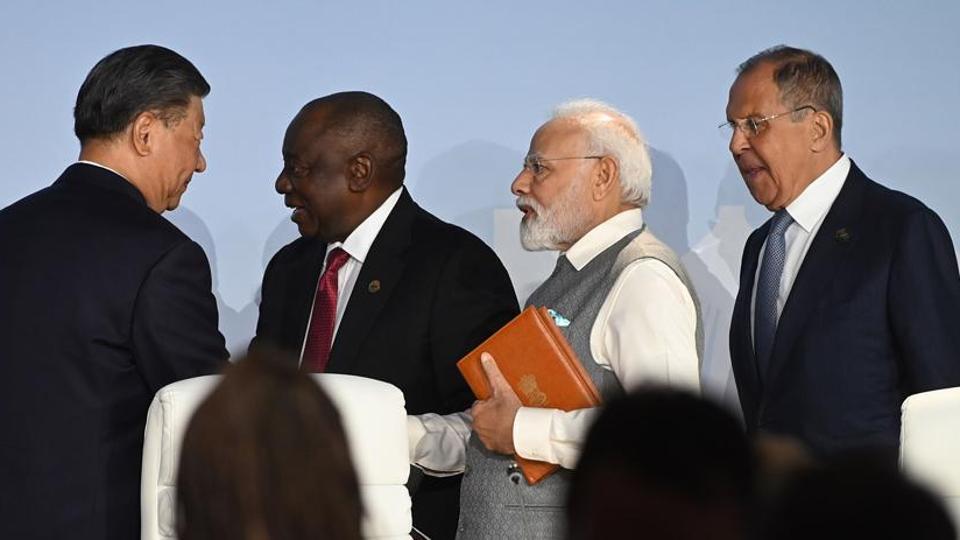
People familiar with the matter clarified that the Modi-Xi encounter was the outcome of a pending Chinese request for a bilateral meeting after China’s foreign ministry issued a readout that said the conversation was held at the Indian leadership’s request.
The two leaders had an “informal conversation” on Wednesday, the people said on condition of anonymity.
Modi told Xi during the conversation that maintaining peace and tranquillity in the border areas and respecting the Line of Actual Control (LAC) are “essential” for normalising bilateral ties, foreign secretary Vinay Kwatra told a media briefing in Johannesburg on Thursday.
Also Read: ‘Respecting LAC essential’: PM Modi’s clear message to Xi on Brics sidelines
The Chinese readout stated Xi talked with Modi on the sidelines of the Brics (Brazil-Russia-India-China-South Africa) Summit “at the latter’s request”.
But one of the people cited above said, “There was a pending request from the Chinese side for a bilateral meeting.”
He added, “The two leaders, however, had an informal conversation in the leaders lounge during the Brics Summit.”
The Chinese readout also skirted any mention of efforts to resolve the military standoff on the LAC through disengagement of troops and de-escalation, and only quoted Xi as saying that the “two sides should bear in mind the overall interests of their bilateral relations and handle properly the border issue so as to jointly safeguard peace and tranquillity in the border region”.
Kwatra had said the two leaders agreed to “direct their relevant officials to intensify efforts at expeditious disengagement and de-escalation”.
China’s readout further said Modi and Xi had a “candid and in-depth exchange of views on current China-India relations and other questions of shared interest”. Xi “stressed that improving China-India relations serves the common interests of the two countries and peoples, and is also conducive to peace, stability and development of the world and the region”, it added.
On Friday, Chinese foreign ministry spokesperson Wang Wenbin sought to downplay the standoff on the LAC, currently into its fourth year, by saying that the “boundary question is a historical issue and does not represent the entirety of China-India relations”.
“We should place it appropriately in our bilateral relations and seek a fair, reasonable and mutually acceptable settlement through peaceful and friendly consultations,” Wang told a regular news conference.
“Before the boundary question is settled, the two sides need to jointly safeguard peace and tranquillity in the border areas. We hope to work with India to act on the important common understandings between the two leaders, increase strategic mutual trust, focus on our consensus and cooperation, remove disturbances and obstacles and advance the bilateral relations along a sound and stable track,” he added.
Following a brutal clash at Galwan Valley in June 2020 that killed 20 Indian soldiers and at least four Chinese troops, the two sides have deployed nearly 60,000 troops each in Ladakh sector. Despite several rounds of diplomatic and military talks, they are yet to disengage frontline troops at frictions points such as Depsang and Demchok.