
 E-Paper



India, Kuwait announce joint commission to boost ties in energy
The decision to establish the joint commission co-chaired by the foreign ministers of the two sides was part of a joint statement issued at the end of Kuwaiti foreign minister Ahmed Nasser al-Mohammed al-Sabah’s brief visit to New Delhi.


India and Kuwait on Thursday announced the creation of a joint commission to further institutionalise their relations in areas ranging from energy to defence and to forge a framework for cooperation in the future.
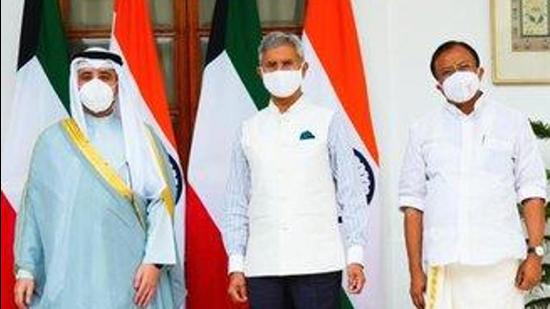
The decision to establish the joint commission co-chaired by the foreign ministers of the two sides was part of a joint statement issued at the end of Kuwaiti foreign minister Ahmed Nasser al-Mohammed al-Sabah’s brief visit to New Delhi.
Al-Sabah, who arrived late last night, held talks with external affairs minister S Jaishankar before leaving for Pakistan. Al-Sabah and Jaishankar reviewed all aspects of bilateral ties and discussed regional developments.
India is among the largest trading partners of Kuwait, and bilateral trade was worth $10.86 billion during 2019-20. India’s imports, mainly oil, were worth $9.6 billion in this period. Kuwait was the 10th largest oil supplier to India during 2019-20 and met 3.8% of the country’s energy needs. Kuwait is also home to nearly 900,000 Indian expatriates.
The joint commission will act as an umbrella for all bilateral institutional engagements such as foreign office consultations and joint working groups. Apart from existing working groups on hydrocarbons, manpower and mobility, and healthcare, new groups will be created on trade and investment, defence and security, and maritime cooperation.
The joint commission will work to strengthen ties in the fields of energy, trade, investment, manpower, skills, science and technology, IT, health and education. It will also review existing bilateral agreements and find solutions to any hurdles in their implementation.
Al-Sabah thanked the Indian government for supplying 200,000 doses of Covishield vaccines to Kuwait in February. Jaishankar, in turn, thanked the Kuwaiti government for taking care of the large Indian community during the pandemic. He hoped the Indian community will be able to resume travel to Kuwait in big numbers soon.
Ahead of his talks with Jaishankar, Al-Sabah told a small group of reporters late on Wednesday that Kuwait is looking to India and the world community to help revive the peace process between Palestinians and Israelis as allowing the matter to linger could jeopardise any potential for progress.
He described the Abraham Accords signed by Israel and Gulf Cooperation Council (GCC) members such as Bahrain and the United Arab Emirates (UAE) as sovereign decisions by countries regarding the conduct of foreign relations.
“Saying that, we think that the peace process is very important. We think that now it is the opportune time to revive the peace process between the Palestinians and the Israelis. We think that if we leave the peace process to linger even further...it might jeopardise any potential for it to see the light of day,” he said.
“And it needs the understanding and the support of the whole international community, including India, in this matter,” he added.
Al-Sabah lauded India for standing by Kuwait in its “darkest moments and in our direst time”, including the provision of medical aid at the peak of the pandemic last year. He singled out the “white army of Indian nationals” – or nurses and doctors – who were combating Covid-19 alongside Kuwaitis.
India had deployed a 15-member medical rapid response team to Kuwait last April to help in testing and treating infected people.
Al-Sabah also played down a bill on reducing the number of foreign nationals that was discussed by Kuwait’s Parliament last year, saying it was only aimed at illegal residents.
Kuwait’s population of 4.1 million includes 1.4 million Kuwaitis and almost 900,000 Indians, he noted. “They [Indians] share with us our bread and butter. They have contributed very much and are still contributing in our development and strengthening our cooperation,” he said.
“The Indian community is an element of security of Kuwait and also an integral part of the new generation ahead as they are very much involved in our education system. The bill discussed last year was only for illegal expats in Kuwait and is not aimed at any of the more than 170 nationalities present in the country,” he added.


