
 E-Paper



India should work towards universal health care: Bill Gates
The report by the government policy think tank, titled Health System for a New India: Building Blocks-Potential Pathways to Reform, noted that India’s health system was lagging behind those in comparable countries on many key performance indicators.


India’s health care system has improved significantly over the past decade, Bill Gates, co-chair of the Bill & Melinda Gates Foundation, said on Monday, adding that the goal for India should now be to work towards universal health care and improving its primary healthcare system.
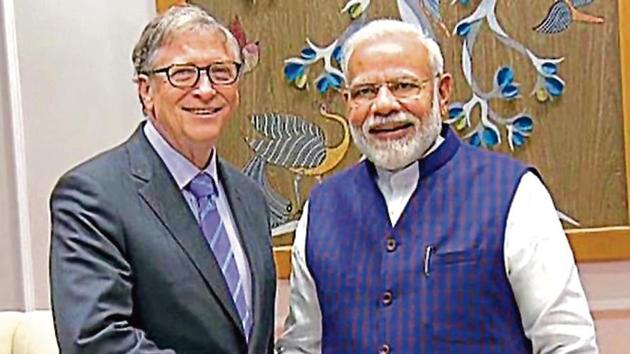
“As we look forward we need to remember that primary healthcare is very impactful,” Gates said at the launch of a Niti Aayog report on improving India’s health care infrastructure.”Making sure that mothers, when they deliver, they are getting good attention and advice in the first 30 days about vaccines, breastfeeding and nutrition. That is very low cost and high impact. We need to make sure that primary health element is done very well.”
The report by the government policy think tank, titled Health System for a New India: Building Blocks-Potential Pathways to Reform, noted that India’s health system was lagging behind those in comparable countries on many key performance indicators.
Gates suggested that the private sector be enlisted in the effort to improve the healthcare system. “Many countries have had a tough time with health systems,” he said. “The United States is not a perfect example of how to run a health system. We manage to spend more than any other country and we don’t get what you would expect for that. So, looking at other middle-income countries and seeing what they did well is really important in this report,” he added.
To be sure, Niti Aayog clarified that it is not recommending a single-payer universal health care system in India. A single-payer health care system is a type of universal health care financed by taxes that covers the costs of essential health care for all residents with costs covered by a single public system.
“We are not recommending a single public system per se; as has been pointed out earlier, there are at least hundreds of financials pools which are already existing. One can’t realistically expect that all these will be merged in a single pool at this time. There are single payer systems across the world but with the level of fragmentation we cannot expect it to happen realistically for the next 10-15 years ,” said Alok Kumar, advisor (health) at Niti Aayog.
In the long run, there is a lot to be done at the federal and state level, Gates said.
The Niti Aayog report highlights the challenges plaguing India’s underperforming health Industry. India’s health system is lagging behind comparable countries in many key performance indicators, it noted.
Fragmentation, understood as a myriad of organizations, institutions (formal and informal rules), management and administrative arrangements as well as entitlements that do not coordinate harmoniously and are often subjected to contradictory incentives, all hamper continuity of care and portability of benefits.


