E-Paper



India’s most famous police station in urgent need of repairs
The building of the police station is classified as a “Grade 2” heritage structure, which means that it is a structure of “local/regional importance” and “possesses historical significance”

 Prefer HTon Google


New Delhi: Since even before India’s independence, the Parliament Street police station has earned the moniker of possibly being the most famous police station in the country. Located on Sansad Marg—jjust down the road from the old Parliament complex—this is the police station where protesting politicians and political demonstrators are often detained—making it India’s political police station.
In 2022, to honour freedom fighters such as Bhagat Singh and Mahatma Gandhi, the façade of the century-old structure was decorated with LED lights and posters of freedom fighter Bhagat Singh —possibly the most famous of the hundreds of high-profile detainees ever held at the police station.
The building of the police station is classified as a “Grade 2” heritage structure, which means that it is a structure of “local/regional importance” and “possesses historical significance.”
But with wide cracks visible across its white walls, along with patches of water damage, which has combined with a lack of ventilation to start buildup of mould, the interiors of the building lie in a shocking state of disrepair. The deterioration is also not just cosmetic; the building’s structural integrity and safety are a major concern, according to Delhi Police officers.
Despite its storied past, the police station’s repairs and restoration are tangled in red tape—the structure falls under the jurisdiction of the New Delhi Municipal Council (NDMC), and only the civic body’s heritage conservation committee can assign its maintenance.
“The police station does fall in our area, but we only get information if a major revamp or structural change is being done. We allow other authorities to do smaller work by themselves,” according to an NDMC spokesperson.
Police officers posted at the station said they have submitted written requests to seniors about addressing the disrepair of the building. “A letter was then sent to Indian National Trust for Art and Cultural Heritage (INTACH) in February to conduct a survey and make a report,” the officer said, on condition of anonymity.
Vijaya Amujure, director at INTACH’s architecture heritage division, said her team made a preliminary report in February and approached senior police officials to take “necessary” action for the conservation of the building, but there has been no forward movement since.
According to police, the report received mentions multiple observations about the building’s water seepage problem, the moulds, the “covered up” corridors, and how many areas have “limited” ventilation.
Delhi Police spokesperson Suman Nalwa said, “No such proposal has been finalised yet. All options are open at the moment.”
Beginnings in the British Raj
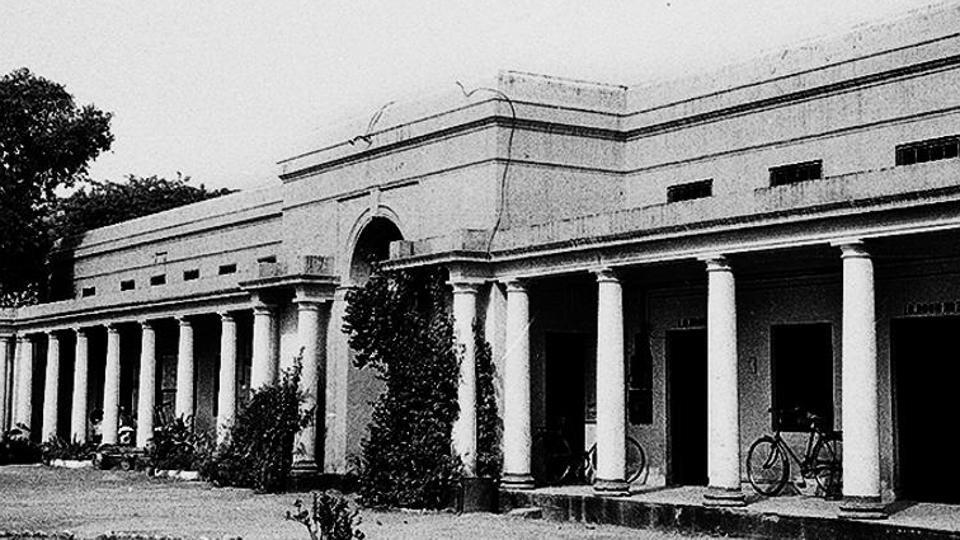
The Parliament Street police station was built in 1913 and originally served as a residential area for security personnel to protect Raisina Hill, which then comprised the Viceroy’s residence and the imperial secretariat.
It was only in 1920 that the structure was converted into a fully functional police station, with offices and a lockup, said police.
One of the oldest police stations in the city, the landmark structure today comprises three sections. The first, located at the front, has the offices of the New Delhi police district deputy commissioner of police and assistant commissioner of police. Behind this is a two-storeyed police station with offices and a central courtyard. The third section is at the back of the building and comprises a campus area for the 5th battalion of the Delhi Armed Police, with rooms for personnel.
The first FIR lodged at the police station—written in Shikasta Urdu—was in December 1913, on the complaint of a person named Zuman Bela who alleged theft of an overcoat, a pair of trousers, and socks. Over time, however, the police station’s proximity to corridors of power has meant that many of the people apprehended here are political detainees.
Historian Sohail Hashmi said the Parliament Street police station gained popularity as most political protests in Delhi would be staged at Rafi Marg, and police always brought detainees to this police station.
Perhaps the two most famous detainees at the police station were Bhagat Singh and Batukeshwar Dutt, who were detained here after the bombing of the assembly on 8 April, 1929.
“Till the late 1980s, a court used to be located next to the police station. All those detained would be taken to court directly from the police station,” he said.
Hashmi said he, too, was detained at the police station during the Emergency in 1975 and was picked up from Jawaharlal Nehru University. “I remember Bharath Raj Muthukumar (who later became an IFS officer and was posted as the ambassador to Belarus, Azerbaijan, and Tajikistan) was also detained during the emergency,” he said.
In 1978, when the then Shah of Iran Mohammed Reza Pahlavi came to India for the first time, hundreds of Iranian students in India staged a protest against him near Parliament and were all detained at the Parliament Street police station.
This is also the police station where the July 2001 assassination of gangster-turned MP Phoolan Devi was investigated. Her gold bangles and a wooden bed are still case property/evidence at the station’s maalkhana (evidence warehouse).
The pressing need for conservation
While the police station is closely intertwined with the history of pre- and post-Independent India, more than a century since it was built, the landmark structure is now facing a dire need for restoration.
ACP Rajendra Singh Kalkal, the former in-charge of the Delhi Police museum, said that seepage is a major problem in the building. “There’s also some minor damage to walls, and the building needs waterproofing,” he told HT.
The inner walls of the station also show signs of damage.
“This is because of the rains this year. There’s always a seepage problem in some offices. The problem with our police station is that we have files that are crucial to ongoing cases, in addition to electronic equipment that too is very important. Sometimes, the rainwater also damages our furniture,” said the police officer quoted above.
During a spot check on June 20, HT found that many of the inner walls have developed cracks around the ceiling and the edges. A quick look inside an officer’s office revealed white walls with prominent water marks and mould. At other places, the paint had peeled off, and several walls were missing entire chunks. Multiple rooms inside the police station also showed signs of seepage.
There were also issues of limited ventilation in spots where furniture or files were stacked up near the windows or entry/exit points.
INTACH’s Amujure said her team, in their initial report, flagged several issues to the New Delhi police district.
“There were issues with ventilation as the station has been expanded and more things have been put by the police over time. The corridor seems blocked. There are also waterproofing issues. All these have been flagged since the building has not been repaired in a few years. We will wait until the other parties involved decide on something,” she said.