E-Paper



Number Theory: Is the Congress pursuing a high risk-high reward tactic in Punjab?
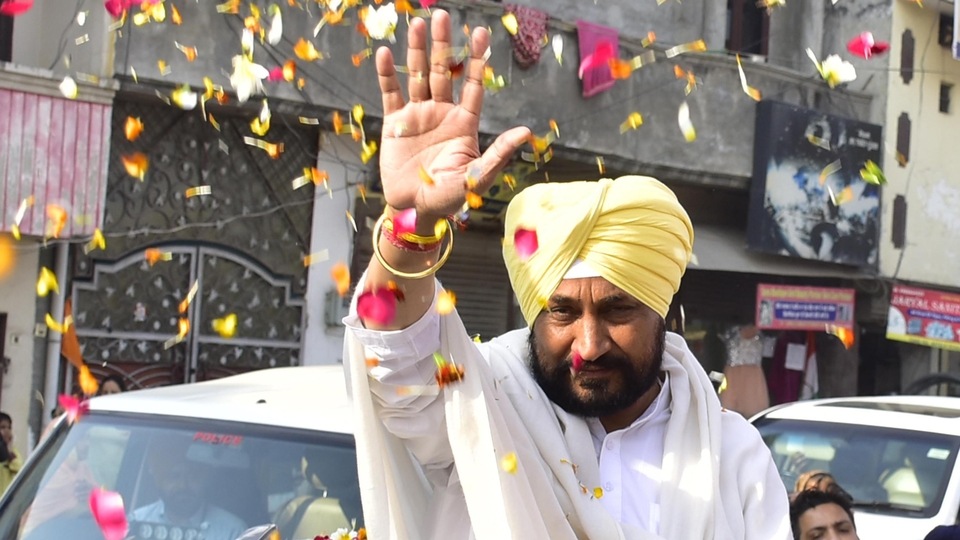
Punjab election: The Congress is hoping to beat anti-incumbency in Punjab by putting all its bets on its newly appointed chief minister Charanjit Singh Channi

 Prefer HTon Google


All of Punjab’s 117 assembly constituencies (ACs) will vote on February 20. The state has seen unprecedented political turbulence before the elections. It was the epicentre of farmers’ protests against the three farm laws brought by the union government in 2020. The protests forced the Shiromani Akali Dal (SAD), one of the oldest allies of the Bharatiya Janata Party (BJP), to walk out of the National Democratic Alliance (NDA). In order to compensate for its potential losses, the SAD decided on an alliance with the Bahujan Samaj Party (BSP).
The BJP’s political isolation in the state, ironical as it sounds, came to an end thanks to the Congress. With former chief minister Amarinder Singh walking out of the Congress to float a new party called the Punjab Lok Congress (PLC) and forging an alliance with the BJP, the latter has successfully avoided being irrelevant in these elections.
The Congress is hoping to beat anti-incumbency by putting all its bets on its newly appointed chief minister Charanjit Singh Channi. Channi is from the numerically significant Scheduled Caste (SC) group in the state.
Last but not the least, the Aam Admi Party is hoping to capture power this time, something it sees as a natural progression from its position as the principal opposition in the state. To be sure, a conglomeration of the various farmers’ organizations has also put up candidates. While there is no point in speculating about the results, Punjab’s politics could be at the cusp of a fundamental change.
Degree of political competition set to increase
When the AAP won four Lok Sabha seats in the 2014 Lok Sabha elections in Punjab, it made its first impact outside Delhi. In Delhi’s case, AAP’s eventual dominance came at the cost of the Congress which failed to even open its account in the 2015 and 2020 assembly elections. In Punjab, the AAP’s entry created a proper tripartite contest. The median value of Effective Number of Participants (ENOP) for Punjab’s 117 ACs crossed 3 for the first time in 2014 and has not gone below since. ENOP is the reciprocal of sum of squares of vote share of each candidate in a given constituency, and a higher value denotes greater degree of competition. Unless one of the supposedly weaker alliances (SAD-BSP or PLC-BJP) collapses completely, one would expect ENOP value to increase further in these elections.
This also means a lower vote share can translate into victories
A lot of commentators are predicting that the fragmentation of politics in Punjab might throw a hung assembly this time. While this is indeed a possibility, another logical possibility is a party managing a majority with a much lower vote share than has been the case in the past. Median vote share of winning candidates in Punjab proves this point. In assembly elections, the median vote share of a winning MLA came down to 43.81% in 2017 from its 2012 value of 46.07%. The 2017 value was the lowest in Punjab since 1977, the earliest election in which Punjab had 117 ACs. The corresponding values of median vote share of a winning MP at the AC-level in the 2009, 2014 and 2019 Lok Sabha elections were 49.03%, 43.79%, and 44.21% respectively. The latter two are comparable to the 2017 assembly election and, at the AC-level, also much lower (the number was above 47% before 2014) than in the Lok Sabha elections going back to 1999, the earliest year for which AC-level results have been compiled by Trivedi Centre for Political Data at Ashoka University.
To be sure, assembly elections can be more fragmented than Lok Sabha polls in India. If this number falls further, it would also mean that political parties may be tempted to opt for a high risk-high reward strategy, targeting a smaller voter base, but consolidating a larger part of it.
Is this the Congress’s game-plan?
The political developments during the campaigning the Punjab suggest that the Congress has been facing some sort of discontent within its Hindu support base, but that the leadership is not very perturbed about it.
For example, Sunil Jakhar, its former state unit chief went public with his grievance that he was being sidelined because of his Hindu identity. Ashwani Kumar, a former cabinet minister in the United Progressive Alliance (UPA) government from Punjab (also a Hindu) quit the party on February 15 and publicly expressed confidence about the AAP’s electoral prospects. Chief minister Channi’s remarks celebrating Congress leader Priyanka Gandhi’s identity as Punjab’s daughter-in-law and vowing to not let the ‘Uttar Pradesh, Bihar, Delhi de bhaiye’, who have come here to rule, enter the state”, was another proof of the fact that the tactics of asserting the party’s Sikh identity, even at the risk of alienating Hindus, is perhaps a conscious one. Does this make sense?
Looking at summary demographics of Punjab is a good way to look at this question. Hindus make up 35.8% of the state’s population, while Sikhs make up 61% of the population. In particular, Hindu SCs and OBCs are 11% and 8.3% of the total population, and Sikh SCs and OBCs are 26.6% and 9.6% of the total population. The share of population that doesn’t belong to either of these two religions is just 3.2%.
In the 2019 Lok Sabha elections, when the Congress won in 77 out of the 117 AC segments in the state, it had a lead among all communities except upper caste Hindus and OBC Sikhs where the SAD-BJP alliance was ahead . AAP’s support base saw a sharp collapse compared to 2014 across groups, with the exception of Dalit Sikhs.
With the SAD and BJP parting ways, the natural alliance between the urban Hindu base of the BJP and the rural Sikh base of the SAD has become weakened. The Congress is right in fearing that the Hindu voter who is willing to change the government might move over to the AAP, which is being seen as the strongest challenger to the Congress. However, its electoral rhetoric bordering on Sikh chauvinism suggests that it is hoping to compensate for the loss by making a dent into AAP’s Sikh, especially Dalit Sikh vote, rather than preventing erosion of its Hindu support. The AAP did have higher support among Sikhs in the 2017 assembly elections than in the2019 Lok Sabha.