
 E-Paper



Jagan govt ban on roadshows, rallies sparks political slugfest
Within a day of issuance of the GO, police enforced the order to prevent the public rally of Naidu during his three-day tour at his constituency Kuppam in Chittoor district from January 4 to 6. The police seized his campaign vehicle, snatched the microphones and put up barricades all along the route

 Prefer HTon Google


Hyderabad
The last week’s order issued by the Jagan Mohan Reddy government in Andhra Pradesh banning roadshows, public rallies and political processions on roads, including state and national highways, is snowballing into a major political controversy in the state.
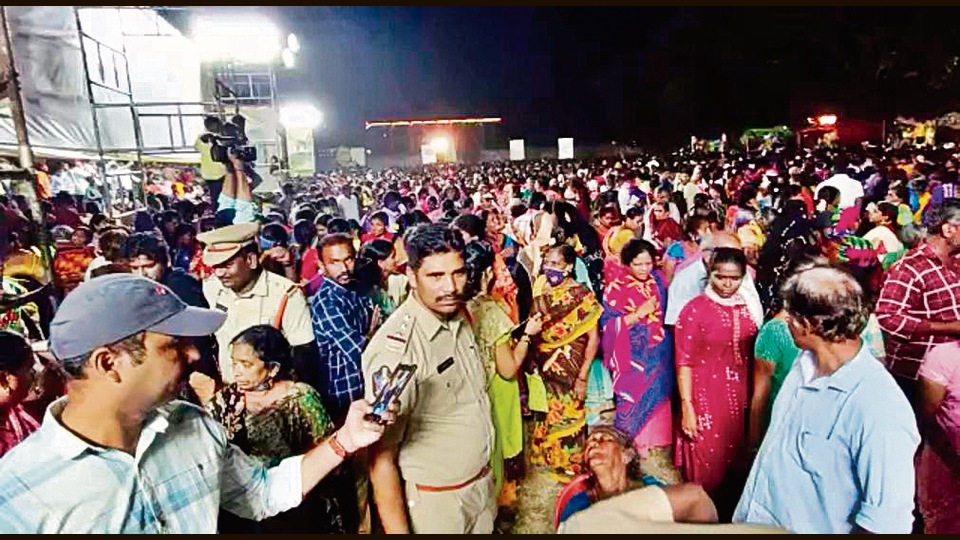
The immediate provocation for the issuance of the government order was the two stampede incidents at the public rallies of Telugu Desam Party president N Chandrababu Naidu – one at Kandukuru in Nellore district on December 28 in which eight people died and the second one at Guntur on January 1 which claimed the lives of three people.
But the opposition parties are alleging that the GO was issued only to prevent them from reaching out to the people in the coming months in the run-up to the assembly elections in the state early next year.
Within a day of issuance of the GO, the police enforced the order strictly to prevent the public rally of Naidu during his three-day tour at his constituency Kuppam in Chittoor district from January 4 to 6. The police seized his campaign vehicle, snatched the microphones and put up barricades all along the route.
The police resorted to lathi charge to disperse hundreds of TDP workers who tried to take out a rally in the constituency along with Naidu. The TDP chief had to squat on the roads to protest, walk through the villages to reach out to the people and climb up his caravan to address the people.
The TDP has even expressed suspicion that two stampede incidents at Kandukuru and Nellore could be the handiwork of the ruling YSR Congress Party as part of the conspiracy to prevent the principal opposition party from going to the people.
“The way three people died in a stampede soon after Naidu left the venue at Guntur on January 1 is really suspicious. We wonder whether there were any sleeper cells of the ruling party, who might have been behind the three deaths so that they could blame Naidu,” TDP politburo member Varla Ramaiah alleged.
The TDP leader demanded that cases under Sections 120 (B) and 302 of IPC be registered against the persons responsible for the deaths or the government hand over the case to the CBI for a comprehensive inquiry.
YSRCP official spokesman and state irrigation minister Ambati Rambabu, however, strongly denied the allegation of the TDP. “Instead of taking responsibility for the stampede incidents, which happened only due to the publicity craze of Naidu, the TDP leaders are trying to throw blame on the government. Let them cry from rooftops, but the government will not revoke the order, which was issued only to ensure public safety,” Rambabu said.
What is there in the GO?
Prominent lawyer Jandhyala Ravishankar said there is in fact nothing new in the latest GO, which only reiterated Section 30 of the Police Act of 1861. “It says how the police have the authority to impose restrictions on public gatherings to prevent any untoward incidents. It is different matter that now the government wants to make use of the provisions,” he said.
According to Section 30 of the Police Act, 1861, a superintendent or assistant superintendent of police of a district is empowered to take action and grant permission for such rallies and processions on public roads and prescribe the routes for the same. The SP or ASP would also take into consideration the possibility of any breach of peace due to uncontrolled procession on the roads or streets before granting the permission.
As per Section 30A of the Act, the police official is also empowered to stop any procession which violates the conditions of the permission and may disperse such processions or rallies. “It shall be the duty of the police to keep order on the public roads, and in the public streets, thoroughfares, ghats and landing places, on the occasions of assemblies and processions on the public roads and in the public streets obstructing the people.”
Quoting these sections, the GO clarified that no rallies, processions or political meetings could be conducted on roads and public streets in panchayats, municipalities, besides state and national highways, including road margins, drains attached to any such street and so on.
“By and large, alternative locations for such congregations would be available by way of public grounds and the applicants may also be suggested to locate alternative private places for the purposes of such meetings in order to mitigate hardship to the people at large,” the GO said.
Only for Opposition?
The TDP leaders are apprehensive that the government might not allow Naidu’s son and TDP general secretary Nara Lokesh to take out his marathon 400-day padayatra, starting from January 27.
“Lokesh obviously cannot walk in the sky. He has to walk on public roads, state and national highways. And when he takes out the padayatra, he will not be alone and hundreds of people will accompany him. What will happen if the police do not give him permission stating that it is causing inconvenience to the people?” TDP official spokesman K Pattabhi asked.
Jana Sena Party president and film star Pawan Kalyan is also expected to take out his state-wide yatra soon on his newly acquired van. “Since he is a film star, he will definitely draw thousands of people to his rallies, apart from the party workers in thousands. It is the responsibility of the police to ensure that there are no stampedes or any other untoward incidents,” a Jana Sena leader said.
YSRCP general secretary and advisor to the government on public affairs Sajjala Ramakrishna Reddy said the GO is applicable to all the parties, including the ruling party. “There is no exception to the ruling party. The opposition charge is baseless,” he said.
However, the TDP president pointed out that the entire Rajahmundry town came to a standstill when chief minister Y S Jagan Mohan Reddy visited the city for his public meeting on January 3. Similarly, state education minister Botsa Satyanarayana also took part in the huge rally in Vizianagaram on the same day on the occasion of Savitribai Phule birth anniversary.
“Are these restrictions not applicable to the ruling party? Why are the police targeting only me and my party leaders?” Naidu asked.
A TDP leader pointed out that the GO has a provision for the police to give permission for the meetings on public roads in rare and exceptional circumstances and for reasons to be recorded in writing. “The police can give permission for the ruling party citing this clause,” he said.


