
 E-Paper



Jharkhand polls: In Santhal region, JMM fights for ex-CM Shibu Soren’s pride
Locals and experts say the ageing Shibu Soren’s influence has waned in the past five years. Soren rose to prominence after his 1972 agitation against local money lenders, called mahajans, who lent money by keeping tribal land as mortgage.


In Jharkhand, there was a perception that the tribal-dominated Santhal region decided the next chief minister. The Bharatiya Janata Party (BJP) broke this notion in 2014, winning just seven of the 18 assembly seats in the region, considered a bastion of Shibu Soren and his Jharkhand Mukti Morcha (JMM), and still forming the government. In the 2019 Lok Sabha elections, BJP leader Sunil Soren defeated Shibu Soren, 78, from the Dumka seat.
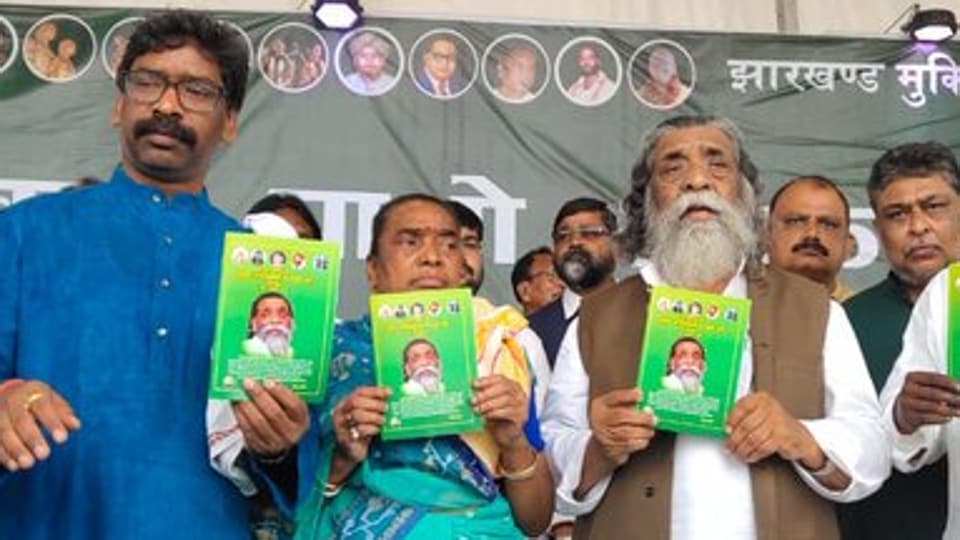
Locals and experts say the ageing Shibu Soren’s influence has waned in the past five years. Soren rose to prominence after his 1972 agitation against local money lenders, called mahajans, who lent money by keeping tribal land as mortgage.
In the campaign for the 2019 assembly elections, Soren has campaigned only for a few days ahead of the fifth and final phase of voting. “Guruji’s [Soren’s] health does not allow him to campaign for long hours,” his son, Basant Soren, said.
The JMM, the principal party in the opposition alliance also comprising the Congress and the Rashtriya Janata Dal (RJD), missed him in the campaign phase in the Santhal region, where a large tribal population still recognises him as their leader.
A section of JMM leaders believes the Opposition’s chances of staking claim to forming the next government in Jharkhand would depend on its performance in the region. Despite the tide in the BJP’s favour in 2014, the JMM got nine seats from the region. The party eventually won 17 of the 81 seats in the state in 2014.
This time too, the JMM is facing a challenge from the ruling Bharatiya Janata Party (BJP) as chief minister Raghubar Das has focused on development in the region in the last five years.
“Santhal region was the most-visited area by the chief minister in Jharkhand [in the last five years]. Almost every weekend he used to be here,” said Louis Marandi, welfare minister and BJP lawmaker from Dumka.
She also praised Soren for making tribals aware of their rights but was quick to add that this election is not about “Guruji (as Shibu Soren is called in the region)”.
“It [the election] is about the work BJP has done. We have changed the face of Santhal region in the last five years and have also strengthened our party...unlike past, we now have workers in every village,” she said.
Pato Modhi, a resident of Dohar Langi village in Dumka district, said majority of people in the tribal belt still identity themselves with Soren and his party’s symbol of bow and arrow.
“People recall how Guruji got back their land from the mahajans and fought for the tribal rights. That respect is not there for his sons, a reason for his [Shibu Soren] defeat in 2019 Lok Sabha polls,” he said.
Gopal Hemram of village Nasda in the same district is of the view that Soren understands tribals’ plight like no other leader in Jharkhand. “...his doors are always open for us,” he said.
Abhir Roy of Inderbani village, a few kilometres from Soren’s village in Dumka, differed. “Soren created a divide between tribals and non-tribals and became popular because of that,” he said at the village chaupal (meeting place of villagers).
Shibu Lal Hembrom, a tribal, had something else to say. “Today, we are cultivating our land because of him. To me, he is Dishom Guru (world leader),” said Hembrom.
In many houses in the Santhal region, people still have photographs of a young Shibu Soren from the time of his protest against moneylenders in undivided Bihar in 1972.
After his 1972 agitation, the Bihar government in 1974 brought the Land Restoration Law to give back tribals their mortgaged land, and this “ushered in the first land reforms” in the region, said Soren’s friend and JMM general secretary, Vijay Kumar Singh. He said Soren is a “thought” that would survive for centuries in the Santhal region.
Two years after the agitation, Soren launched the JMM in 1974, following an economic blockade in Dhanbad against the acquisition of agriculture land for mining projects. Tens of thousands of tribal people participated in it, Singh, who has been Soren’s lawyer since 1974, said. The JMM was launched with a call to carve out a tribal state from Bihar, which happened in 2000.
Soren was the Jharkhand chief minister for three brief terms — March 2-12 (2005), August 2008- January 2009, and December 2009-May 2010 in a politically unstable state. Incumbent Das is the first CM who will complete five years in office.
The importance of the region for the JMM can also be gauged from the fact that Soren’s son and the Opposition alliance’s face in this election, Hemant Soren, is contesting from two constituencies in the region — Dumka and Barhait. His sister-in-law, Sita Soren, is contesting from Jama. All three assembly segments are in Dumka district, the birthplace of Soren.
Basant Soren, who is running a JMM campaign in the region, was confident of his party doing better than the 2014 elections.
Pramod Pathak, a professor of management at the Indian Institute of Mines, Dhanbad, said the Santhal region still remains a JMM bastion even though the BJP has made deep inroads in the last five years. “...the sympathy for Shibu Soren, after the loss in 2019 Lok Sabha polls, could help the JMM,” he said.


