
 E-Paper



Just 14 robberies as Delhi’s crime rate dips in lockdown
The city police’s crime data in the three weeks (March 1 to March 21) before the lockdown period and after that(March 22 to March 31), accessed by Hindustan Times, shows that there has been an unprecedened reduction in all types of crime across the city.

 Prefer HTon Google


Delhi Police are in the middle of an extremely rare respite from all kinds of crime starting March 22, when stringent measures were put in place to stave off the spread of the coronavirus disease (Covid-19), before a nationwide lockdown took effect three days later. The police maintaining a higher profile outdoors to enforce the lockdown, and fear of the virus, has helped.
Not a single case of abduction (of adults) or extortion has been reported since the lockdown. Crimes such as robbery, snatching, kidnapping (of minors) and theft have dropped significantly compared to the situation before the police and the state government enforced the complete lockdown in Delhi on March 22, when the nation observed a “Janta Curfew” on the Prime Minister’s call.
Click here for the complete coverage of the Covid-19 pandemic
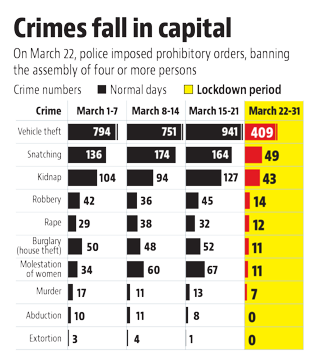
On March 22, Delhi Police imposed prohibitory orders under section 144 of the Code of Criminal Procedure, banning the assembly of four or more persons across the city. It was the first time in four decades that prohibitory orders had been issued for the whole capital city. On March 25, the three-week nationwide lockdown kicked in.
The city police’s crime data in the three weeks (March 1 to March 21) before the lockdown period and after that(March 22 to March 31), accessed by Hindustan Times, shows that there has been an unprecedened reduction in all types of crime across the city.
Sample this – between March 1 and March 21, 63 persons died in road accidents. At least 1,600 road accident deaths are reported each year – an average of around four deaths every day. The number of road accident deaths in Delhi each year is at least three times the level in Mumbai and Bengaluru.
But between March 22 and March 31, there were only eight deaths. Public and most private transport vehicles have gone off the roads for the duration of the lockdown, explaining the dip.
There is a dip in vehicle thefts too – on an average around 140 vehicles are stolen every day. Between March 1 and 21, 2486 vehicles were reported stolen, but after the prohibitory orders came into force, the vehicle stolen data was 409.
There has been a significant drop in kidnappings -- at least 100 abductions are reported every week in Delhi. There were 325 cases in the first three weeks of March but after March 21, the total number of kidnappings reported was 43.
While the city reports around 2,000 abduction cases every year, there has not been a single case of abduction since March 22(Between March 1 and 21, there were 29 abduction cases).
“The numbers are coming down for the first time in decades. Let me give you an example. Kidnapping cases in Delhi are usually of minor girls who are kidnapped by their friends or neighbours. That also includes many cases of elopement. Now with everyone home and people practising social distancing, kidnapping cases have come down drastically,” a senior police officer, who did not wish to be named, said .
Incidents of snatching, one of the most common crimes in Delhi, has decreased for the first time. There are typically around 150 snatching cases every week – there were 474 cases between March 1 and March 21 -- but after March 22, police have recorded only 49.
With traffic thin and the roads empty, some criminals do go about their work. Rakesh Rana, a cinematographer from Kakrola had just stepped out of an ATM kiosk in Outer Delhi after withdrawing money when the city’s infamous bike-borne snatchers struck.
“It was dark when I left the ATM. Two men on a motorcycle came out of nowhere and snatched my cell phone. All shops in the area were closed so there were no people around. Those bikers took advantage of the dark and the open road. Before I could react, they were gone. The empty roads helped them flee,” he said.
Lawbreakers have also turned to new ways of committing crimes.
On Friday, a milkman was arrested in South Avenue for allegedly smuggling liquor inside milk canisters. All liquor shops are closed in Delhi. Borders have also been sealed. Within Delhi, only those supplying essential services and products (milk included) are exempted from prohibitory orders.
A police officer who is probing the case said, “The man is a Bulandshahr resident and was smuggling liquor posing as a milkman. He had the milk canisters fitted on his bike. He even managed to cross police barricades without being stopped. He had bought the liquor from Haryana and had planned to sell it in Uttar Pradesh.”
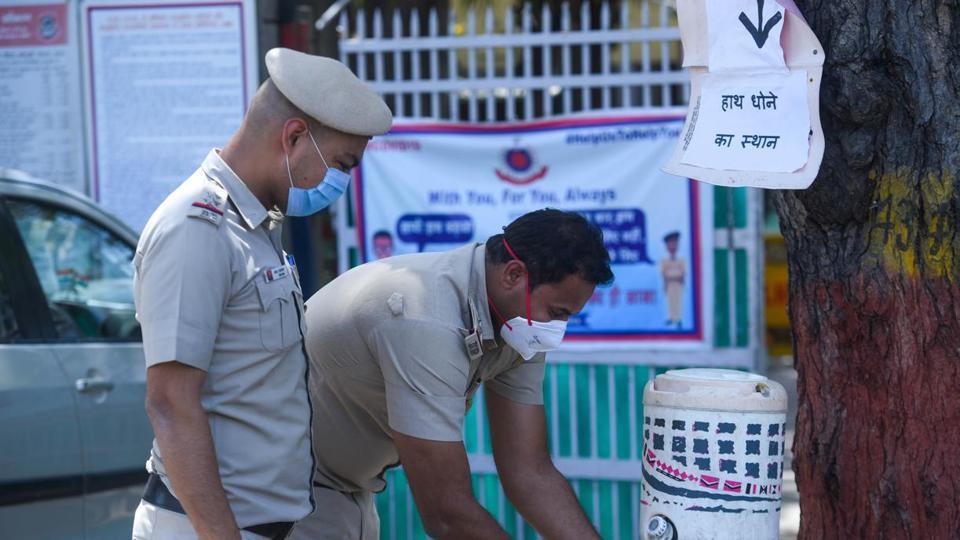
Perhaps Delhi’s situation can be best described by a viral photograph on social media, which shows a policeman with a sanitiser bottle placed in his holster instead of a gun.
Police say criminals are also wary of Covid-19 and have suddenly gone incognito. Last week, the video of a group of alleged gangster inside Tihar was widely circulated in social media, in which they are heard complaining about cleanliness inside the prison. The prisoners were heard talking about how scared they were of Covid-19.
While Delhi’s criminals seem to be homebound in this lockdown period, police personnel across the city are now working to feed the hungry and the homeless. The police helpline – 011 23469526—for Covid-19 requests has received 474 calls from people who said they were starving and had no money.
The police control room vans, which are the first respondents to crime, are also doubling up as ambulances. Since March 23, the police vehicles have rushed at least 143 pregnant women to hospital.
Additional commissioner of police MS Randhawa, who is the police’s spokesperson, admitted that incidence of crime had come down drastically. The officer said police are focusing on feeding the hungry and transporting people to hospital.
“Our officers are on the roads across the city to ensure the lockdown. Crimes have definitely come down. At every police station, our officers are working to feed the hungry citizens. Our officers have tied up with NGOs and Good Samaritans and are feeding the underprivileged every day. We will also ensure that the low crime rate remains the same in the days to come,” he said.


