
 E-Paper



Karnataka elections: What polls mean for the Congress and the BJP
Which way is the wind blowing in Karnataka? State votes Saturday and results will be out on May 15.


Karnataka began voting at 7 on Saturday morning to elect 222 legislators to the state assembly in a keenly watched election that has national significance. The state has 224 seats, but election has been postponed in south Bengaluru’s Jayanagar after the BJP candidate died and in the city’s RR Nagar, where more than 9,000 voter ID cards were seized from an apartment on Tuesday.
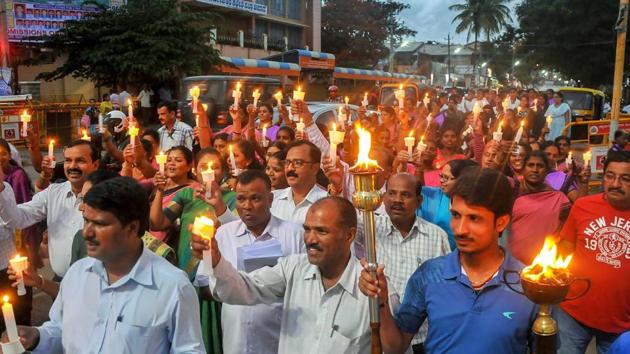
The Bharatiya Janata Party (BJP) treats every election as a life-and-death mission, but even allowing for that, the interest in the elections in a state which has, for the past 22 years, has always had a party other than the one in power in New Delhi, does seem disproportionate.
There are reasons for such interest though.
For the Congress, Karnataka is the last major state outside Punjab where it is in power. Prime Minister Narendra Modi has been taunting it, saying it will become a PPP party (Punjab, Puducherry and Parivar) and that the Karnataka is currently being used as an ATM. For the Grand Old Party of India, a win here would be a shot of confidence ahead of upcoming battles in Madhya Pradesh, Chhattisgarh and Rajasthan later in the year, apart from the big prize of the general elections in 2019. The importance of Karnataka can be gauged by the fact that even United Progressive Alliance (UPA) chairperson Sonia Gandhi has hit the campaign trail after a two-year hiatus.
The BJP is attempting to snatch the last large prize in the Congress’s kitty. After falling out with N Chandrababu Naidu in Andhra Pradesh, it will be hoping that a win in Karnataka will serve as a gateway to its southern ambitions. It will also want to send a message to both opponents and allies who might be sitting on the fence ahead of 2019 that it is still the pre-eminent national party.
The Janata Dal (Secular) led by former prime minister HD Deve Gowda knows it has no real chance of forming a government of its own and is hoping for a hung house, which would allow it to extract its pound of flesh.
While it’s hazardous to guess what counting day (May 15) will hold, there are some very interesting issues that the campaign has highlighted.
No anti-incumbency, no wave
It is clear that the Siddaramaiah government has no serious anti-incumbency baggage. There is no large visible wave, either, for or against the government. While Modi has called it a 10% government (implying a cut off everything), Siddaramaiah’s government has managed to get by five years without a major scandal.
However, agrarian distress, controversies over sharing of waters of the Cauvery and Mahadayi, unemployment, poor infrastructure (especially in Bengaluru), lack of health facilities and housing, and Kannada identity remain key issues on the ground. Then there are factors such as caste and religion – never far away from any Indian election.
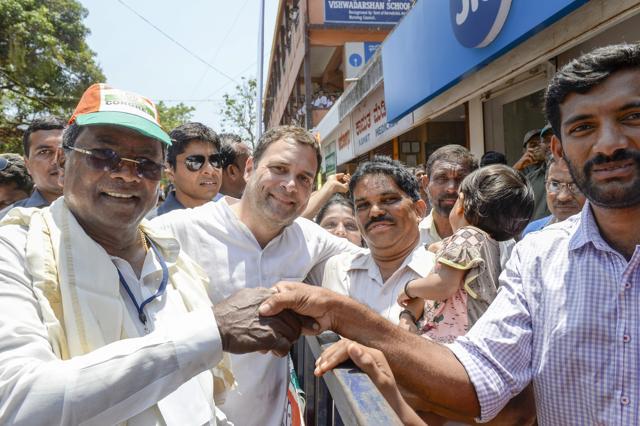
A seasoned politician, the chief minister who was considered to be somewhat somnolent in the first three years of his administration, has been hyperactive in the last two. He unleashed a series of “bhagyas” (benefits) such as ‘Anna Bhagya’ (rice at R1 per kg), Shaadi Bhagyaa, Anila Bhagya (Gas connection at subsidised price) and populist interventions such as the Indira canteens to serve affordable food. Siddaramaiah may have the mien of being a rural politician, but not many outside the state are aware that he has presented a record 13 budgets and thus knows how to balance the state’s fiscal needs very well.
Siddaramaiah must also thank his stars. After three years of successive drought, the state received normal rainfall in most parts last year, abating rural distress to some extent. He also waived off farmer loans taken from cooperative banks amounting to Rs 8165 crore, adding to the rural feel-good factor.

Lingayat factor
In what might turn out to be either a masterstroke or a massive mistake, in order to weaken the BJP’s social coalition, the state government recognised Lingayatism as a minority religion just ahead of the elections. It also recommended that the Centre recognise it as such and confer benefits given to other minorities. This has put the BJP in a spot: the Veerashaiva – Lingayats, accounting for around 15% of the state’s population are seen to be its main support base. It can publicly neither oppose nor support this move.
Even in ticket distribution, Siddaramaiah has had his say. Surprisingly the Congress this time around has had much lesser internal rebellion on choices of candidates compared to the more “disciplined” BJP. Siddaramaiah has also unleashed a new found aggression both on social media and on the campaign trail which has caught BJP by surprise. For every punch landed, he has returned the favour twice, even threatening to slap a R100 crore defamation suit on the PM and the BJP president.
Interestingly, unlike in Gujarat, where Congress president Rahul Gandhi led from the front, in Karnataka he has played a more supporting role, letting Siddaramaiah who has local connect, take centre stage. The Congress pitch has been that it has walked the talk by fulfilling 90% of promises in its last manifesto and is going to elections under the slogan ‘Karnatakada Hemme, Congress Mathomme’ (Karnataka’s pride, give Congress a chance again).
Amit Shah’s game plan: Yeddy, Reddy and Modi
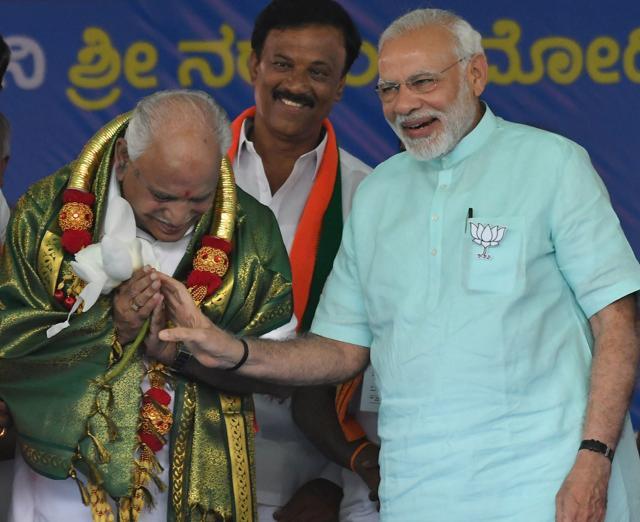
Like in most elections, BJP president Amit Shah has taken charge of the campaign in the state. BS Yeddyurappa may have rebelled and parted with the BJP in 2013, forming a breakaway party Karnataka Janata Party, but he came back in 2014; he is still the most popular face in the BJP. Yeddyurappa, though, has been unhappy because he hasn’t called all the shots. He has been unable to get even his son Vijayendra and close aides such as Shobha Karandlaje tickets to contest elections. Some of those who have missed out have rebelled. For instance, SK Bellubi and Thippeswamy are either contesting from other parties or as independents, damaging the BJP’s chances.
Shah, though, has been relentlessly touring the state visiting heads of influential mutts and interacting with religious leaders, to counter the division in Lingayat votes. After a two month break when Modi did not visit the state, Shah convinced the party’s most popular face to do a series of rallies in the last week of the campaign. Shah seems to be quietly confident that the party will at least get a simple majority. The number of rallies to be addressed by the PM was increased from 15 to 21 indicating either that Shah felt Modi’s speeches were required to push the party closer to halfway mark or was buoyed by the response and hoping it to increase further.
Interestingly, despite its campaign around “corruption free” administration, the BJP has given tickets to nearly eight family-members or close associates of Janardhana Reddy, the tainted mining baron who is out on bail. While Shah has publicly distanced the BJP from Reddy, his party men have been merrily using the latter’s clout and services to garner votes. The Sangh parivar, which has clout in the state, especially in the coastal region has also become very active. Few would discount Shah’s ability to strategise. BJP has been asking ‘Sarkara Badalise, BJP Gellisi” (change the government, ensure win for BJP).
Janata Dal (Secular): Kingmaker or king?
Sustaining a regional force in a state with heavy presence of two national parties is not an easy task. However Deve Gowda and his son and former CM H D Kumaraswamy have managed to do it, primarily on the fact that Vokkaligas, the second-largest community in the state spread over the Old Mysuru region, have largely been loyal backers of the party.
Having been out of power for a decade, JD (S) has been constrained in terms of resources but still packs enough punch to win about 10-20% of seats in the state. The best case scenario for the party is where both Congress and BJP lack a majority and are dependent on it to make numbers. If it crosses 50 seats, it will demand the CM’s chair or at least the chair by rotation, an arrangement it had with the BJP earlier.
What is the likely outcome?
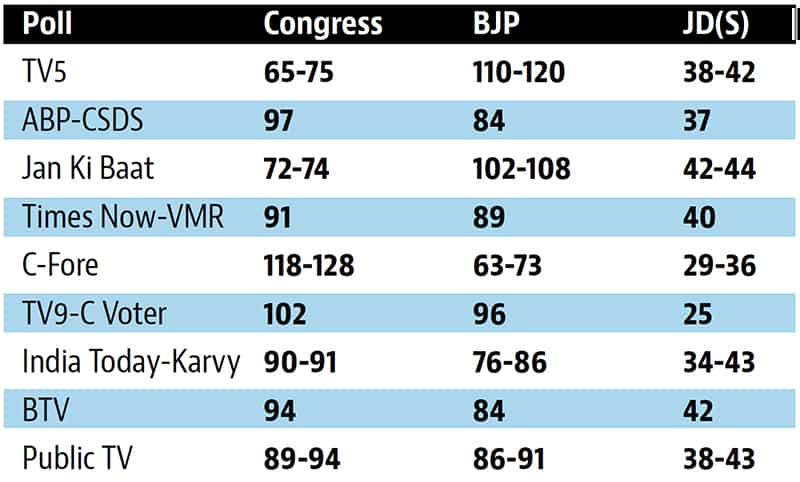
Opinion polls have margins of error and have notoriously gone wrong in the past. But of the eight polls done by well-known agencies till now, four indicate a hung house, three indicate Congress having a majority and only one gives the BJP a majority of its own. Whether this will change based on Modi’s last-week blitz will be revealed on May 15. History is against Siddaramaiah though. The last time a state government was re-elected was in 1985.


