E-Paper



Local residents tie ‘raksha sutras’, pray for old-growth Deodar trees near Uttarakhand’s Harsil
Villagers, environmental activists, political leaders tied raksha sutras — a thread that symbolises protection — to old-growth Deodar trees near Harsil in the upper reaches of Bhagirathi eco-sensitive zone (ESZ) to save them from the axe

 Prefer HTon Google


Villagers, environmental activists, political leaders tied raksha sutras — a thread that symbolises protection — to old-growth Deodar trees near Harsil in the upper reaches of Bhagirathi eco-sensitive zone (ESZ) to save them from the axe. These trees are likely to be cleared for the expansion of the 20.6-km Char Dham route between Bhaironghati to Jhala in Uttar Kashi district, people familiar with the matter said.
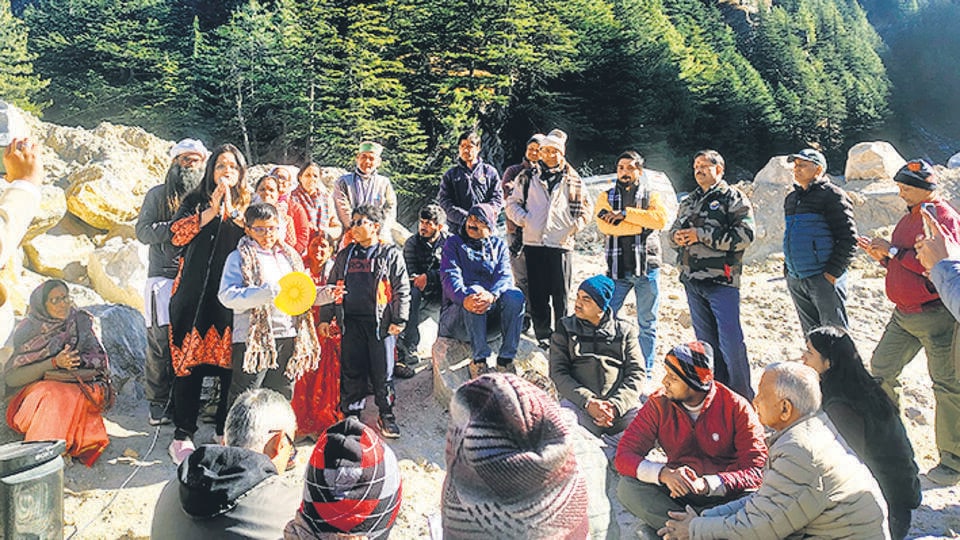
Local residents sang Garhwali songs about saving the mountains and forests, before tying rakhis to the trees and holding a Deodar pooja for the trees likely to be cut.
HT reported on Friday that around 6,000 Deodar trees have been marked on the Char Dham stretch for felling after the Uttarakhand government gave its nod for the route’s widening, people aware of the details said. Around 6,000 deodar trees have been marked on the stretch for felling, according to local residents.
According to a letter by head of forest forces, Uttarakhand, the stretch will involve the loss of 41.92 hectares of forest area, which includes several Deodar trees.
In a letter dated November 12 to the nodal officer, Uttarakhand, forest land, the HOFF (Uttarakhand head of forest forces) said that the road widening is “strategically important for national security.”
The project, hence, has been considered under section 1A, sub-section (2)(c) of the Forest (Conservation and Augmentation) Act, 1980 (as amended in 2023) –– which exempts strategic linear projects, situated within a distance of 100km along international borders or Line of Control or Line of Actual Control, from forest clearance, the letter said.
“If a project is declared strategic by the ministry of defence or the ministry of home, the state has the authority to approve diversion of land. Since this stretch is in the Bhagirathi ESZ, there is also a monitoring committee constituted by the ministry of environment, forest and climate change (MoEFCC). They have also considered this project and it has received approval following these deliberations,” said a senior official, who was involved in the clearance process, on condition of anonymity.
Environment groups opposing the proposed road widening have announced a march to protest against the state-level clearance. Local groups have organised a yatra on Saturday from Delhi and Rishikesh up to Uttarkashi, Bhaironghati and Harsil, where public gatherings will be held to discuss their concerns over the project.
“First of all, I want to tell you two things: it is said that the development being carried out in this country, Uttarakhand, is being done with security in mind. I want to say that we do not differentiate between development and security, but we should keep in mind that if the Himalayas are not safe, then no development is safe. Where will you develop if the Himalayas themselves are not safe? The security of development, the security of the country, and the security of the environment are all interconnected with the security of the country’s economy and the security of its agriculture. You cannot separate them. None of our programs are against the security of the country; rather, we want the country to be secure, and for that, the Himalayas must be secure,” said former Union minister and veteran BJP leader, Murli Manohar Joshi who attended the protest virtually.
“The Himalayas are the greatest symbol of our country; they are the very identity of India. Those who respect the culture of this country, those who call themselves Sanatani, their foremost duty becomes to protect these regions, to protect the sacred Ganges, to protect these sacred trees, so that the Himalayas remain safe. If the Himalayas are safe, we are safe. If the Himalayas are healthy, we are healthy. We exist because the Himalayas are above us,” he added. Members of Swadeshi Jagran Manch and Rashtriya Swayamsevak Sangh also attended the yatra. “Tying Raksha Sutra to the Deodar trees is symbolic of the resolve by the citizens for the protection and conservation of our culture, and the ecology of this highly fragile and vulnerable area,” said Mallika Bhanot, environmentalist and member of Ganga Ahvaan, a civil society collective.