
 E-Paper



Lok Sabha election 2019| Rural voters: Not spoilt for choice
During campaigns, many residents in these constituencies had complained of the absence of farmer issues in the agenda of political parties.


Delhi Police head constable Varsha Yadav, who was stationed at a polling station in west Delhi’s Deenpur village for the sixth phase voting of the Lok Sabha elections on Sunday, said voters had lined up outside the station even before the gates were opened at 6am.
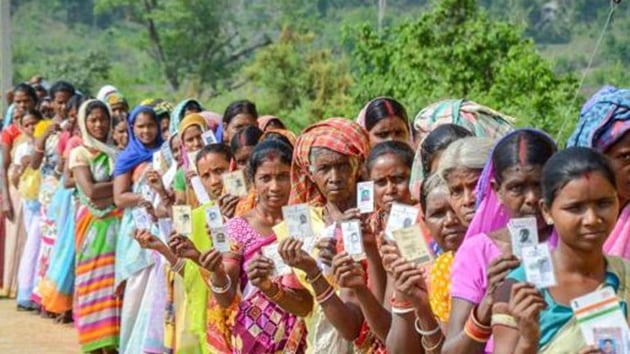
There was no let up in the number of people turning up to vote after that, she said.
“We thought that around afternoon people will stop coming because of the heat. However, even around 2-3 pm voters kept coming in,” Yadav said.
During campaigns, many residents in these constituencies had complained of the absence of farmer issues in the agenda of political parties.
However, at the polling stations, farmers were heard talking about the “greater interest of the country”.
When asked, many farmers said “lack of options” with respect to farmer-friendly manifestos had left them with no choice but to pick from the “better” candidate from the available lot.
In many villages around Najafgarh, voters were seen flocking to their respective polling stations. Most men were in dhoti kurtas while women in salwar kameez, with a ghunghat covering their faces.
“We had a woman official at the booths to check the identity cards of women voters so that women who insisted in covering their faces would feel comfortable,” a polling official at the Shyam Vihar polling station said.
For many in these areas, national security and the recent military strikes by the Indian Army were key issues while casting their vote.
For others, however, local issues mattered more.
The rural portion of the north-west Delhi constituency comprises around 85 villages mainly in Bawana, Badli, Mundka, Narela and Nagloi Jat.
The rural belt, dominated by Jat villages, voted on issues ranging from lack of hospitals and higher education institutes and unemployment to poor connectivity with urban areas and inflated tube well bills.
Umed Singh, 93, a resident of Salahpur Majra Dabas village said that though national security was an important issue, problems such as employment and lack of hospitals should not be forgotten.
“Hospitals and higher education institutes should be constructed in rural areas. Villagers have to travel at least 12 km for medical treatment. Similarly, students, especially girls, have to go as far as Alipur and Bawana to get higher education. We want the new MP to address these burning issues,” Singh said.
Kamla Chhikara, a resident of Jaunti village, which was adopted by sitting MP Udit Raj, said she hoped the new MP would pay attention to the sanitation and inflated tube well bills.
“For the last one year we have been getting inflated tube well bills. We have requested the government to address the issue but to no avail. The drains of the village are not regularly cleaned as sanitation staff often remains on strike,” she said.
In south Delhi, where the rural belt largely comes under assembly segments of Chhatarpur and Badarpur, a large number of voters said that they voted in hope of better public transport.
“Our address reflects that we are residents of Delhi, but practically it is not so. The way we live is quite different from that of the rest of the city and lack of transport has played a major role in that. There are not adequate bus routes which connect the city with villages. It is a big problem for people who do not own vehicles,” 28-year-old Jyoti Rawat, a resident of Mithapur village in Badarpur, said.


