
 E-Paper



Lok Sabha elections in 7 phases; voting starts April 19, results on Jun 4
In 2019, the Lok Sabha poll schedule was announced on March 10 and the polling was held across seven phases beginning April 11

 Prefer HTon Google


The world’s largest democratic exercise—the Lok Sabha elections in India —will be held across seven phases from April 19 to June 1 while balloting for Andhra Pradesh, Sikkim, Arunachal Pradesh, and Odisha assemblies will take place on April 19 and May 13, the Election Commission of India (ECI) announced on Saturday. The results will be announced on June 4.
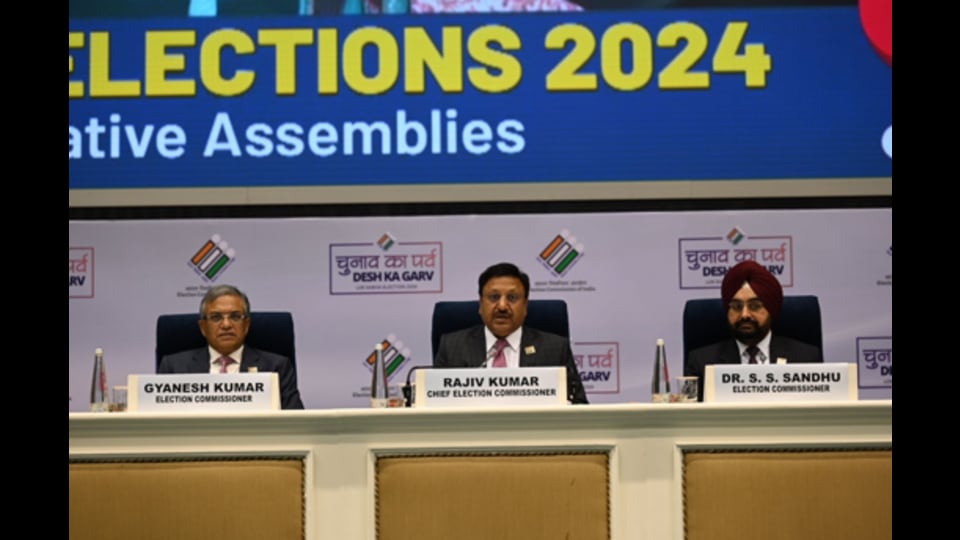
“After assessment in all states, we are confident of ensuring a memorable, independent and impartial polls,” chief election commissioner Rajiv Kumar said at a press briefing that was livestreamed on social media platforms of ECI. He said they were determined to tackle the use of muscle, money, misinformation and violations of the poll code.
Prime Minister Narendra Modi said the Bharatiya Janata Party (BJP) and the National Democratic Alliance (NDA) were fully prepared for elections. He added they were going to the people based on their track record of good governance and service delivery across sectors. He called the Opposition rudderless and issueless. “All they can do is abuse us and practice vote bank politics. Their dynastic approach and attempts to divide society are not being accepted. Equally hurting them is their corruption track record. People don’t want such leadership.”
BJP chief JP Nadda urged people to vote in record numbers and strengthen the foundation of the world’s largest democracy. “I welcome the announcement of Lok Sabha elections 2024 by the Election Commission. Elections are the biggest festival of democracy. It is a medium to keep the country and the state moving on the path of development and good governance,” Nadda wrote on X.
“Under the leadership of respected Prime Minister Shri @narendramodi ji, BJP will form the government with an overwhelming majority and will work with determination to fulfil the aspirations of the people for the next 5 years.”
The 18th Lok Sabha has to be constituted before June 16, when the term of the current House ends. The terms of the assemblies in Andhra Pradesh, Sikkim, Arunachal Pradesh, and Odisha will also end in June.
The BJP returned to power in 2019 with a bigger majority of 303 seats in the 543-member Lok Sabha in 2019. The Congress got 52 seats. The BJP has set a target of 370 seats and 400 for the NDA it leads on the back of welfare politics, development, and Hindutva plank.
If voted back to power, Modi, who on Friday sought suggestions from people for shaping his “Viksit Bharat” (developed India) agenda, will be India’s first head of government since Jawaharlal Nehru to get three consecutive terms.
Former allies have returned to the NDA ahead of the polls, as the BJP looks to defend its fortress in northern India and make inroads in eastern and southern India.
The Opposition’s Indian National Democratic Inclusive Alliance (INDIA) hopes to cut into the BJP’s electoral track record and broad social coalition.
The schedule was announced two days after the President appointed retired bureaucrats Gyanesh Kumar and Sukhbir Singh Sandhu as election commissioners.
The Prime Minister-led selection committee named the commissioners for the first time under a new law a day before the Supreme Court on Friday refused to stay the appointments and said it would hear the challenge to the legislation.
In 2019, the Lok Sabha poll schedule was announced on March 10. The polling was held in seven phases beginning on April 11, and the votes were counted on May 23.
A turnout of 67%, the highest since the first election in 1951-52, was recorded in 2019. The first election process in independent India in 1951 was a months-long process that spilled over into 1952. The turnout was just 45% as the authorities struggled to reach remote areas in a country where the vast majority of the electorate was illiterate.
The women’s turnout in 2019 outstripped that of men — 67.18% to 67.01%— for the first time.
Nearly 970 million people are eligible to vote at over 1.2 million polling stations for the 2024 Lok Sabha polls. The number is almost four times the number of voters in the US, the world’s second-next-largest democracy. The number of voters in India is also more than Europe’s population.
A total of 26.3 million new electors have been added ahead of the 2024 national polls. Around 14.1 million new women voters surpassed the newly enrolled male voters (12.2 million) by 15%. The number of third-gender voters has increased from 39,680 in 2014 to a little over 48,000.
Over 20 million young electors in the 18-19 and 20-29 age groups were added to the electoral rolls. At least 18.5 million voters were above 80. The number of centenarians (those who are 100 and above) stood at 238,000.
Uttar Pradesh had the maximum number of voters at 153 million as of February 8 and Lakshadweep had the lowest — 57,000.


