E-Paper



Coronavirus update: Migrants must be screened for Covid-19, Centre tells states
The Centre on Sunday issued a formal order directing state governments and Union Territories (UT) administrations to effectively seal state and district borders to stop the movement of migrant workers during the 21-day lockdown period ending April 14.

 Prefer HTon Google


All migrant workers-- either homebound or staying at a state-run shelter in the cities- must be screened for the coronavirus disease (Covid-19), the Centre has told directed state governments, and those who have already left the cities for their home state will serve a mandatory 14 days in quarantine at their destinations.
The workers will be screened and quarantined on the basis of their risk score, calculated on the basis of their age, co-morbid conditions and history of contact with people who may have travelled abroad or may be Covid-19 patients or suspected to be carrying the virus.
“Like we did passenger screening at the airports, similarly we will also do risk profiling of these migrant workers. Depending on the risk score, they will be accordingly quarantined,” Lav Aggarwal, joint secretary, Union health ministry, said at a press conference.
“Directions have been given to all states in this regard,” he added.
The Centre on Sunday issued a formal order directing state governments and Union Territories (UT) administrations to effectively seal state and district borders to stop the movement of migrant workers during the 21-day lockdown period ending April 14.
Cabinet secretary Rajiv Gauba and Union home secretary Ajay Bhalla, during a video conference, asked chief secretaries and directors-general of police (DGPs) to ensure there is no movement of people across cities or on highways when the lockdown is in force. And the states have been directed to, accordingly, make arrangements for the food, shelter and other necessities of migrant workers.
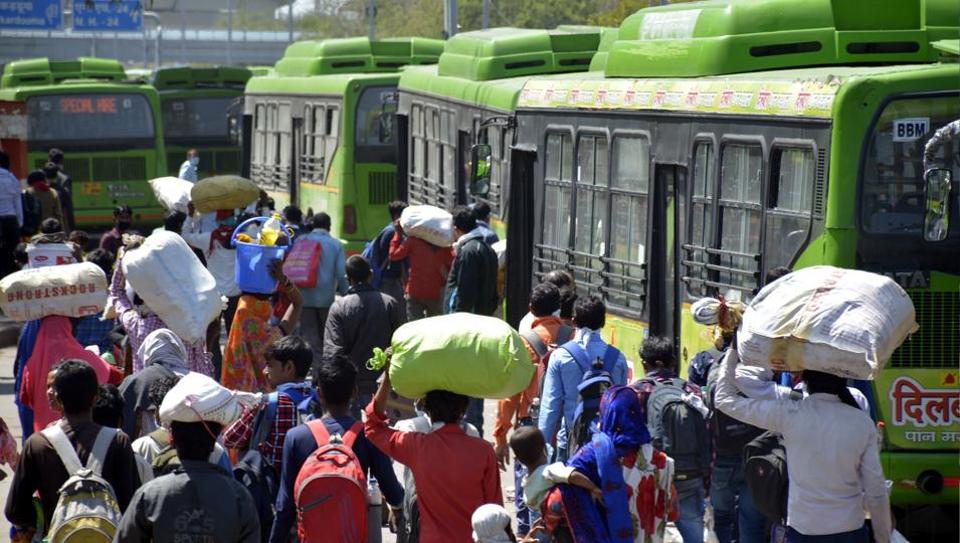
In the absence of a source of income, and landlords evicting them, thousands of migrant workers have been moving across borders on foot towards their hometowns. Most of them could be seen carrying children on their shoulders and even elderly parents on their backs. Many hadn’t had a full meal in days, largely surviving on food distributed by good Samaritans.
“Only goods vehicle should be moving across borders; no migrant worker should be on the roads. There have been special arrangements suggested for migrant workers that the states and UTs will have to follow,” said Punya Salila Srivastava, joint secretary, home ministry.
District magistrates and superintendents of police have also been directed to look into the issue and make adequate arrangements for implementation of these directions by the central government.
“Government is taking all possible measures to handle this issue. Directions have been issued to the states to provide food and shelter to the stranded migrant workers, and those who have already left for their home states will have to be placed under a minimum of 14 days’ quarantine at the point of destination under standard healthcare protocol,” she added.