
 E-Paper



HT’s journey can help us build Viksit Bharat, says PM Modi at HTLS
At the centenary celebrations of Hindustan Times, PM Modi reflects on the media institution’s 100-year legacy and lays out his vision for a developed India

 Prefer HTon Google


The journey of 100 years traversed by Hindustan Times is historic and this experience can help build a developed India, Prime Minister Narendra Modi said on Saturday as he released a commemorative postage stamp to mark the occasion and showcased his road map to imprint India’s stamp on the 21st century.
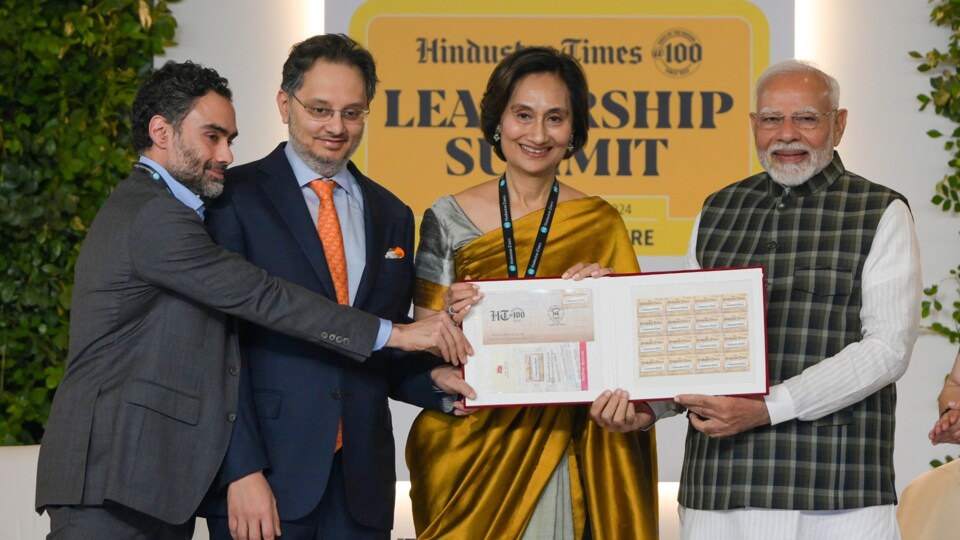
Delivering the inaugural address at the 22nd Hindustan Times Leadership Summit, Modi hailed the newspaper — it was inaugurated by Mahatma Gandhi on September 15, 1924 to become the voice of the freedom movement — and underlined that the capacity and sagacity of the ordinary citizen of India has propelled the country’s extraordinary journey over the last century.
“A 100 years ago, respected Bapu [as Gandhi was known to his followers] inaugurated HT. He spoke the Gujarati language. After 100 years, you have called another Gujarati… the journey of a 100 years is very long. All of you are deserving of praise and I wish you the best for the future,” Modi said.
“Completing the journey of a 100 years is a historic accomplishment. I congratulate everyone who has been a part of his enterprise, who fought adversity and endured,” he added.
In his address, the Prime Minister spoke about the National Democratic Alliance (NDA) government’s record in delivering public goods and welfare benefits, eschewing vote bank politics, restoring public confidence in governance, and giving the administration a higher purpose – attaining developed country status by the centenary of India’s independence, August 15, 1947.
He also spoke about his government’s mantra – of investment to employment, development to dignity, and of spending big on the people and saving big for the people. He urged Indians to transform the social mindset and not accept anything other than world-class standards.
“This approach has to be relentlessly maintained among the public. And HT has a big role to play in this mission. Your experience of a 100 years will be of great use in making India a developed country,” the PM said.
Modi released a commemorative postage stamp, depicting HT’s journey from 1924 to 2024 through two editions of the newspaper – the 1924 edition in the background and the 2024 in the foreground, with its ethos “First Voice, Last Word” displayed prominently.
“I thank the Prime Minister from the bottom of my heart for releasing the commemorate postage stamp. This is a milestone in our long journey, and we know that our mission is far from over,” said HT Media Limited chairperson and Hindustan Times editorial director Shobhana Bhartia.
Run out of a two-storey building in the now-extinct Burn Bastion Road in central Delhi, HT was financed with money pooled in by freedom fighters Lala Lajpat Rai and Madan Mohan Malviya, before industrialist GD Birla stepped in on Gandhi’s request in 1927.
Its longest-serving editor was Gandhi’s son Devadas Gandhi who gave space to freedom stalwarts such as Jawaharlal Nehru and Subhas Chandra Bose and global icons such as Martin Luther King Jr to write for the paper. Over the last century, HT transformed from a chronicler of the freedom movement to a witness in India’s global rise.
Many of these landmarks were showcased at a special exhibition curated at the 22nd HT Leadership Summit.
“I saw the splendid exhibition, which was not just an exhibition but an experience. It felt like the history of a 100 years were in front of my eyes,” the PM said.
“I saw the editions printed on the day of independence and the day India became a republic. I noted the luminaries who wrote for HT, such as Martin Luther King Jr, Babu Subhas Chandra Bose, Syama Prasad Mookerjee, Atal Bihari Vajpayee and MS Swaminathan,” he added.
Modi noted that he saw the editions on the day India achieved independence in 1947 and became a republic in 1950. He underlined the luminaries who wrote for HT – including Martin Luther King Jr (who wrote an ode to Gandhi on the latter’s 10th death anniversary in 1958), Netaji Subhas Chandra Bose (who wrote on diplomacy in a special edition in 1938), Syama Prasad Mookerjee (who wrote on the Constitution in 1950), MS Swaminathan (who wrote on the green revolution in 1968) and Atal Bihari Vajpayee (who wrote on independence in 1997).
“Their writing illuminated your newspaper. Truly, this has been a long and extraordinary journey – beginning from the battle of independence and the ocean of hope unlocked by freedom,” he said.
He mentioned some landmark editions to illustrate this journey.
The first was the edition dated October 28, 1947,which marked the accession of Kashmir to India. “Through your newspaper, I felt the energy of that day. But in that moment, I also felt how indecisiveness had hurled Kashmir into violence for seven decades. Today, when your newspaper reports about record voting in Jammu and Kashmir, it marks a contrast,” Modi said.
The second was the edition dated April 7, 1980,which marked the formation of the Bharatiya Janata Party (BJP). “On one side of the paper is Assam being declared a disturbed area, and the other side reported on Atal ji laying the foundation of the BJP. It is a matter of great pleasure that BJP has today succeeded in bringing lasting peace to Assam,” he said, illustrating the Bodoland Festival held in Delhi as a signifier of this new amity and prosperity. “The Bodo peace treaty has transformed their life.”
The third was the edition dated November 28, 2008, which reported on the 2008 Mumbai terror strikes. “This was a time when terrorism sponsored by the neighbouring country made our citizens feel insecure in their cities and homes. Today, the situation has changed. Those terrorists now feel insecure inside their homes,” he said.
The PM said that the 100-year journey was marked by 25 years of slavery under colonial rule and 75 years of freedom. “In these 100 years, the power that has built India’s fate and given the country direction is the capacity and sagacity of the ordinary citizen,” he added.
Using the figure of the ordinary citizen, Modi touched on milestones in India’s journey. He said big experts have often misunderstood and underestimated the strength of the ordinary citizen.
“When the British were leaving India , it was said that the country will fragment and had no future. When Emergency was imposed, some people thought it would continue in perpetuity and that democracy was over. But then, the ordinary citizen of India stood up and didn’t take long in uprooting Emergency,” he said.
“When Covid struck the world, everyone thought that India would become a global burden. But the ordinary citizen fought determinedly,” he said.
He referred to the turbulent 1990s when five general elections were held in a decade. “Imagine the instability in the country at the time. Newspaper columnists prophesied that this was the new normal. But the ordinary citizen proved them wrong.”
“Today when there is uncertainty and instability across the world, when many countries are seeing governments tumble every election, the people of India have chosen us for the third time.”
In his speech, he spoke about the National Democratic Alliance (NDA) government’s record in delivering public goods and welfare benefits, eschewing vote bank politics, restoring public confidence in governance, and giving the administration a higher purpose – attaining developed country status by 2047.
He also mentioned about his government’s mantra – of progressing from investment to employment, development to dignity, and of spending big on the people and saving big for the people. He urged Indians to transform the social mindset and not accept anything other than world-class standards – two things required to make the 21st century an Indian century.
“When India celebrates its centenary, you’ll be 125 years. At that time, HT might write – Viksit Bharat ka yeh shandar akhbar hai (This is the prestigious newspaper of a developed India). You’ll be a witness to this journey,” he added.
The PM hailed the contribution of HT as a newspaper, and held out suggestions for tangible steps that HT could take to contribute to wider nation building in the coming generations. He advised HT to sponsor students to delve deeper into the 100-year legacy and do their doctoral research on the subject, asked the paper to set up chairs and positions in universities that could boost an Indian point of view across the globe, and to digitise the exhibition for taking it to schools and new, young audiences.
“The journey of journalism in India will be illustrated by this work. It’ll be a great service,” he said.
“You have a great capital -- the trust and prestige you have earned over 100 years. I am sure it will be useful for the coming generations of India. I have full faith that you will take this journey forward.”


