
 E-Paper



‘Running on water’: PM's roadshows after 'save petrol' call spark reaction; markets spooked by 7 appeals amid Iran war
Framing austerity as patriotic duty amid US-Iran conflict in West Asia, PM Modi flagged rising crude oil prices and disruptions to global supply chains.

 Prefer HTon Google


Prime Minister Narendra Modi's Sunday appeal urging Indians to cut fuel consumption, avoid buying gold, and work from home wherever possible, predictably sparked a fierce political controversy. It also played a part in a sharp stock market fall on Monday, besides unleashing a wave of mockery on social media. Much of the mockery was centred on the stark contrast between his message of austerity and his own packed schedule of roadshows and convoys.
Speaking at a BJP rally in Hyderabad on May 10, Modi asked citizens to reduce petrol and diesel consumption, use metro services and carpool, shift to electric vehicles, work from home, postpone foreign travel, and avoid gold purchases for up to a year.
A shareable image titled “Modi 7 Appeals” with key points was quickly circulated by the government's and aligned social media handles.
What Modi said
Framing the austerity as a patriotic duty amid the ongoing US-Iran conflict in West Asia, he said rising crude oil prices and disruptions to global supply chains were placing severe pressure on India's foreign exchange reserves.
"We have to save foreign exchange by any means," he told the gathering, underlining that gold and petroleum products were paid for in dollars when imported.
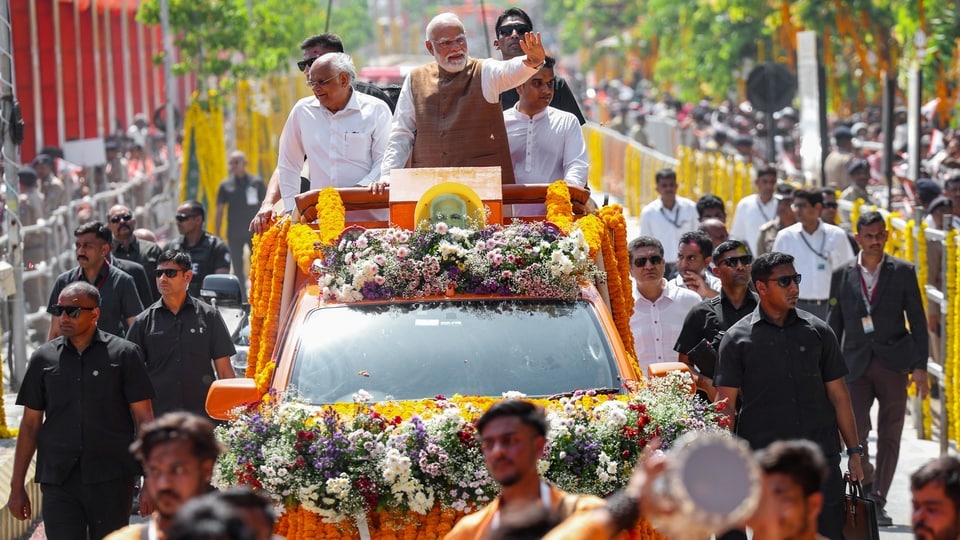
Within hours, the speech produced a spectacle on social media. Videos circulated of Modi leading a roadshow in Jamnagar, Gujarat, in an armoured SUV reportedly giving a low fuel average, surrounded by a convoy of dozens of vehicles. The scene arrived just two hours after his Hyderabad address, noted critics on X.
Roadshows soon after
By Monday, he had conducted roadshows in Somnath and was headed to Vadodara, making it three roadshows in 12 hours, noted other X users. In the five days prior to his speech, he had held five roadshows in total, including in Patna and Kolkata.
"Modi in Hyderabad: Save fuel, use metro, carpool, work from home; don't buy gold. Modi two hours later: Roadshow in Jamnagar in an armoured Range Rover-type SUV giving around 5 km/l, with a massive convoy behind him," wrote one X user (@sharma_views), whose post quickly went viral. Another user by the name Deepal Trivedi was more caustic in a post, “Modi ji's planes and convoys do not run on petrol or diesel. They run on water.”
Senior columnist and former Rajya Sabha MP Mrinal Pande asked in Hindi whether the vehicles in Modi's convoy were “running on cow urine or sugarcane juice”.
Another X user, Mohit Chauhan, noted that Modi had conducted over 40 public meetings and 10 roadshows with convoys of 100-plus cars, travelling by private planes and helicopters, over the preceding month alone.
The mockery deepened when it emerged that the Prime Minister is scheduled to depart on a seven-day overseas visit to the UAE, Sweden, the Netherlands, Norway and Italy on Friday — just four days after telling the public to avoid foreign travel for a year.
Opposition leaders were swift in their attacks too.
Political rivals say ‘worse is set to come’
"These are not words of counsel; they are proofs of failure," Congress leader Rahul Gandhi wrote on X.
"In 12 years (of his rule as PM), he's brought the country to such a pass that the public has to be told what to buy, what not to buy, where to go, where not to go. Running the country is no longer within the reach of a compromised PM," he wrote.
Congress comms incharge Jairam Ramesh read PM Modi's speech as a signal of worse to come.
"A phase of stringent cost-cutting measures, including a hike in fuel prices, may be on the horizon, and an atmosphere is being created to make them more acceptable," he said.
Samajwadi Party chief Akhilesh Yadav questioned why a “crisis” was been remembered only after the recent elections in four states and a UT were over.
"During the elections, BJP leaders took thousands of chartered flights. Were those planes flying on water?" he asked.
RJD leader Tejashwi Yadav offered a contrast too, noting on X that in the 2024 Lok Sabha campaign, Modi had accused the Opposition of planning to "snatch the mangalsutra" from Hindu women — a remark widely seen as defending traditional gold ownership — and was now asking those same citizens to stop buying it.
Meanwhile, in a more concrete development, a union representing IT workers wrote to the Union labour ministry on Monday seeking a mandatory government directive for companies to implement work from home.
The union pointed to the Covid-19 pandemic as proof that large-scale remote work was “practical, technologically feasible and operationally sustainable”.
But employment concerns were raised about the gold sector, as some social media users pointed out that over 4 million (49 lakh) people are employed in teh jewellery industry.
“This is not some emotional appeal. It is a calculated move. Brace up. It's a precursor to a steep increase in diesel and petrol prices,” posted another user.
Commercial LPG cylinder prices have already been hiked twice in the past two months. "Seems like the bubble is about to burst," wrote another user, "The harsh reality which was hidden for so many weeks is about to create havoc."
Matrket indices drop sharply
The stock market delivered its own verdict. On Monday, the BSE Sensex tumbled over 1,300 points — its steepest single-day fall since March — to close at 76,015. Jewellery stocks bore the brunt, and the rupee too hit another all-time closing low of 95.31 against the US dollar.
Analysts at Motilal Oswal and Geojit Investments both cited Modi's address alongside the global crude spike as a direct trigger for the sell-off. There was one silver lining: EV stocks rallied sharply.
"The cautious mood deepened after the PM's appeal to conserve energy and avoid non-essential foreign travel, prompting investors to reassess the economic impact of higher crude prices, rupee weakness, and pressure on the current account deficit," Vinod Nair, head of research at Geojit Investments Limited, said as per news agency PTI.
‘In the national interest’
BJP IT cell chief Amit Malviya pushed back against the criticism, arguing that Modi had not demanded sacrifice but had called for “conscious choices in the national interest”, drawing a comparison to Nehru's similar appeals during the Korean War.
Also Read | With Somnath temple and Nehru reference, PM slams Oppn's ‘appeasement’ politics
The Modi government has so far kept up the assertion that austerity is only a cautionary move and that India has “enough reserves” of fuel.
Union minister Giriraj Singh of the BJP, meanwhile, showed off his new EV in that context.
"Should the need arise, we should refrain from using diesel and petrol vehicles for at least one day a week; and instead of using PNG or LPG, we should start cooking on induction cooktops. We are doing this, and I urge you to do the same," he said.


