
 E-Paper



Museum dedicated to artist Achutan Ramachandran Nair to open in Kerala
On October 5, a museum with Ramachandran’s paintings, sculptures, and illustrations, as well as a few of his wife’s watercolours, will open to the public in Kerala’s Kollam district

 Prefer HTon Google


As early as 1972, Achutan Ramachandran Nair envisioned a modest museum run by him and his artist-wife, Tan Chameli, that would realise a long-held dream of a life dedicated to art. More than five decades on, a version of his vision has come true. On October 5, a museum with Ramachandran’s paintings, sculptures, and illustrations, as well as a few of his wife’s watercolours, will open to the public in Kerala’s Kollam district.
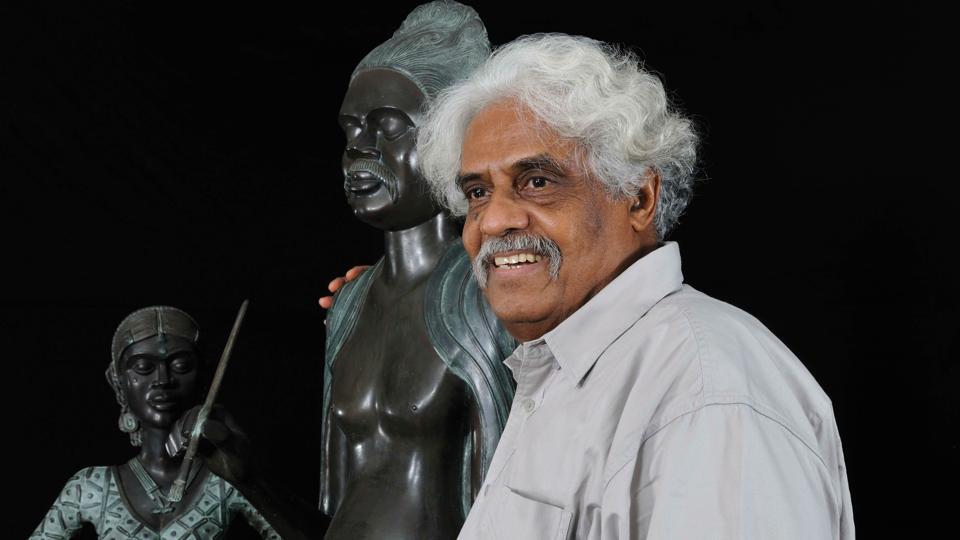
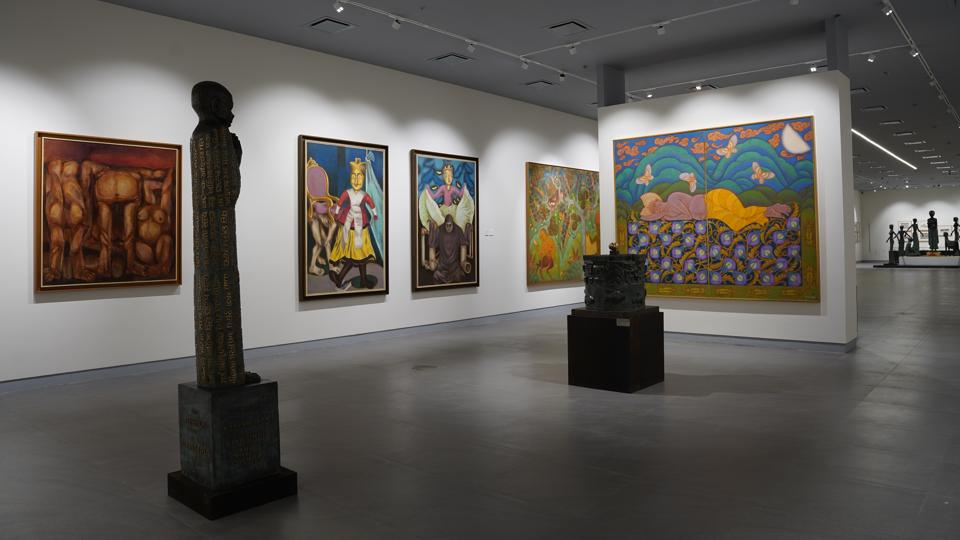
Housed in one of the buildings of the Sree Narayana Guru Cultural Complex, opened by the state government in 2023, the Ramachandran Museum will be run under the aegis of the Kerala Lalit Kala Akademi. It will also house artworks collected by the renowned artist over the years, along with some personal belongings and a recreation of his studio. Its emblem comes from Ramachandran’s 2002 oil on canvas, Song of the Simbul Tree.
The works on display represent key phases of his long career and comprise 12 oil paintings, including four monumental Lotus Ponds works; three sculptures, including one of three iconic bronze Gandhi pieces; original illustrations made for children’s books published nationally and internationally; and seven stamp designs commissioned by the Department of Posts (formerly Post and Telegraph Department), including one for the 50th anniversary of the 1930 Dandi March. It will also showcase his and Chameli’s collection of Rajasthani miniatures, mostly from Nathdwara, and oil paintings of the Raja Ravi Varma school from Kerala.
Shortly before he died in February 2024, the 89-year-old artist expressed his desire to donate a number of his works in a handwritten letter to Kerala chief minister Pinarayi Vijayan.
“Around two years ago, after the third attack of the coronavirus, my husband’s health deteriorated very badly. He was bedridden for a long time. His old friend M.A. Baby, the General Secretary of Communist Party of India (Marxist), came over for a visit and proposed a museum of his works in Kerala. That’s when [Ramachandran and I] sat down and decided what body of work should we give to the museum. He told me that he would like me to donate 10 of my watercolours too, but I was not sure at first. He told me that I had been very important for his creative life, so it was necessary to have my works there too,” Chameli Ramachandran said.
Trained at Santiniketan, West Bengal, under Benodebehari Mukherjee and Nandalal Bose — who introduced him to the art of Asia and its aesthetics — and influenced by the sculptures of Ramkinkar Baij, as well as a host of progressive writers and musicians during his early years in Kerala, Ramachandran moved to New Delhi in 1964 and taught at Jamia Millia Islamia for 27 years.
Santiniketan had a profound impact on him, Professor R. Siva Kumar, who has curated the collection in the upcoming museum, said. “It taught him that art can have an impact on society in more subtle ways. There was more to art than powerful personal expression or social commentary.”
It is also where he met his future wife, whose father was eminent Chinese scholar Tan Yun-Shan, who opened the Department of Chinese Studies in Santiniketan at the behest of its founder Rabindranath Tagore. Tan Chameli herself studied art and trained under masters like Mukherjee and Baij. After marrying A. Ramachandran, she did not practice her own art until the early 1990s, when she took up Chinese ink and brush. She did, however, collaborate with her husband in writing and illustrating children’s books, which were published in India, Japan, Korea, and England.
Ramachandran was first recognised as a strong new voice in the art scene with Encounter, a 24-ft-wide painting depicting the human body as stark opposites — as much meat as the Vitruvian Man — which he completed in 1967. However, his artistic career spanned several styles and mediums.
In the mid-1970s, he dipped into literature and mythology, and his works took the form of political satires in which the absurd turned surreal. He made etchings like The End of the Yadavas (1979) and Khushiyon ka Bagh (1981), inspired by writers like Saadat Hasan Manto and Anwar Sajaad, respectively.
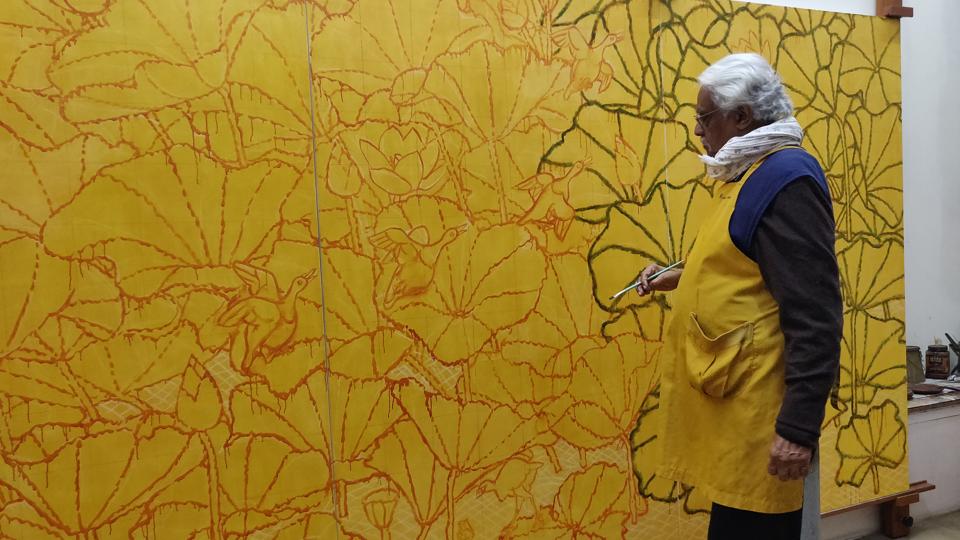
In the 1980s, his efforts to create a language “influenced by an eclectic mix of Indian traditions in painting and sculpture — figures from Ajanta murals, decorative flora from Hoysala sculptures, and the vibrant colour palette of Malwa miniatures” saw an early form in Yayati, which Ramachandran began in 1984. The artist once wrote that Yayati was a turning point in his work because it compelled him to incorporate elements of classical proportions and postures. His Lotus Pond works — four of which will be shown in the museum — can be considered the apogee of this stylistic practice.
“Indeed, this move from existentialist expressionism to mythological reimagination and social satire also spanned the trajectory of several Malayalam writers of the period, including his friends G. Aravindan and C. N. Sreekantan Nair,” Siva Kumar added.
This was also the period when Ramachandran turned to ceramics — a set of nine rare experimentations will be on display at the new museum — and even tried his hand at miniatures.
Political events played an important role in Ramachandran’s artistic responses. However, the 1984 anti-Sikh riots had a profound impact on him, Siva Kumar said.
“In a society where people were immune to violence, trying to fight violence with images of violence was meaningless,” the curator said.
The artist began his peregrinations in rural parts of India, visiting villages in Rajasthan, such as the Bhil villages of Pai and Undri, sketching residents, and returning to nature to draw from life anew. In the 1990s, he began making single-figure sculptures and life-size sculptural assemblages. One such assemblage, titled In Trance, which depicts a central figure modelled on himself, will be showcased at the museum.
Critics have long debated whether to call Ramachandran a modernist. According to some, his turn towards Indian and Asian antecedents — even Mexican sculptors and other non-Western traditions and mythologies — seemed diametrically opposite to Western modernism. However, Siva Kumar argues that while Ramachandran accepted modern values like rationalism, secularism, and scientific temperament, he also questioned the irrefutable validity of Western modernism.
His iconisation of Mahatma Gandhi, who stood as a symbol of non-violence, is one of the ways in which Ramachandran responded to the political events of his time. He created a large mural for Gandhi Darshan in 1969, made a stamp to commemorate the Dandi March — which the Mahatma led to break the colonial salt laws — and later created three bronze statues depicting the Mahatma. One of them, which will be on display at the museum, shows the Mahatma wearing a shawl inscribed with the words satya ahimsa (truth, non-violence) in multiple Indian languages. As late as 2020, he was also making ink-on-paper sketches of Gandhi. Some of these works will be on display too.
“He was a critical insider who interrogated modernism based on his Indian experience rather than an anti-modernist or traditionalist artist,” Siva Kumar said.
Ramachandran was awarded the Padma Bhushan in 2005.


