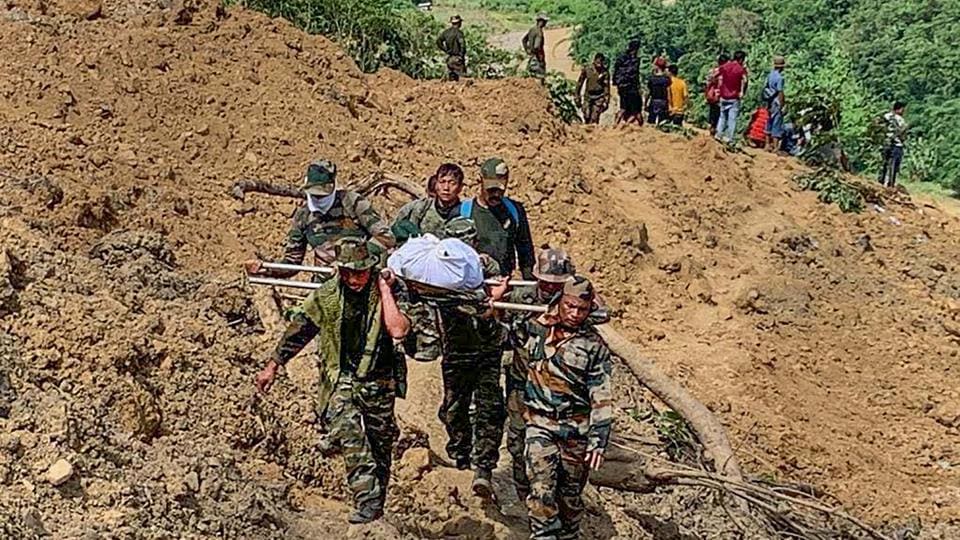
Last week’s devastating landslide in the Noney district of Manipur, which claimed nearly 50 lives, has raised questions about whether the disaster that took place close to a railway construction site was a natural one or caused by human activity in the region’s topography. The landslide in Noney took place at Tupul. It is part of the 111 km railway line project aimed at connecting Jiribam in Manipur to the state capital, Imphal.
The search operation for the survivors of the massive landslide in Manipur’s Noney district. (PTI)
The landslide, said to be the first of such magnitude in the state’s history, hit the railway construction camp at Marangching part 5 areas, about 75 km west of the state capital, on midnight of June 29. It also struck a camp of Territorial Army (TA) camps of the Indian Army deployed in the area for protecting the construction site. Most of the deaths have been of TA personnel and construction workers staying in the area.
While landslides induced by heavy rainfall during the monsoon season are a common occurrence in Manipur and other hilly areas in the Northeast, there’s a possibility that increased construction works such as the widening of roads, laying down of new railway tracks, and other activities could play a role in the frequency and nature of these landslides.
In August, 2018, the Union environment ministry stated in Rajya Sabha that most landslides in Manipur were “anthropogenically” induced and were caused due to several factors, including the modification of mountain and hill slopes for construction and road widening. As per the ministry’s data, the state witnessed six major landslides in 2018, three in 2017, one in 2015, and four in 2010.
“Studies have indicated that landslides in Manipur are mostly anthropogenically-induced, caused as a result of modification of slopes for construction, widening of the road, quarrying for construction materials, fragile lithology, complex geological structures and heavy rainfall,” then Union minister of state for environment Mahesh Sharma told Rajya Sabha.
In 2019, the Geological Survey of India (GSI) prepared a landslide susceptibility report in the Tamenglong and Noney districts of Manipur and found that 170 landslides took place in the area between 2011 and 2017.
“Most landslides have occurred in extensive slope cut during the construction of road/railway lines. Out of 170 recorded slides, only 30 were on natural slopes and the rest were of anthropogenic origin (due to human activity),” the GSI report said.
“Landslides caused under natural conditions vary in size and constitute about 76% of the inventory and the remaining 24% are caused by anthropogenic activities like slope cutting for road and railway lines. Some of the bigger landslides in the area are mainly caused due to anthropogenic activities triggered by extensive slope cuts during the construction of road/railway line,” the report added.
The report found that the majority of landslides affecting the NH37 are caused due to slopes that were cut unscientifically and left unsupported at the bottom, which are devoid of lined drainage, and become prone to landslides during monsoon rains. Most landslides were recorded on poorly maintained roads in the area.
The report mentions the Noney-Maranching Road, which is around 24 km in length and is located on moderate to high susceptible slopes. “The high susceptible zone is concentrated along the areas where there are extensive slope cuts and validated by many extensive slope cut failures in the area… Slope cutting for the railway is being carried out extensively above the road stretch causing most of the landslides,” the report mentioned.
“In recent times, due to government schemes, the area has several road constructions and railway cutting. A huge number of landslides were collected from these roads and they were not necessarily due to extensive slope cuts. Some were deep gully erosion due to blockade of natural nala (drain) course by road construction. The roads are also unmetalled without any proper lined drainage on the sides and proper culverts and are accessible only during the dry season. Due to these anthropogenic activities, the landslides are distributed along all the susceptibility classes,” the report said.
Both the environment ministry’s statement in Rajya Sabha and the GSI landslide susceptibility report of the area in Manipur where last week’s landslide took place indicate that the devastation was a disaster waiting to happen. Lessons must be learnt from this one and steps must be taken to prevent such destruction and deaths in coming years.
A seasoned senior journalist, I have nearly three decades of experience across print, digital, and online platforms, covering political transitions, insurgencies, environmental issues, and development stories in India and Nepal. I am skilled in breaking news, leading editorial teams and launch of newspaper editions. I am adept at leveraging digital trends and social media to expand global reach, with a strong ethical foundation and a reputation for impactful journalism.
An alumnus of Asian College of Journalism, I joined Hindustan Times in New Delhi as a trainee reporter in May 1997. Over the years, I have been posted in Dehradun, Kathmandu (Nepal) and Guwahati. Currently, as Senior Assistant Editor at Hindustan Times, I lead a team reporting on India’s northeastern states. My work involves in-depth analysis, and engaging multimedia storytelling across formats, including text, photo, video, and interactive content. I am skilled in producing timely, shareable content, leveraging digital platforms and social media to engage global audiences.
Throughout my career with the Hindustan Times, I have led diverse editorial teams, designed capacity-building activities, and supported reporters in developing strong story ideas, ethical reporting practices, digital skills, and fact-checking techniques. As Senior Assistant Editor for Northeast India, I have been responsible for guiding correspondents through complex political, humanitarian, and community-level stories using multimedia formats. Earlier, as Foreign Correspondent in Nepal, I produced extensive reporting during Nepal’s democratic transition and the 2015 earthquake and its aftermath.Read More

 E-Paper




 Prefer HTon Google