
 E-Paper



New rules to fast-track joint services commands
Jointness among the three services is an essential prerequisite to the creation of theatre commands and was in focus during Operation Sindoor. It led to a four-day confrontation that showcased the Indian military’s synergy

 Prefer HTon Google


India has notified new rules under an overarching law to boost jointness, command efficiency and operational synergy in the armed forces at a critical moment when they are charting a path towards theaterisation --- a long-awaited reform for the best use of the military’s resources to fight future wars, weeks after the May 7-10 clash with Pakistan that saw the three services work jointly for best battle outcomes.
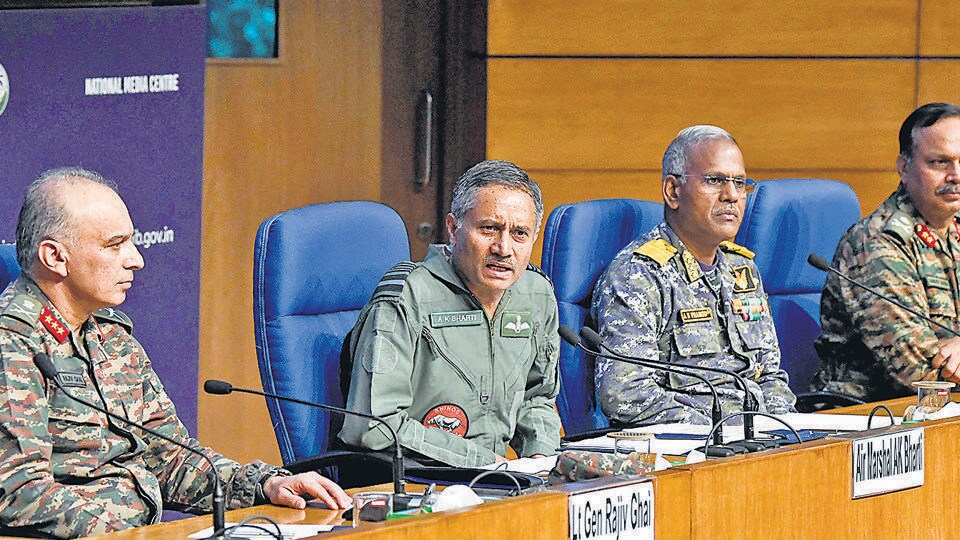
The government notified the rules under the Inter-Services Organisations (Command, Control and Discipline) Act, 2023 in the Gazette of India on May 27, signalling its intent to fast-track the setting up of joint services commands --- a key goal of the ongoing theaterisation drive. Such commands will consist of military elements, assets, and personnel drawn from the three services and placed under a commander-in-chief.
“This significant step aims to bolster command, control, and efficient functioning of Inter-Services Organisations (ISOs), thereby strengthening jointness among the armed forces,” the defence ministry said on Wednesday.
Jointness among the three services is an essential prerequisite to the creation of theatre commands and was in focus during Operation Sindoor --- New Delhi’s direct military response to the April 22 Pahalgam terror attack in which 26 people were killed. It led to a four-day confrontation that showcased the Indian military’s synergy.
The moves comes a year after the Act was notified in the gazette, empowering the government to set up ISOs --- including joint services commands --- and bestowing powers on the heads of such organisations to exercise command and control over the tri-services personnel serving under them to ensure discipline and effective discharge of duties.
Such personnel were earlier governed by the respective laws of the three services: the Army Act, 1950, the Air Force Act, 1950, and the Navy Act, 1957.
“The rules (notified) are a critical enabler for the functioning of ISOs and establish a comprehensive framework for discipline, administrative control, and operational synergy,” the defence ministry said in a statement.
The setting up of theatre commands for integrated application of force, operational efficiency, and optimal resource utilisation is among the nine areas identified by the defence ministry for focused intervention in 2025, which the ministry has declared as the “year of reforms.”
Other areas include building indigenous capabilities to strengthen the armed forces, simplifying acquisition procedures for swifter capability development and new domains such as cyber and space. Defence minister Rajnath Singh is conducting a quarterly review of the defence reforms --- including theaterisation --- being driven by the government to boost the armed forces’ combat readiness.
The theaterisation model being pursued involves raising the China-centric northern theatre command in Lucknow, the Pakistan-centric western theatre command in Jaipur, and the maritime theatre command in Thiruvananthapuram.
The earlier legal framework of the armed forces had its limitations when it came to tri-services matters as officers of one service lacked the authority to exercise disciplinary and administrative powers over personnel belonging to another service. For instance, a three-star general heading a joint command could not act against air force or navy personnel serving under him.
The lack of such powers had a direct impact on command, control and discipline, officials aware of the matter said.
“With the notification of these rules, the Act is now fully operational. This will empower the heads of ISOs, enable the expeditious disposal of disciplinary cases, and help avoid the duplication of proceedings,” the defence ministry said.
The actions of the three services during the May7-10 military confrontation with Pakistan reflected the synergy of the country’s armed forces, the information and broadcasting ministry said on May 18, in a backgrounder titled Operation Sindoor: Forging One Force.
“The operation unfolded across land, air, and sea --- a seamless demonstration of synergy between the army, air force and navy,” the I&B ministry said at the time. It added that efforts were underway to restructure forces through the setting up of integrated theatre commands by unifying the capabilities of the three services based on geography and function.
Operation Sindoor triggered four days of strikes and counterstrikes with fighter jets, missiles, drones, long-range weapons and heavy artillery before the Indian and Pakistani forces reached an understanding on stopping all military action on May 10.
Between the launch of the operation in the early hours of May 7 and the ceasefire, Indian forces bombed nine terror camps in Pakistan and Pakistan-occupied Kashmir (PoK), killing at least 100 terrorists, and the Indian Air Force (IAF) struck targets at 13 Pakistani airbases and military installations.
The IAF struck two terror sites at Markaz Subhanallah in Bahawalpur and Markaz Taiba near Muridke, while the army hit targets at seven places including Mehmoona Joya in Sialkot, Sawai Nala and Syed Na Bilal in Muzaffarabad, Gulpur and Abbas in Kotli, Barnala in Bhimber, and Sarjal.
The IAF also struck military targets in Rafiqui, Murid, Chaklala, Rahim Yar Khan, Sukkur, Chunian, Pasrur, Sialkot, Skardu, Sargodha, Jacobabad, Bholari and Malir Cantt in Karachi.
The navy played a critical role during the operation.
The forward presence of aircraft carrier INS Vikrant in the northern Arabian Sea, along with its Mig-29K fighters and airborne early warning helicopters, prevented hostile aircraft from coming within several hundred kms of the carrier battle group.
“It compelled the Pakistani air elements to remain bottled up close to the Makran coast, with the Indian Navy denying the enemy any opportunity to be a threat in the maritime space,” a top navy official earlier said.
In March, the defence ministry told a parliamentary panel that a raft of complex issues must be addressed before rolling out integrated theatre commands as they have a direct bearing on the proposed force structure, calling it “a trailblazing reform.”
The ministry’s response to a pointed question on theaterisation was part of a report tabled by the standing committee on defence in Parliament.
“Deliberations on reorganising the armed forces into integrated theatre commands are in progress and currently being examined at various levels before finalisation of an optimal organisational structure to meet the operational requirements,” the report said.
The joint structures would help create and integrate new war-fighting capabilities along with faster assimilation of future technology and tactics, it said. “The concept of theaterisation seeks to mitigate the shortcomings of single service operations and support modern war fighting,” the report added.
The chief of defence staff (CDS) General Anil Chauhan is heading the theaterisation drive.
The appointment of a CDS was one of the most significant recommendations made by the K Subrahmanyam-led Kargil Review Committee (KRC) that was constituted after the 1999 Kargil war to examine various lapses and suggest measures to boost national security. In 2000, the KRC recommended appointing a CDS to provide single-point military advice to the government and foster synergy in warfighting.
A year later, a group of ministers backed the appointment of a CDS, who would bring about much needed jointness among the three services and prioritise defence planning.
The need for a CDS was stressed by several committees and parliamentary panels between 2002 and 2016. But successive governments were unable to build political consensus around a CDS until Prime Minister Narendra Modi announced the post on August 15, 2019.
General Bipin Rawat was appointed the country’s first CDS on December 31, 2019. He was killed in a helicopter crash on December 8, 2021.


