E-Paper



Number Theory: Deciphering the change of guard by BJP in Haryana
BJP may have strategically distanced itself from JJP to ensure that the regional party cuts into the Jat base of the Congress and damages it in the elections
Published on: Mar 13, 2024, 08:43:16 IST


Share via


Copy link

In a surprise move, the Bharatiya Janata Party (BJP) has changed its chief minister in Haryana days before the announcement of 2024 Lok Sabha elections with state party president Nayab Singh Saini replacing Manohar Lal Khattar. To be sure, the reshuffle in Haryana was triggered by the BJP parting ways with the Jannayak Janata Party (JJP), whose leader Dushyant Chautala was the deputy CM in the BJP government until now. What explains this churn? Here are three charts which put this in context.

Deciphering the change of guard by BJP in Haryana
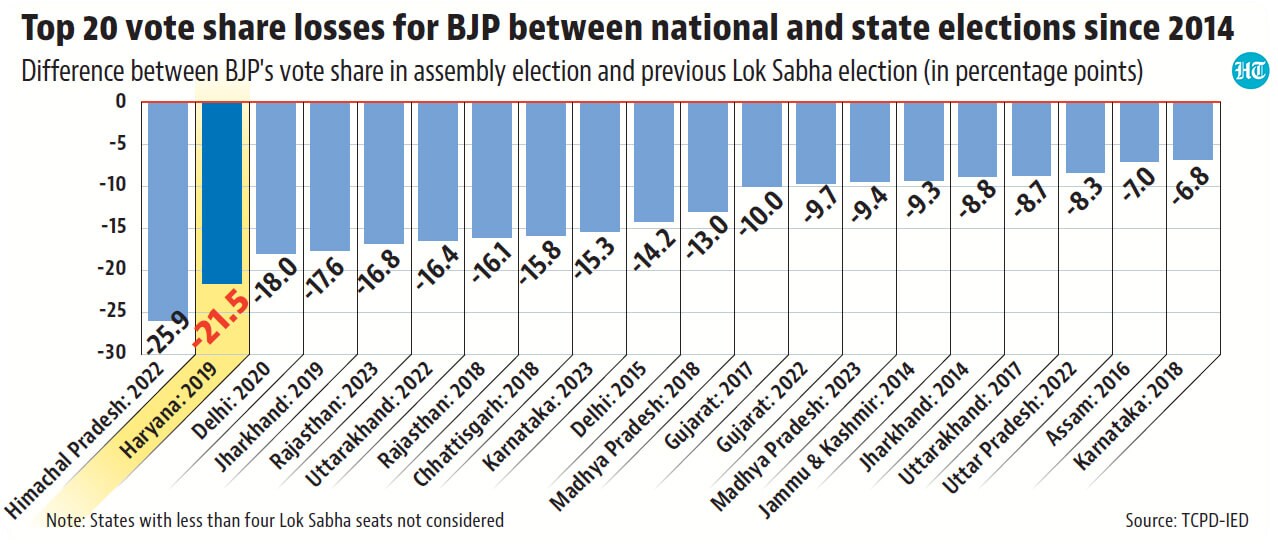
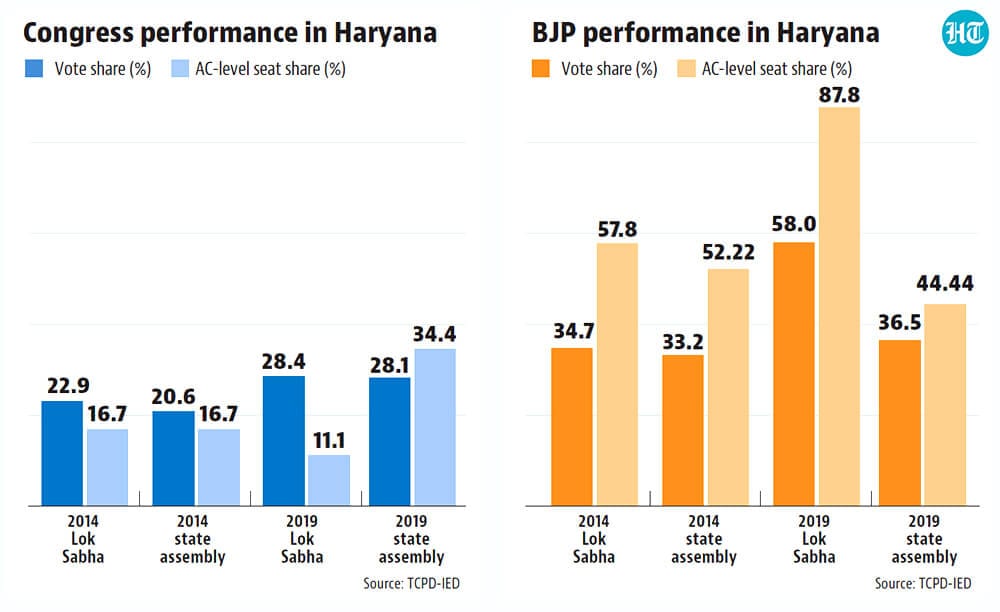
 The BJP was unable to preserve its dominance between the 2019 national and state elections in HaryanaThe BJP won all 10 parliamentary constituencies (PCs) in Haryana in the 2019 Lok Sabha elections and had a vote share of 58% at the state level. Its advantage vis-a-vis the Congress, its main competitor in the state, was a massive 30 percentage points. However, when the 2019 assembly elections were held just six months later, the BJP’s vote share fell sharply to 36.5%, bringing down its assembly constituency (AC)-wise seat share of 88% in the 2019 Lok Sabha elections to 44% in the assembly elections. While the BJP polling a lower vote share in state elections than national elections in the post-2014 period is a well-established trend, the 2019 Haryana assembly elections were an outlier with the fall in vote share between a Lok Sabha and assembly elections being the second largest after the 2022 Himachal Pradesh election.
- The Congress, on the other hand, recovered some ground in 2019 compared to 2014A comparison of the vote share of the Congress party in Lok Sabha and assembly elections held in 2014 and 2019 shows this clearly. While the Congress suffered a fall in its Lok Sabha seat share in 2019 despite a five percentage point rise in vote share, it more than doubled its seat share between the 2014 and 2019 assembly elections with just an eight percentage point increase in vote share. These numbers suggest that the Congress actually bottomed out in Haryana in 2014, and witnessed some sort of revival, even if it was far from what it would take for it to win back the state.
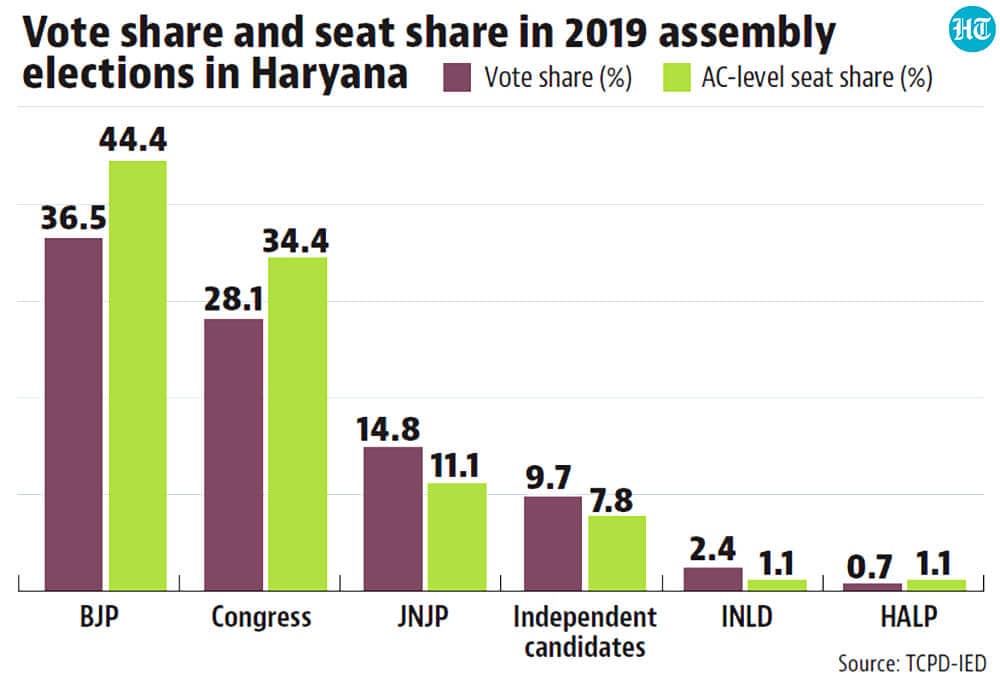
- The prospect of a Congress-JJP government in Haryana after 2019 was a worry for the BJPWith 31 and 10 MLAs each, the combined strength of the Congress and the JJP in the assembly was one more than that of the BJP after the 2019 elections. Had the two parties come together, they could have potentially taken a shot at forming a government in the state with the help of independents. Even from a vote share perspective, a Congress-JJP alliance would have been a formidable combination in the state with a combined vote share of 43% as compared to the BJP’s 36.5%. It was perhaps these set of numbers that made the BJP accommodate the JJP in its government with the deputy chief minister’s post for JJP’s leader Chautala. JJP being part of the BJP government made it much more stable, and the break-up suggests that the BJP now does not want to share its Lok Sabha or assembly seats in a pre-poll alliance.
- Do theories, that this is a decision taken in concert by the BJP and the JJP, ring true?A section of commentators are suggesting that the BJP has strategically distanced itself from the JJP to ensure that the regional party cuts into the Jat base of the Congress and damages it in the elections. While it is always difficult to prove (or disprove) such claims, a look at the 2019 assembly election results suggests that it does not pass the smell test. Of the 77 ACs that the JJP contested but lost in Haryana, it polled more votes than the victory margin in 30 ACs. The Congress and the BJP finished second in 11 and 13 out of these ACs. This suggests that the JJP damaged both the Congress and the BJP almost equally. When seen in this light, the BJP’s decision to decouple with the JJP appears to be driven by confidence rather than anything else. Whether or not it works, of course, will only be known after the results.