E-Paper



Number Theory: How do the 2024 victory margins compare with past elections?
The 2024 results have taken India back to the era of coalition governments with no single party having a majority of its own

 Prefer HTon Google


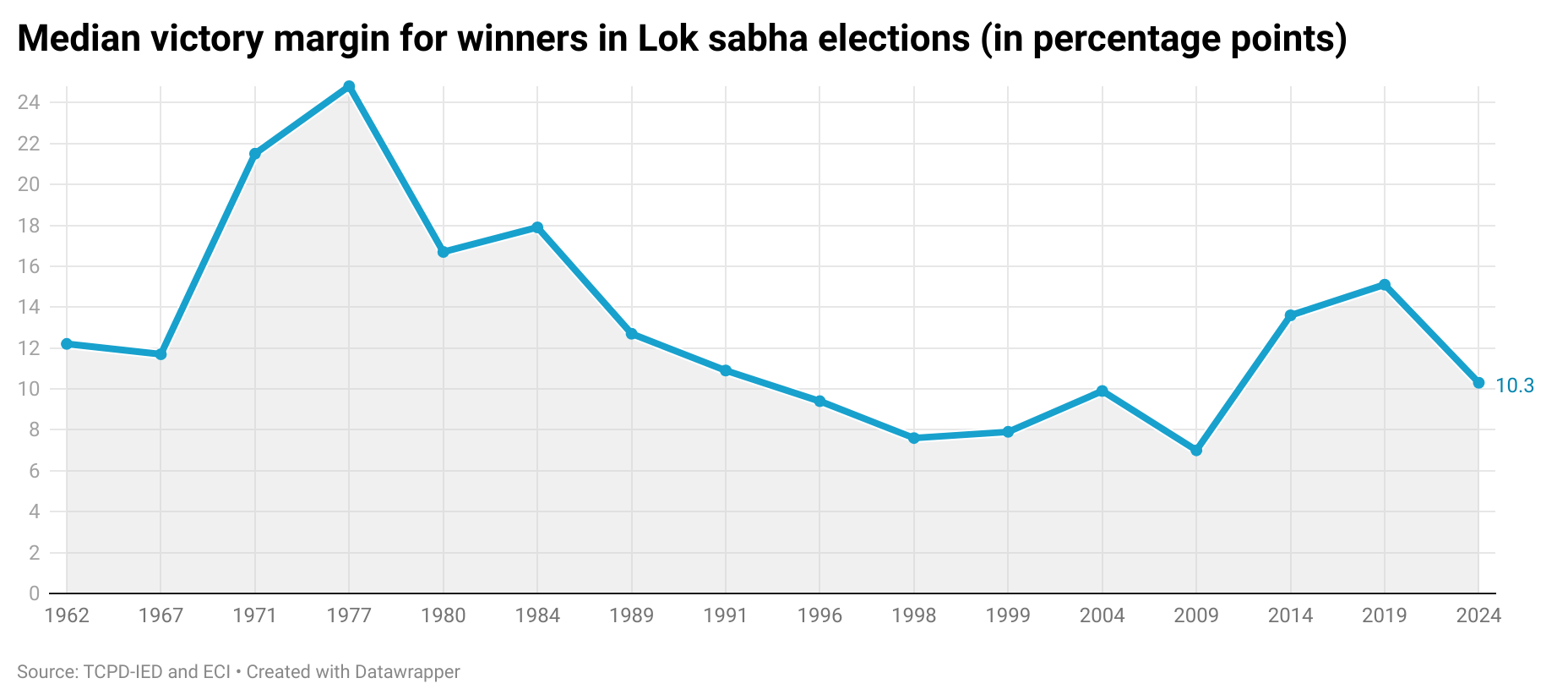
The Bharatiya Janata Party (BJP) became the first party to secure a majority of its own in the Lok Sabha in 30 years in the 2014 elections. It repeated this feat in the 2019 elections. The 2024 results have taken India back to the era of coalition governments with no single party having a majority of its own. Does this trend get reflected in the nature of constituency-level contests as well? Here are four charts that aim to answer this question. The median victory margin at the parliamentary constituency (PC) level in 2024 has fallen by more than five percentage points compared to 2019. In fact, this number is now also lower than what it was in 2014.
To be sure, at 10.3% of the total votes polled, it is still in double digits unlike what used to be the case from 1996 to 2009 elections. What is even more interesting is the fact that the median vote share of the winning candidate has only fallen by 2.5 percentage points between 2019 and 2024.
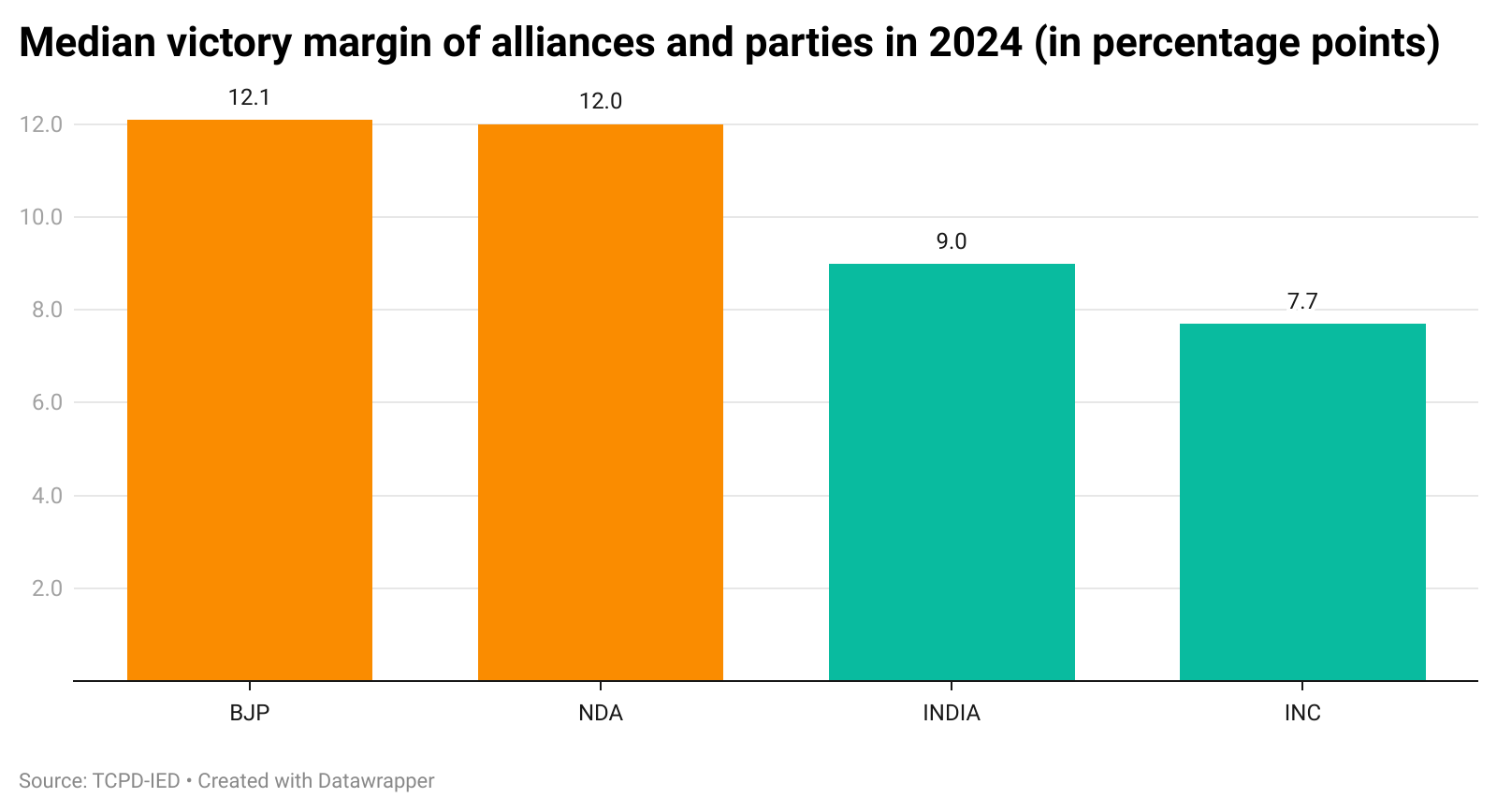
For the BJP, the median victory margin has decreased to 12.1% from 20% in 2019. However, this number has fallen marginally by 1 percentage point to 7.7% in 2024 for the Congress party. The decrease in median victory margin for National Democratic Alliance (NDA) candidates as a whole is similar to that of the BJP.
Also Read: Congress calls NDA ‘Nitish/Naidu dependent alliance’
Also Read: Narendra Modi swearing-in ceremony: Security enhanced across Delhi | 10 points
However, Congress and its alliance partners as a whole have witnessed a fall of 3 percentage points in this number between 2019 and 2024 to 9% percentage points. Even for candidates belonging to non-BJP and non-Congress alliance-based parties, this number has fallen to 8% in 2024 -- a 2 percentage points decrease from 2019. An HT analysis of election results shows that vote share of winning candidates and median victory margins have fallen across party lines and alliances between 2019 and 2024.
Also Read: India logs fall in inequality between 2011-12 and 2022-23, says govt report
 Median victory margin and vote share of winning candidates has fallen compared to 2019The median victory margin at the parliamentary constituency (PC) level in 2024 has fallen by more than five percentage points compared to 2019. In fact, this number is now also lower than what it was in 2014. To be sure, at 10.3% of the total votes polled, it is still in double digits unlike what used to be the case from 1996 to 2009 elections. What is even more interesting is the fact that the median vote share of the winning candidate has only fallen by 2.5 percentage points between 2019 and 2024.
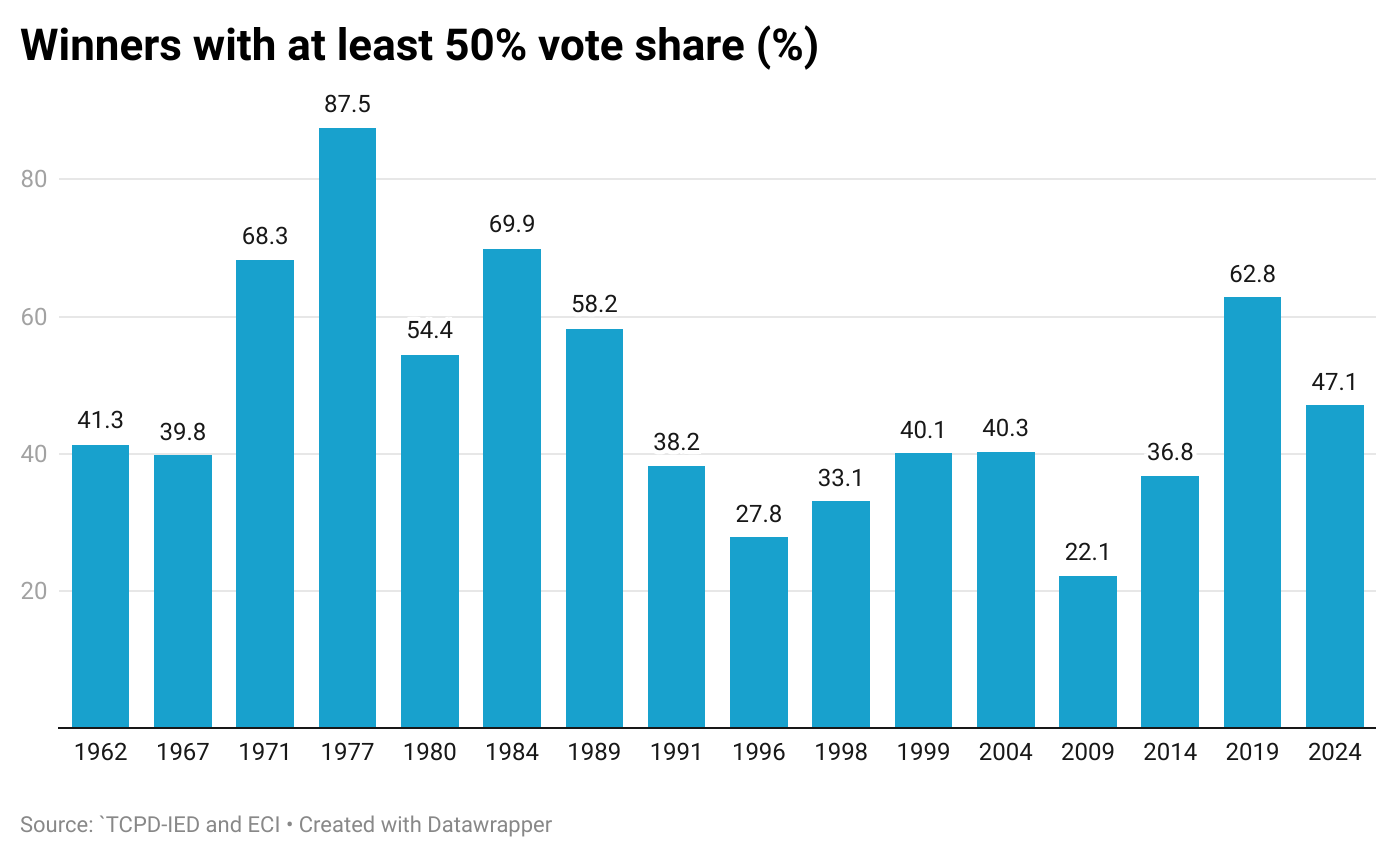
- The share of candidates who polled more than 50% of votes has fallen as wellIf a candidate gets a vote share of 50% or more in a constituency, it means they will win not just a first-past-the-post contest but also the popular vote. The share of candidates with a vote share of 50% or more was 62.8% in the 2019 elections, the highest this number has been since the 1984 elections. In 2024, it fell to 47.15%. While this is a sharp fall compared to 2019, it is still much higher than what this number had been from 1989 to 2014 elections.
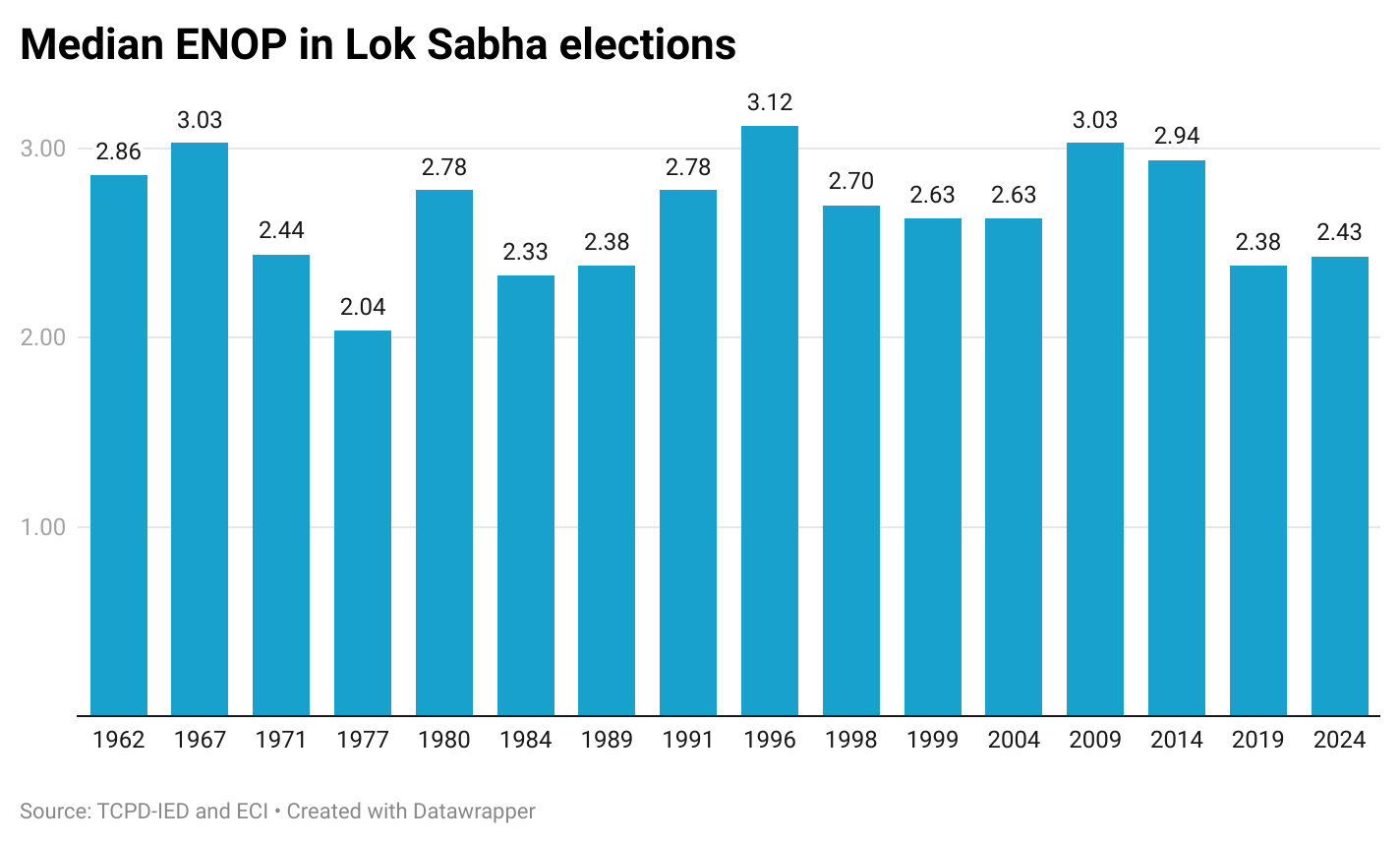
- Constituency-level contests became slightly more competitive than in 2019A comparison of the median value of Effective Number of Parties (ENOP) shows this clearly. ENOP is the reciprocal of the sum of squares of vote share of all candidates in a constituency and a higher value shows more competitive contests. For example, if there are four candidates in a constituency and they get 26%, 25%, 25% and 24% votes ENOP value will be 3.99. If these votes share numbers change to 50%, 45%, 3% and 2% ENOP will fall to 2.2. Median ENOP for parliamentary constituencies (PC) in 2019 was 2.38, the lowest this number had been since the 1989 Lok Sabha elections. In 2024 this number increased marginally to 2.43.
- Is the fall in average vote share of winners and victory margin a reflection of the BJP’s drop?This is an important question to ask because the BJP’s numbers in the Lok Sabha are now lower than what they were in 2014 and 2019. An HT analysis of election results shows that vote share of winning candidates and median victory margins have fallen across party lines and alliances between 2019 and 2024. For the BJP, the median victory margin has decreased to 12.1% from 20% in 2019. However, this number has fallen marginally by 1 percentage point to 7.7% in 2024 for the Congress party. The decrease in median victory margin for National Democratic Alliance (NDA) candidates as a whole is similar to that of the BJP. However, Congress and its alliance partners as a whole have witnessed a fall of 3 percentage points in this number between 2019 and 2024 to 9% percentage points. Even for candidates belonging to non-BJP and non-Congress alliance-based parties, this number has fallen to 8% in 2024 -- a 2 percentage points decrease from 2019.
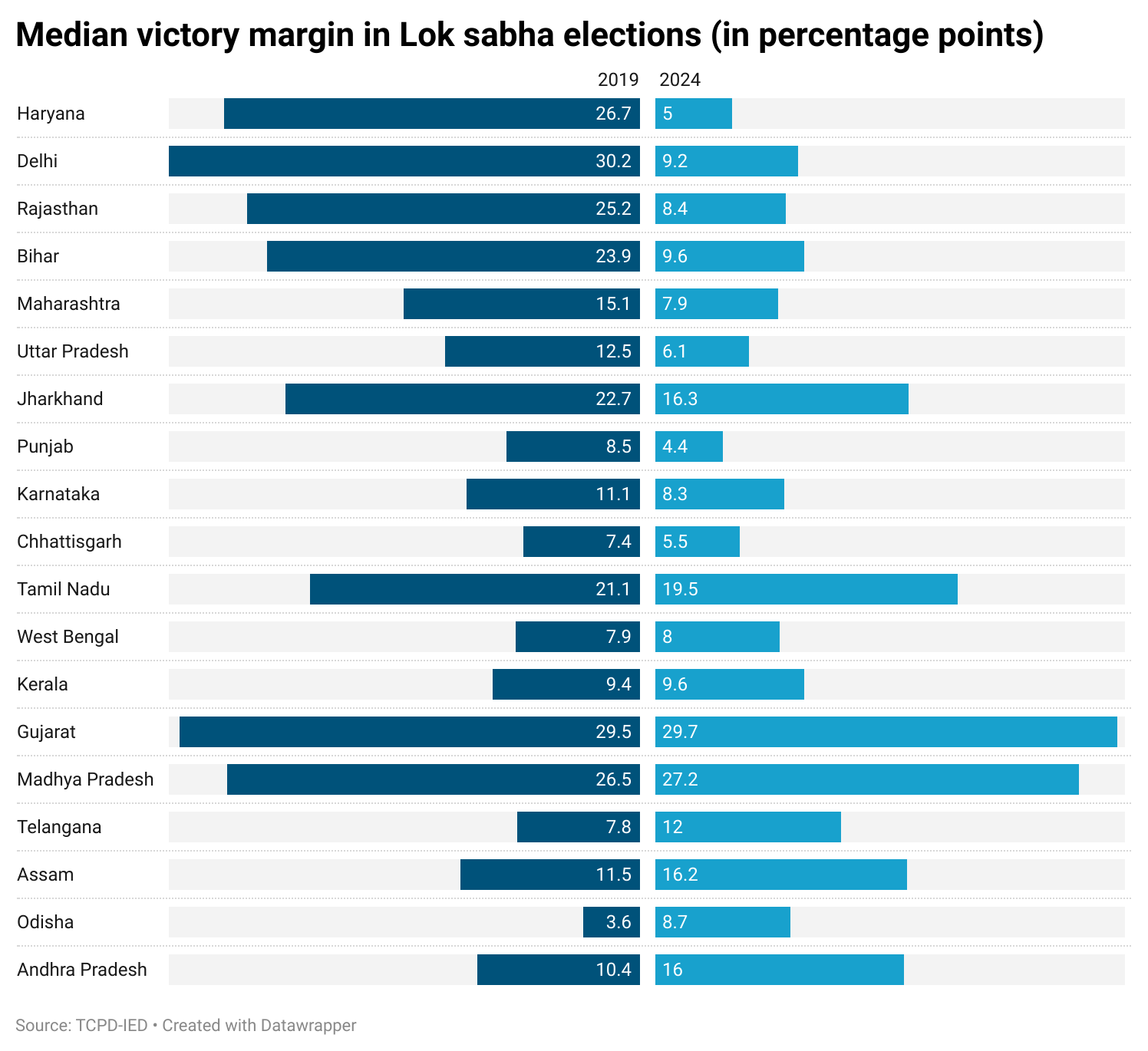
- Victory margin across statesAn analysis of median victory margins at the level of states (with at least seven PCs) shows that it has fallen in 11 out of 19 such states and Union territories, and increased in 8 eight them. The lowest increase is in West Bengal --just 0.1 percentage point from 2019. The fall is the largest in Haryana where it has come down from 26.7% to 5%. In Uttar Pradesh, which sends 80 MPs to the Lok Sabha, it has fallen by nearly six percentage points.