E-Paper



Number Theory: In poll season, paddy price wars in Chhattisgarh explained
What explains the politics over paddy prices in the state? Here are four charts that unpack this question.
Published on: Nov 6, 2023, 10:35:22 IST

 Prefer HTon Google
Share via


Copy link

After Bharatiya Janata Party (BJP) announced it will buy paddy at a price of ₹3,100 per quintal in its poll manifesto — this is almost ₹1,000 more than the current nation-wide Minimum Support Price (MSP) of ₹2,183 per quintal — the Congress has outmatched it with a promise of ₹3,200 per quintal.

As far as the BJP is concerned, the announcement of a paddy procurement bonus is a climb down from policy under the first Narendra Modi government, which explicitly discouraged states to offer bonus over national MSPs.
In poll season, paddy price wars in Chhattisgarh explained
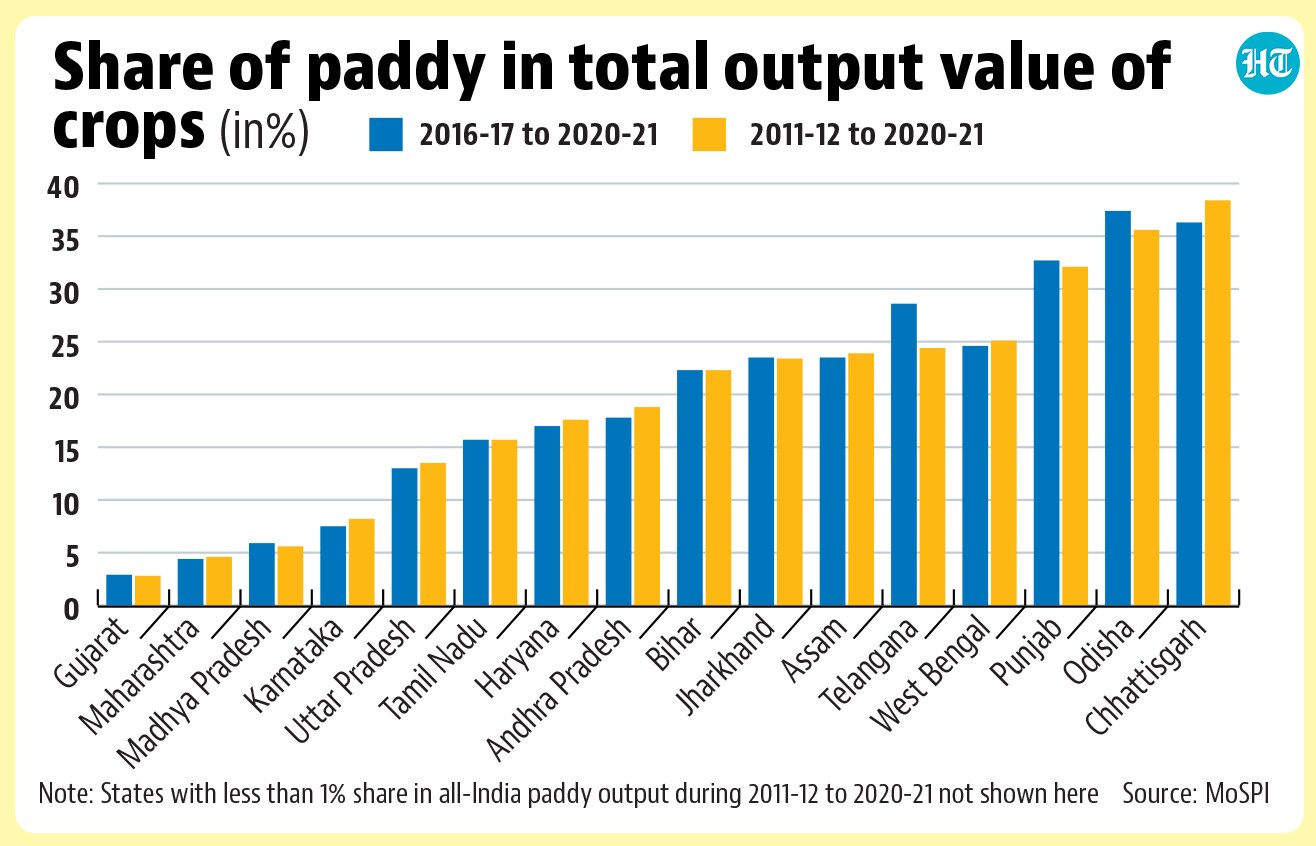
 Paddy is central to crop production in ChhattisgarhThis can be understood from the fact that the crop’s output value (at constant price) was more than a third of the state’s total crop output in the ten years ending 2020-21, the latest period for which this data is available for different states from the National Statistical Office (NSO). The only other states where crop output is concentrated in paddy to this extent are Punjab and Odisha. To be sure, paddy’s share in the total output of crops was somewhat lower in Chhattisgarh in more recent years of the 2012-2021 decade than in the earlier years. For example, this share was 40.8% in the five years ending 2015-16 and reached 36.3% in the five years ending 2020-21. Therefore, while it was far ahead from Punjab and Odisha in the first half of the decade by this metric, these two states are sometimes ahead of Chhattisgarh now.
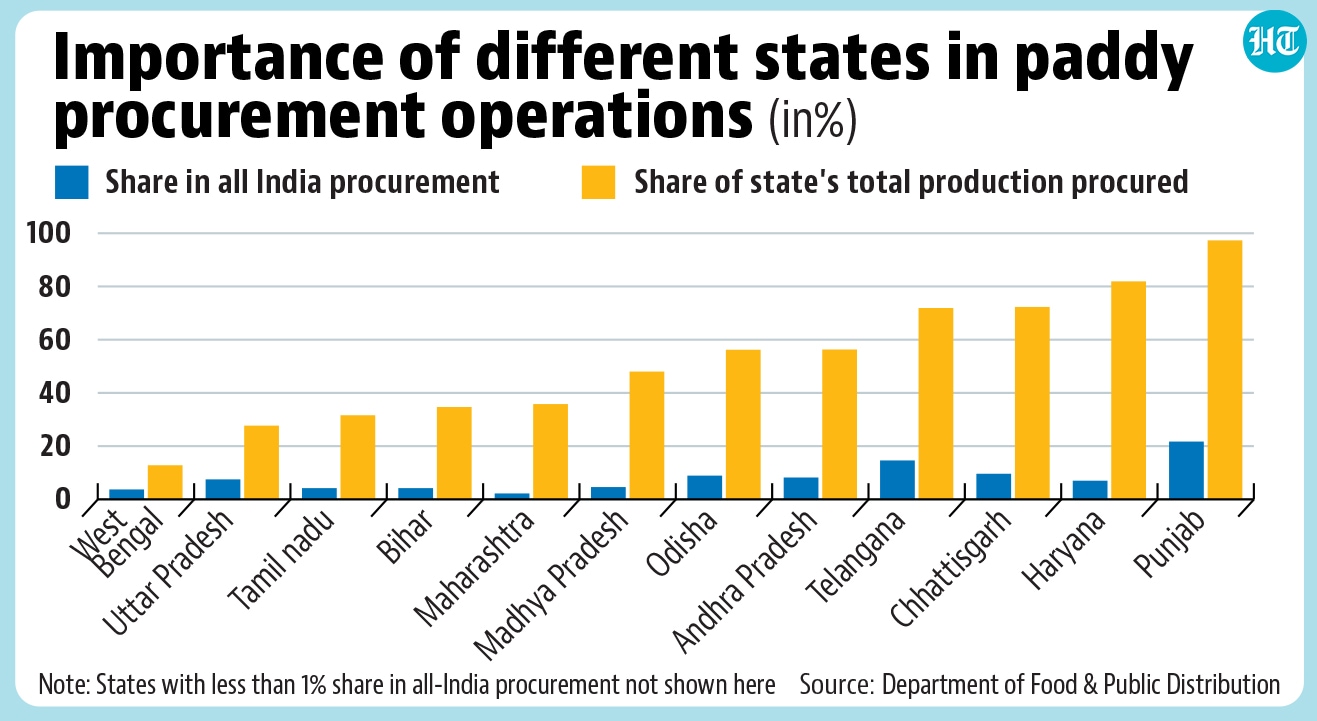
- Chhattisgarh has one of the highest shares of rice procurement in IndiaThe above statistics show that paddy is one of the most important crops in Chhattisgarh. However, is the crop important in MSP operations? It is important to check this because MSP announcements may not be relevant otherwise. Data shows that that is unlikely to be the case with Chhattisgarh. According to data from the Union government’s Department of Food and Public Distribution, procurement agencies bought 218.45 lakh tonnes of rice from Chhattisgarh between 2019-20 to 2022-23. This is 72% of the state’s total rice production during this period. This confirms that Chhattisgarh is an important state for MSP operations of paddy in the country.
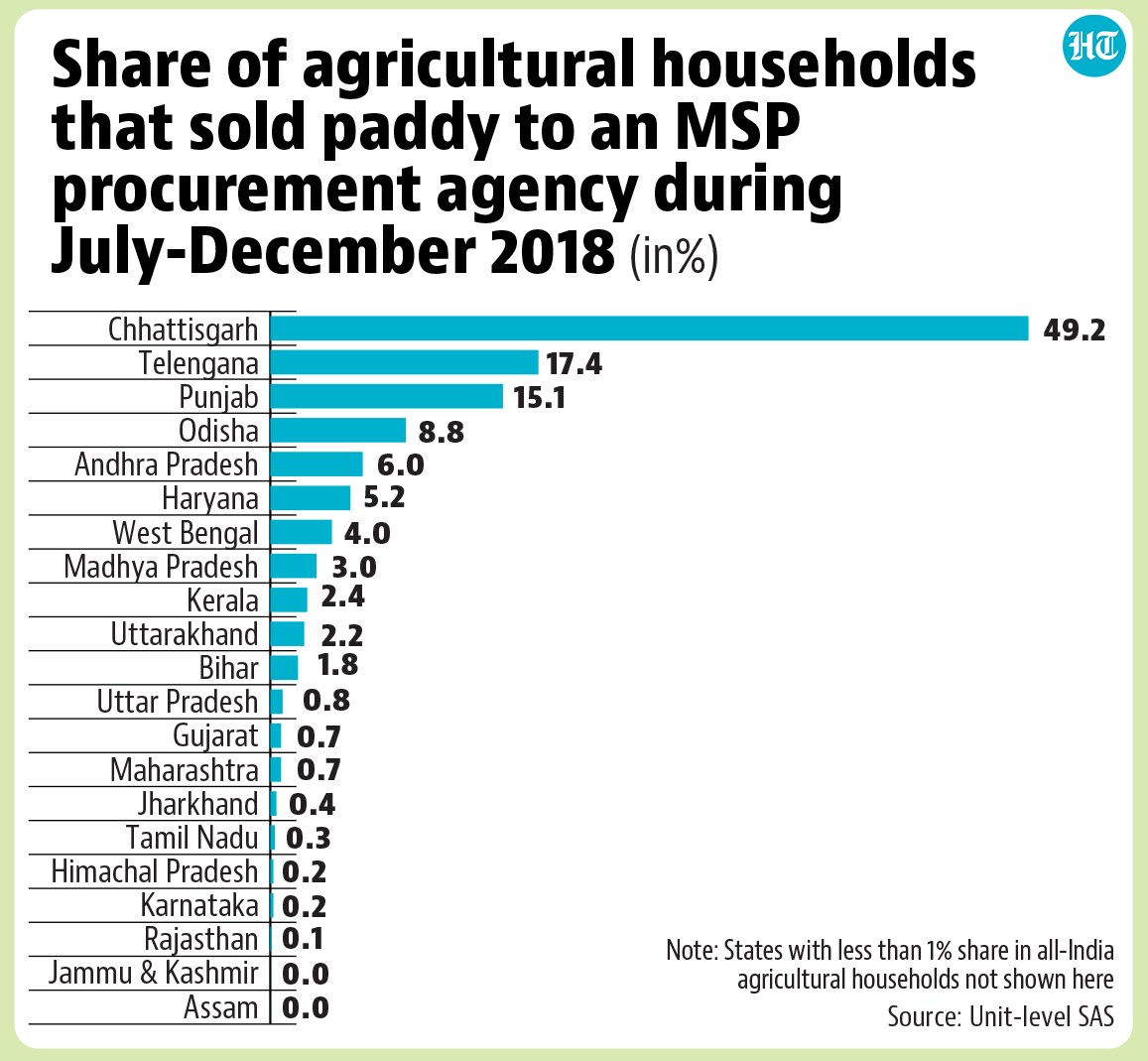
- Paddy MSP operations are also important to a large share of farmers in ChhattisgarhTo be sure, it is entirely possible that most MSP procurement from a state is done from a small set of big producers and other farmers produce paddy to sell in the market or for their own household. As HT reported on October 24, only around 10% of agricultural households in neighbouring Madhya Pradesh sold wheat to a procurement agency during January-June 2019, according to the Situation Assessment Survey (SAS) in agriculture conducted in 2018-19. Agricultural households here are any households with at least one member self-employed in agriculture and that produced agricultural outputs (including those from animal farming) worth ₹4,000 during July 2018-June 2019. Is Chhattisgarh’s paddy procurement similar to Madhya Pradesh’s wheat procurement? Not at all. The data from the same SAS shows that farmers in Chhattisgarh participate in selling paddy to procurement agencies on a much bigger scale. Almost half (49%) of agricultural households in Chhattisgarh sold paddy to an MSP procurement agency during July-December 2018, the period of the SAS relevant to paddy procurement. This is the highest participation by agricultural households of any state in paddy MSP operations in the country, far ahead of second placed Telangana, where this share was 17%. This means that paddy MSP operations in Chhattisgarh are even more important than the numbers on production value and procurement share suggest.
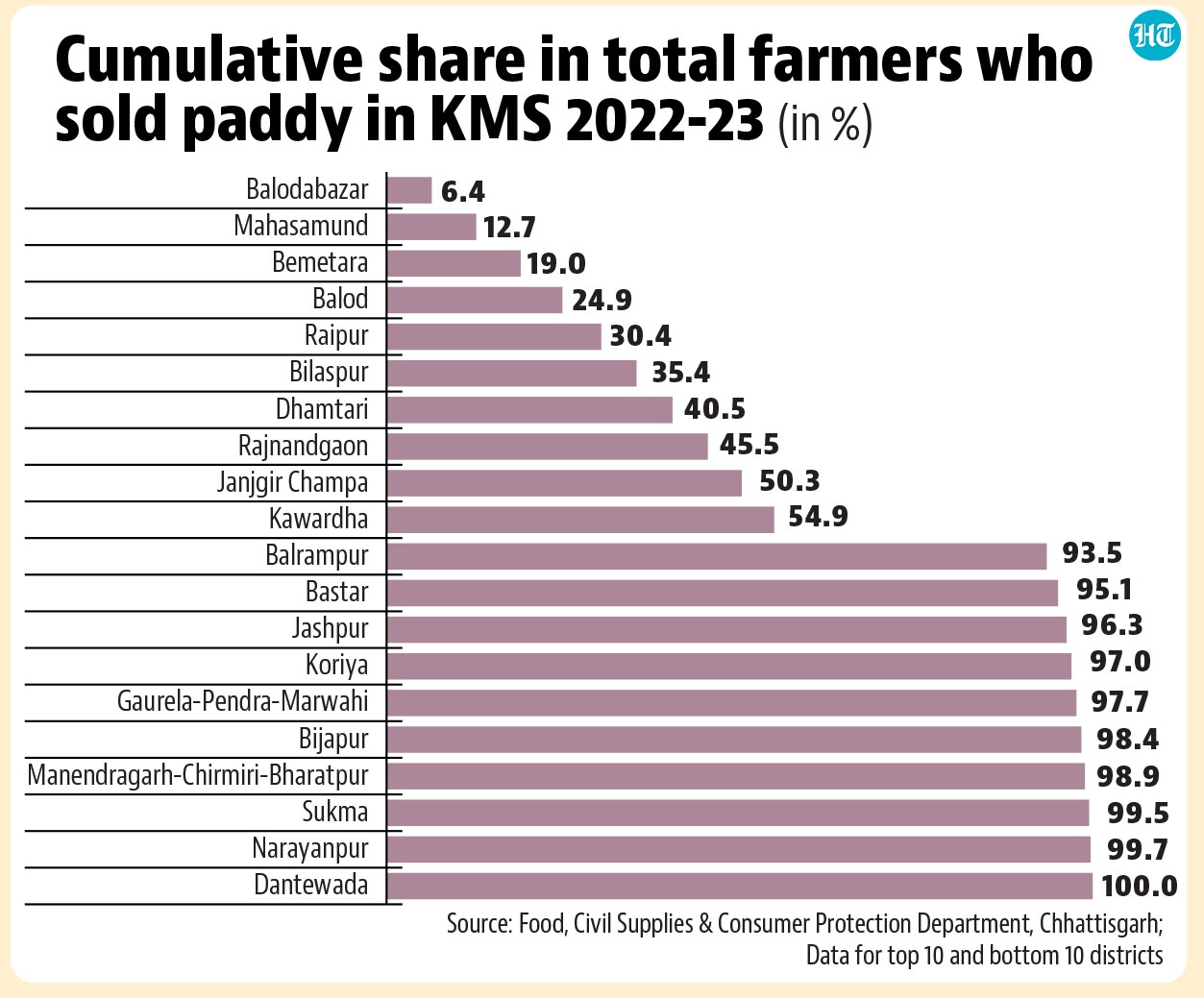
- Can paddy MSP overpower other issues in the state electorally?The above statistics underline why it is tempting for parties to compete on announcing MSP for paddy in Chhattisgarh during elections: a large share of farmers in the state sell the crop to procurement agencies. However, if such farmers are concentrated in a few districts or constituencies, an MSP for the crop will matter in only those areas and not elsewhere. Data suggests that this is not a very big problem in Chhattisgarh. For example, it takes at least nine of 33 districts in the state to account for half the farmers who sold paddy in the 2022-23 kharif marketing season, according to the state’s food, civil supplies and consumer protection department. It took 17 of 33 districts to account for 80% of farmers who sold paddy in the same season. Clearly, while a paddy MSP will not matter in all districts, it is likely to be important in a large share of districts. Balodabazar, Mahasamund, Bemetara, and Balod — each with the highest 6% share in total farmers who sold paddy — will probably be the districts where the MSP announcement matters the most. On the other hand, such announcements will matter the least in districts such as Dantewada, Narayanpur, Sukma, Manendragarh-Chirmiri-Bharatpur, Bijapur, Gaurela-Pendra-Marwahi, and Koriya, which had less than a percent’s share in such farmers.