E-Paper



Number Theory: What explains BJP’s love for Charan Singh?
Charan Singh began his political career in the Congress party and only parted ways with it after the 1967 elections when he was not made the chief minister.


Earlier this month, the Narendra Modi government announced that it was posthumously conferring country’s highest civilian award, the Bharat Ratna, to Chaudhary Charan Singh, who briefly served as the Prime Minister of India for six months in 1979-80. Within days of the decision being announced, the Bharatiya Lok Dal (BLD, now Rashtriya Lok Dal-RLD which was relaunched by Ajit Singh, son of Charan Singh in 1999), currently headed by Charan Singh’s grandson Jayant Singh, the son of Ajit Singh, announced that it was joining the Bhartiya Janata Party (BJP) led National Democratic Alliance (NDA). While the RLD’s current political strength is not necessarily a threat to the BJP even in western Uttar Pradesh – neither Jayant nor his father Ajit Singh could win even their own constituencies in 2014 and 2019 elections – there is good reason to believe that the BJP’s decision to confer Bharat Ratna on Charan Singh is part of a larger political ideological project to usurp his legacy of anti-Congress politics, without which the BJP’s political project would never have attained the dominance it enjoys today. Here are three charts which explain this in detail.

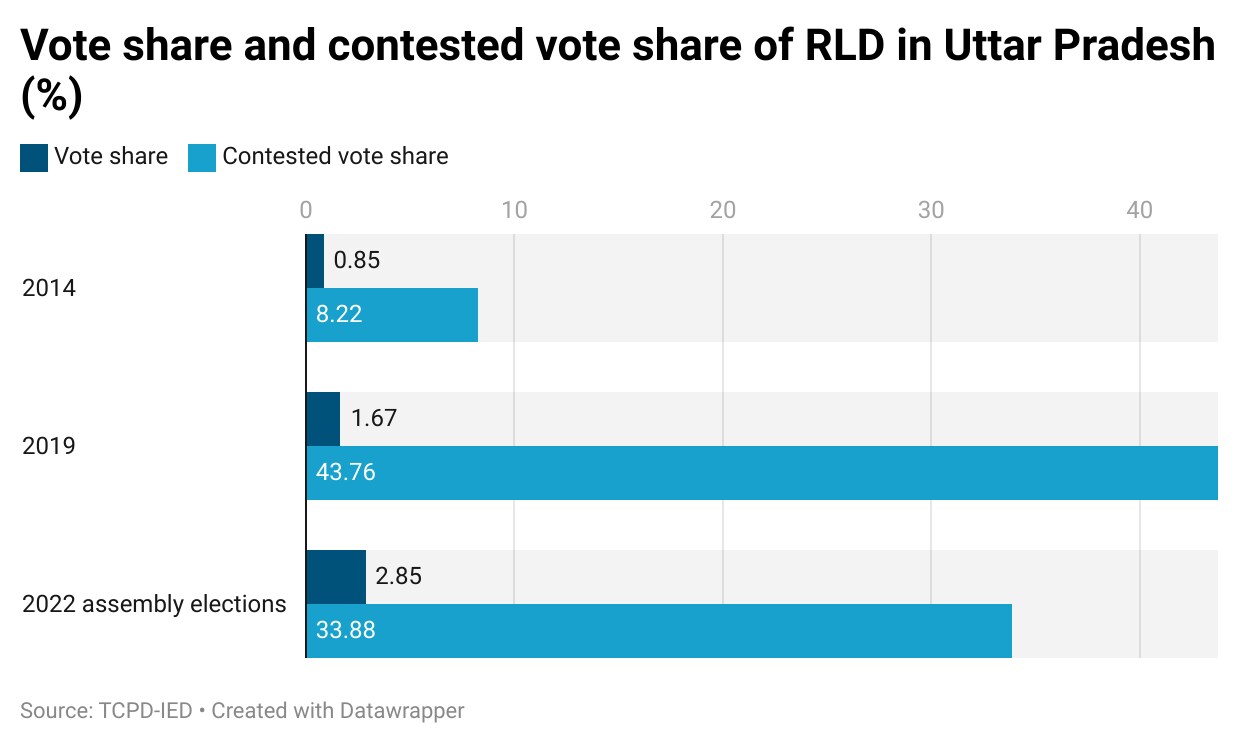
 RLD’s performance has been dismal in the last two Lok Sabha electionsThe RLD did not manage to win any seats in the Lok Sabha elections of both 2014 and 2019. In the 2019 election, it allied with the Bahujan Samaj Party and Samajwadi Party, and contested three seats. In the 2014 election, it contested 8 seats but only managed to obtain a meagre vote share of 0.85%, and a contested vote share of 8.2%. In 2019, its contested vote share improved to 43.75%. And even in the state assembly elections 2022, it managed to win only 8 seats out of the 33 it contested with a vote share of 2.85% at the state level and a contested vote share of 33.88%.
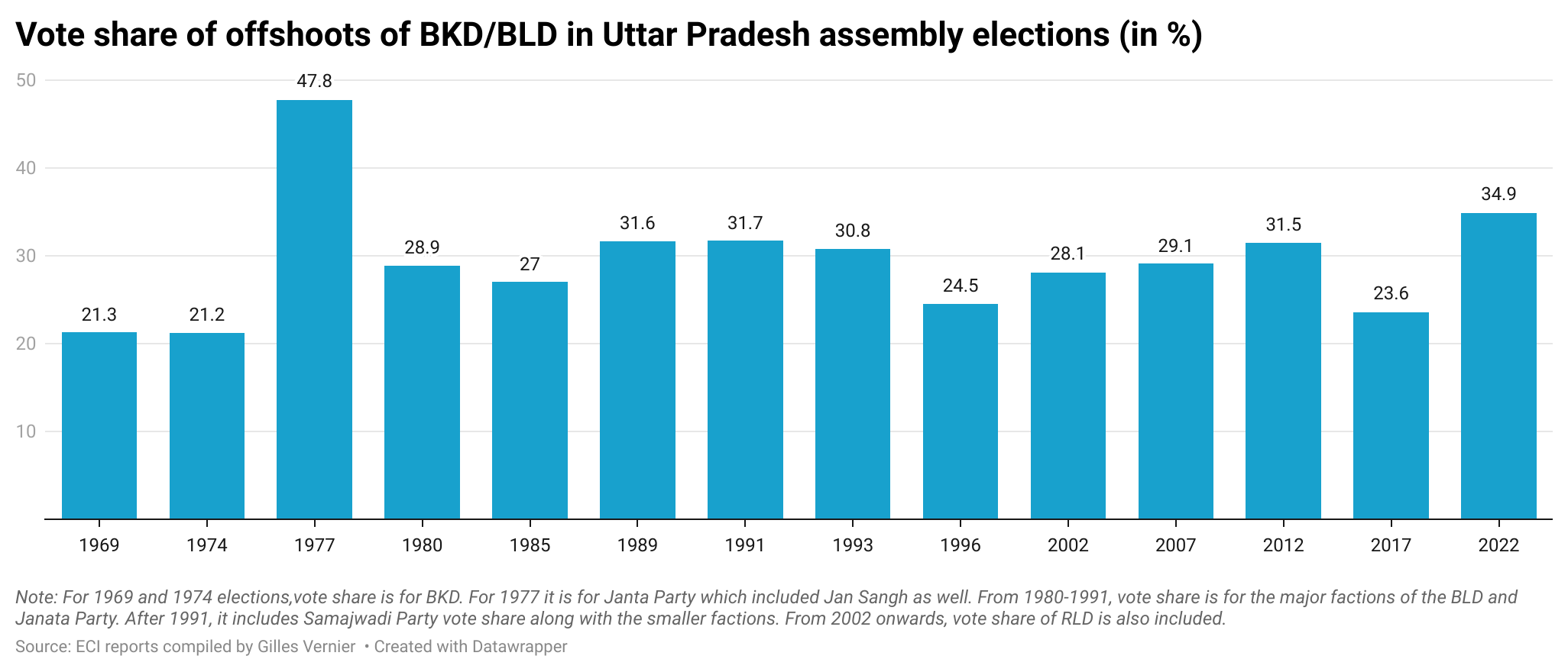
- What did Charan Singh do to the Congress in Uttar Pradesh?Charan Singh began his political career in the Congress party and only parted ways with it after the 1967 elections when he was not made the chief minister. It was as chief minister of the ideologically disparate coalition of the SVD (Samyukta Vidhayak Dal) – this included everyone from the socialists and communists to the Hindu right – that Singh floated his party called the BKD (Bharatiya Kranti Dal). BKD contested its first election in 1969 and became only the second non-Congress party to breach the 20% vote share and seat share threshold in the state. The first non-Congress party to do this was the BJP’s predecessor Bhartiya Jan Sangh (BJS) in the 1967 assembly elections. Charan Singh changed Uttar Pradesh’s politics by imparting agency to dominant rural castes (and peasants) via a social coalition which was popularly referred to as AJGR (resembling the Hindi word Ajgar for python) which brought together Ahirs (Yadavs), Jats, Gurjars and Rajputs. This social coalition put a severe (python like) squeeze on the Congress’s alliance which was based on support from Brahmins, Dalits and Muslims. Two out of the seven Congress chief ministers before Charan Singh were Brahmins (Govind Ballabh Pant and Sucheta Kriplani), two were Kayastha (Sampurnanand twice) and three were Vaishya (Chandra Bhanu Gupta thrice). While the fortunes of Charan Singh’s politics fluctuated wildly from absolute domination (1977) to decimation (1984) in his own lifetime, his political project has outlived his personal politics with players such as the Samajwadi Party completely marginalizing the Congress from India’s most politically important and populous state.
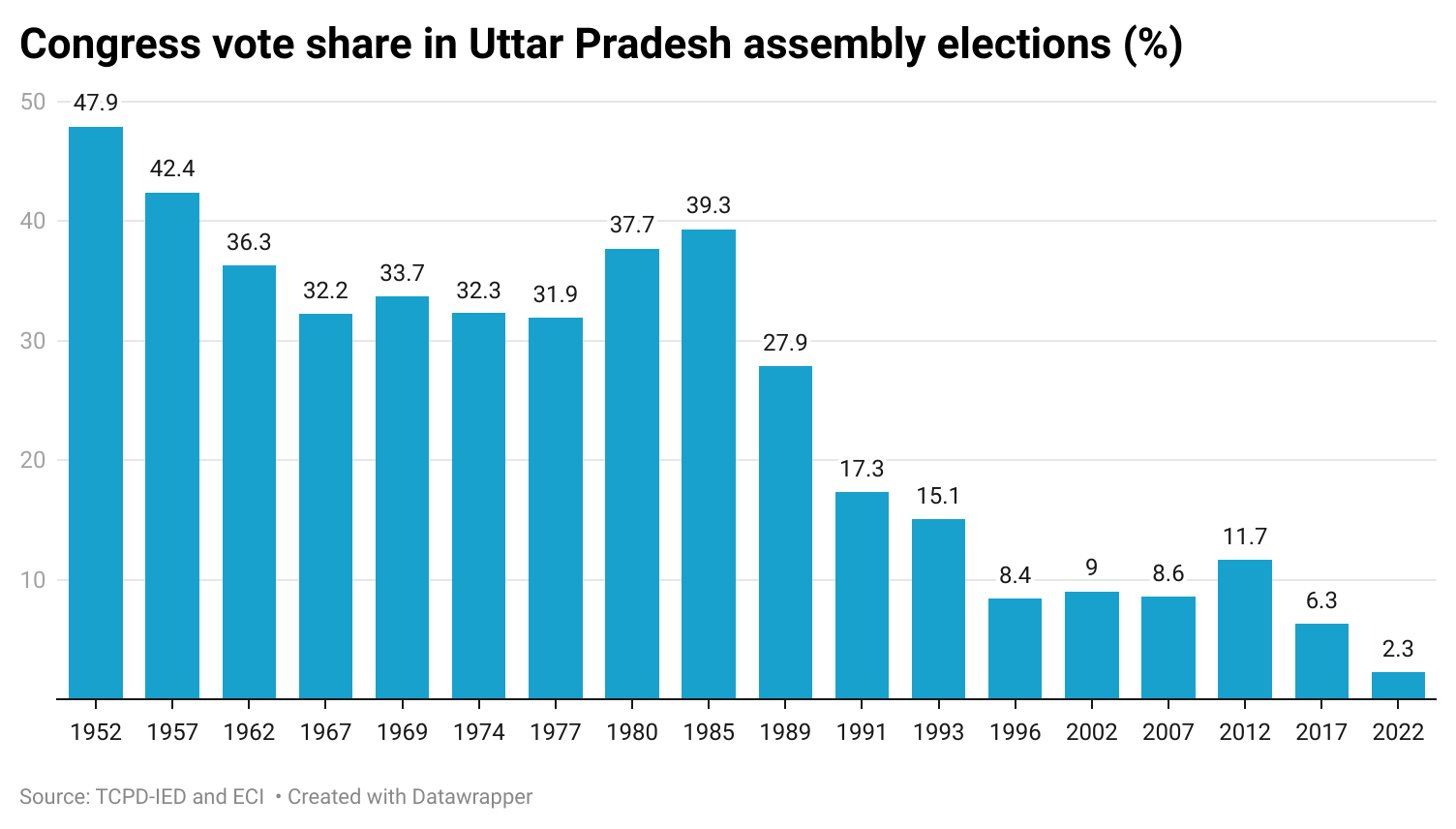
- An already weakened Congress was torn apart in the Mandal-Kamandal churn in the 1990sThe years of 1989-90 were critical in Indian politics, with two significant events shaping the country's polity forever. The Mandal Commission report granted Other Backward Classes (OBCs) 27% reservation, while the BJP's Palampur resolution made the construction of the Ram temple in Ayodhya its core issue. The Mandal-Kamandal churn in Indian politics — Uttar Pradesh was its epicenter —completely destroyed what was an already weakened Congress party with Muslims deserting it on a large scale for the Samajwadi Party and its upper caste voters moving to the BJP. The Congress lost 24.2 percentage points in terms of vote share between the 1985 and 1993 assembly elections in the state. The former was held in the aftermath of Indira Gandhi’s assassination and the latter after the demolition of the Babri mosque. Even at the peak of anti-Congress politics in the 1977 elections, the Congress had managed a vote share of 32% in Uttar Pradesh.
- By honouring Charan Singh’s legacy, the BJP is only paying its due to a man who led the charge against what was then the hegemonic party in India’s largest state. Without this first body blow, the Congress may perhaps have survived the marginalization it suffered in the Mandal-Kamandal churn.