E-Paper



Number Theory: Why junking electoral bonds alone won't achieve much
This is the second of a two-part series on India’s political finance. The first part looked at how electoral bonds changed India’s political funding.
Published on: Feb 28, 2024, 08:22:45 IST

 Prefer HTon Google
Share via


Copy link

The first part of this two-part data journalism series explained how electoral bonds changed India’s political funding landscape. The final part will argue that while junking electoral bonds will definitely do away with institutionalised opacity in India’s political finance landscape, it will not make it completely transparent. One of the biggest reasons for this is the entrenched advantage money enjoys at the local level of democratic competition. Here are three charts that explain this argument in detail.
Why junking electoral bonds alone won't achieve much
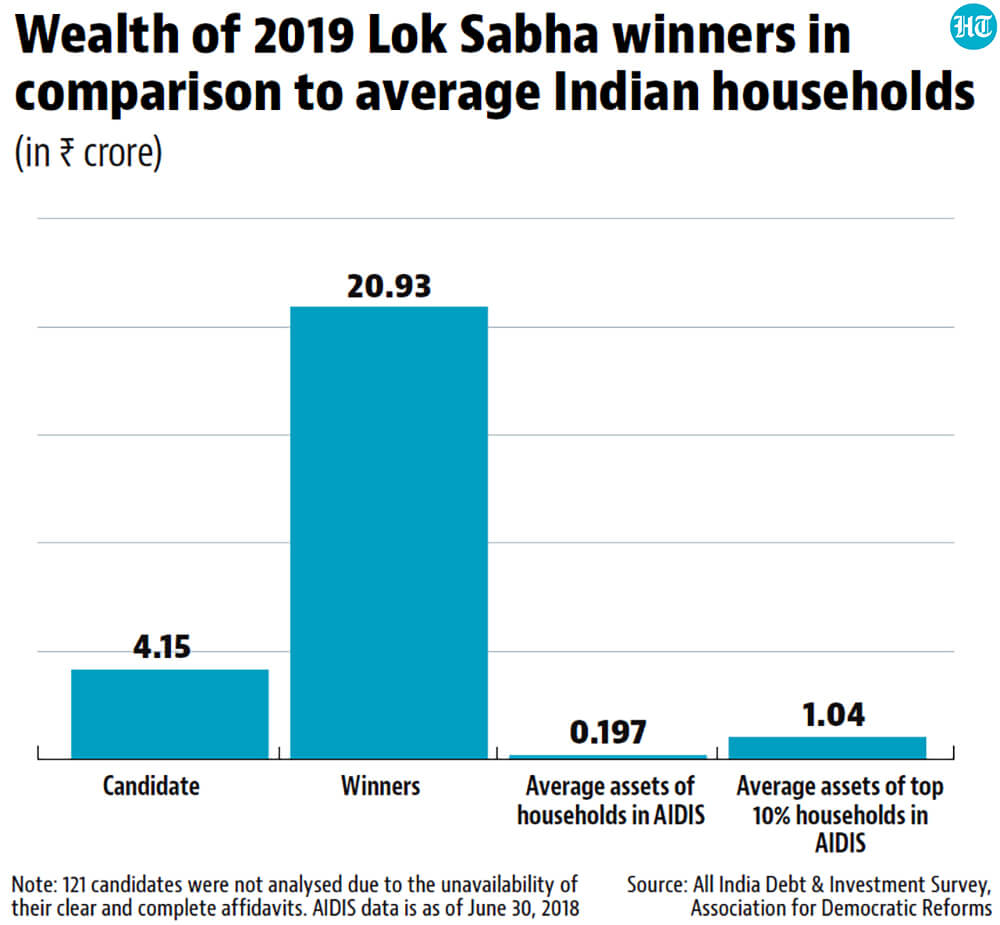
 The average Indian MP is significantly richer than the average IndianThe average asset value – as per election affidavits – of an MP elected to the 2019 Lok Sabha elections was ₹20.93 crore, according to data for 539 MPs available from Association for Democratic Reforms (ADR), a not-for-profit political party watchdog. This is 106 times the average asset value of an Indian household on June 30, 2018, as per data from the All-India Debt and Investment Survey (AIDIS) conducted by the National Statistical Office. This gap in the average assets of an MP and that of an average Indian household is slightly bigger than it was in 2014. In the 2014 Lok Sabha election, the average asset of an MP was ₹14.7 crore (on the basis of data available for 542 MPs available from ADR), 101 times the average asset of an Indian household on June 30, 2012, as per AIDIS. To be sure, the AIDIS that collected data for 2012 had one difference with respect to the AIDIS that collected data for 2018. The 2012 AIDIS calculated the value of buildings as per their normative or guideline values while the 2018 AIDIS calculated this value on the basis of prevailing market prices in the locality.
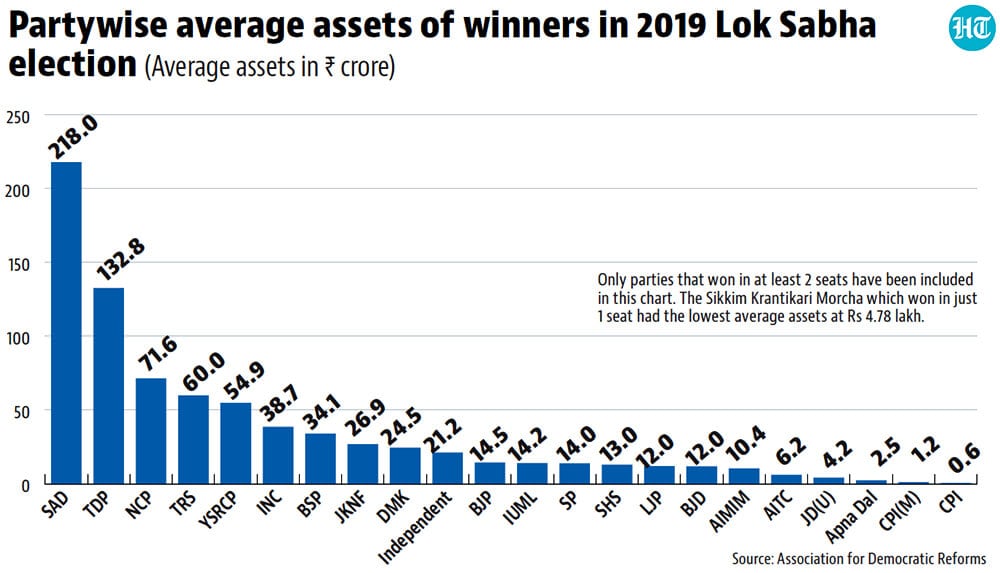
- MPs are super-rich across political linesWhile the BJP enjoys significantly more income compared to other political parties, MPs across political lines are not very different when it comes to their asset levels barring a few exceptions. Data collected by the ADR from election affidavits shows this clearly. For example, 301 (out of 303) winners of BJP analysed by ADR had assets averaging ₹14 crore in the 2019 Lok Sabha election, compared to ₹38 crore for the Congress (51 of 52 winners analysed), and ₹24 crore for the DMK (23 of 24 winners analysed). Even the three Communist Party of India (Marxist) MPs had assets averaging ₹1.24 crore, with the poorest MPs coming from the Viduthalai Chiruthaigal Katchi (average assets of ₹92 lakh), Rashtriya Loktantrik Party (average assets of ₹42 lakh), and the Sikkim Krantikari Morcha ( ₹4.8 lakh). To be sure, the last three won just one seat each in the 2019 Lok Sabha election.
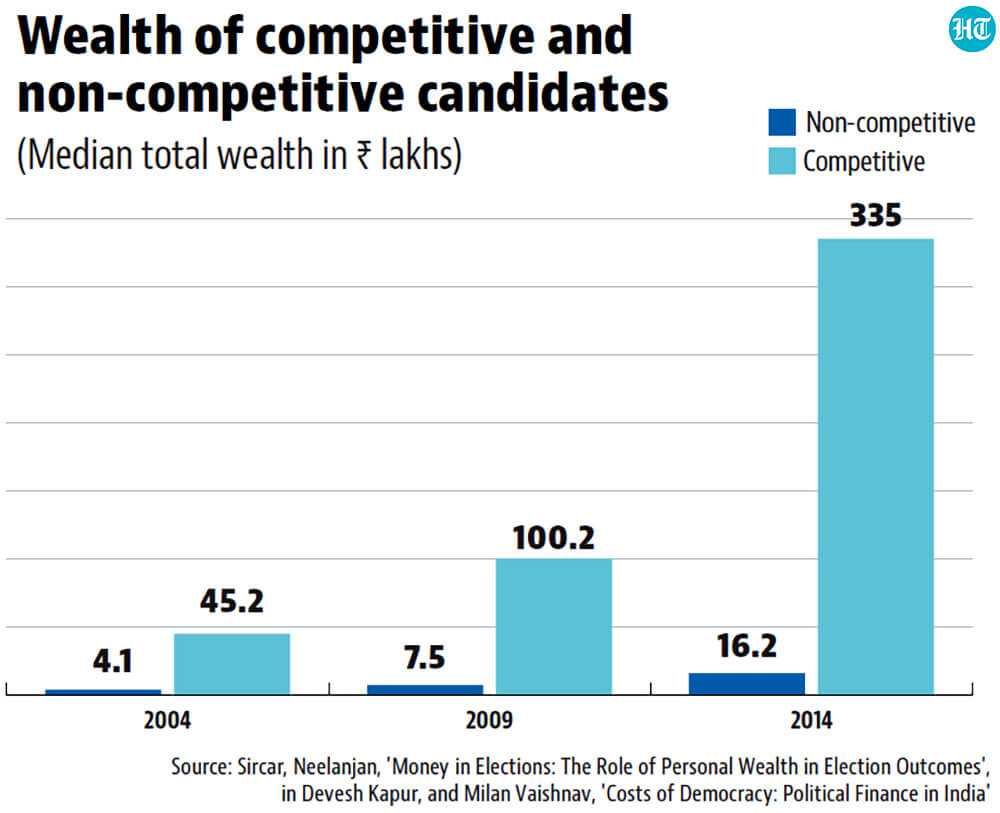
- Research shows that the threshold level wealth for being a competitive candidate has been increasing in Indian electionsAn essay published in the edited volume Costs of Democracy: Political Finance in India by political scientist Neelanjan Sircar shows this clearly. Sircar defines a competitive candidates as the top two finishers in each constituency. His paper has analyzed average assets of a competitive and non-competitive candidates for the 2004, 2009 and 2014 elections. In 2004, the average total asset of a competitive candidate was 11 times that of a non-competitive candidate. This ratio increased to 13 and 21 in the 2009 and 2014 elections. In fact, Sircar adds that the wealth advantage kicks in even before the election process as competitive parties – they are defined as the top two positioned in each constituency – select candidates that are 20 times wealthier than other candidates. These statistics need to be read with the widely held anecdotal belief that candidates spend much more than official limits of spending at the constituency level – it is ₹95 lakh for a Lok Sabha election and ₹70 lakh for an assembly election – to boost their winnability in elections.
- Doing away with something like electoral bonds will clearly help in reducing the opacity in India’s political funding. However, as the statistics given above shows, for democracy to become truly representative, normal people not super-rich need to have a fighting chance at the constituency level. On this count, almost every party is subverting the system.