E-Paper



Number Theory: Why Telangana is the ideal state for a populist government
An HT analysis of Telangana’s finances shows that it is the ideal state for a populist government

 Prefer HTon Google


Whether or not Telangana re-elects the Bharat Rashtra Samiti (BRS), formerly the Telangana Rashtra Samiti (TRS), for the third time will only be known when results are declared on December 3. But whatever be the results, it is clear from the campaigning that the BRS is seeking a re-election on its welfare plank and the principal opposition party, the Congress is trying to outdo the BRS on this front. While political parties exploiting the welfare route to win elections is now common practice in India, an HT analysis of Telangana’s finances shows that it is the ideal state for a populist government. Hyderabad’s revenues and the decoupling from Andhra Pradesh’s population burden is what has made this possible. Here are four charts which explain this in detail.
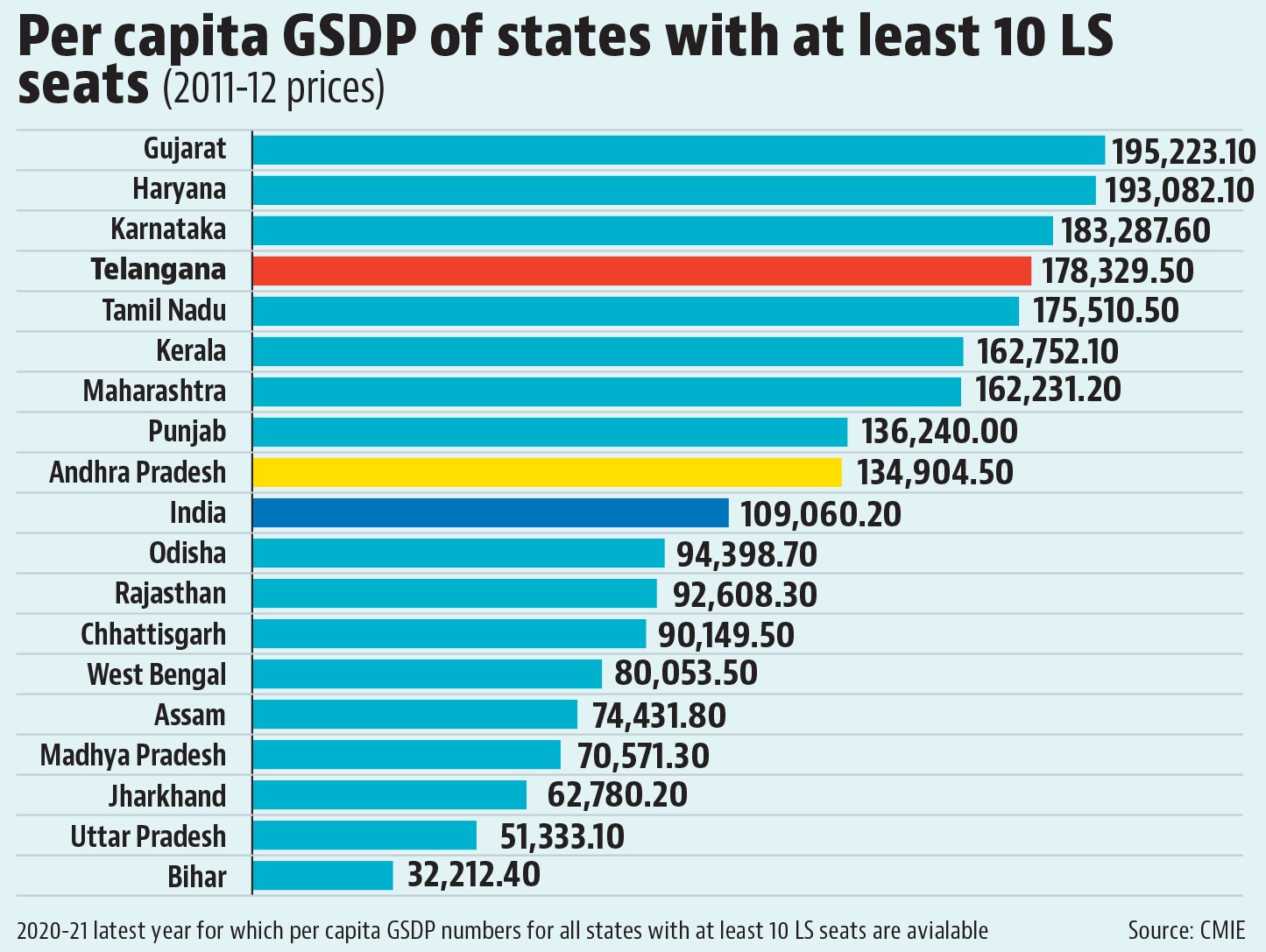
 Andhra Pradesh’s GDP is still higher than Telangana but the latter’s per capita GDP is more than the former’sAccording to the Centre for Monitoring Indian Economy’s (CMIE) database, Andhra Pradesh’s GSDP was ₹7.54 trillion in 2022-23 at constant prices, which is more than Telangana’s ₹7.27 trillion. However, a per capita GSDP comparison puts Telangana ahead of Andhra Pradesh with the numbers being ₹1.91 lakh and ₹1.42 lakh. A comparison of GSDP and per capita GSDP for the two states since 2011-12 – the earliest period for which these numbers are available in the CMIE database – shows that Telangana has always lagged Andhra Pradesh in GSDP but always shown a lead in terms of per capita GSDP. Among states with at least 10 Lok Sabha seats, Telangana is ranked fourth in terms of per capita GSDP. See Chart 1: per capita GSDP of states with at least 10 LS seats
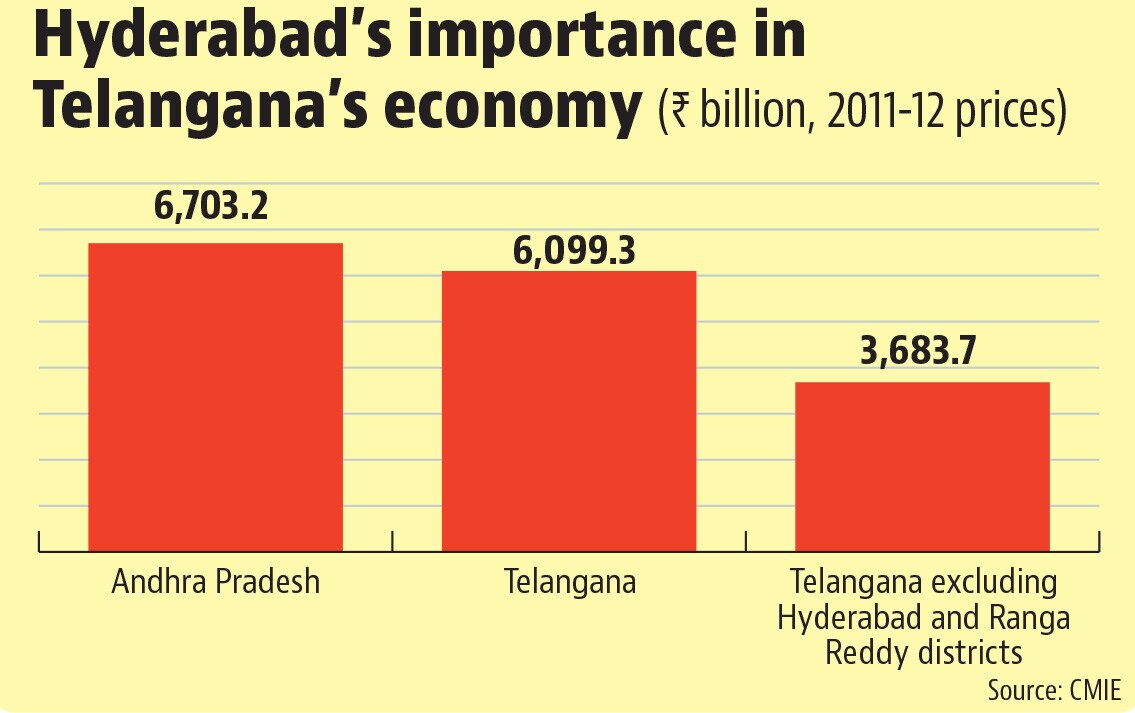
- The Andhra-Telangana economic dynamic would be very different without Hyderabad being in TelanganaA district-wise GSDP comparison of Andhra Pradesh and Telangana from the CMIE database shows this clearly. A ranking of 46 districts in Andhra Pradesh (13) and Telangana (33) by 2020-21 GSDP – latest available numbers – shows that seven out of the top ten districts in the two states are in Andhra Pradesh. If one were to take the top 15 districts, the number of Andhra Pradesh districts increases to 11. What really changes the GSDP game between the two states are the two districts of Hyderabad and Rangareddi, which has been carved out of the old Hyderabad district. Almost all of the new-economy money in services such as IT and global capability centres is concentrated in these two districts. These two districts account for almost 40% of Telangana’s GSDP and more than one-third of all of Andhra Pradesh’s GSDP in 2020-21. Without the greater Hyderabad region, Telangana would not have been able to spend the kind of money it has spent on welfare. See Chart 2: Hyderabad’s importance in Telangana’s economy
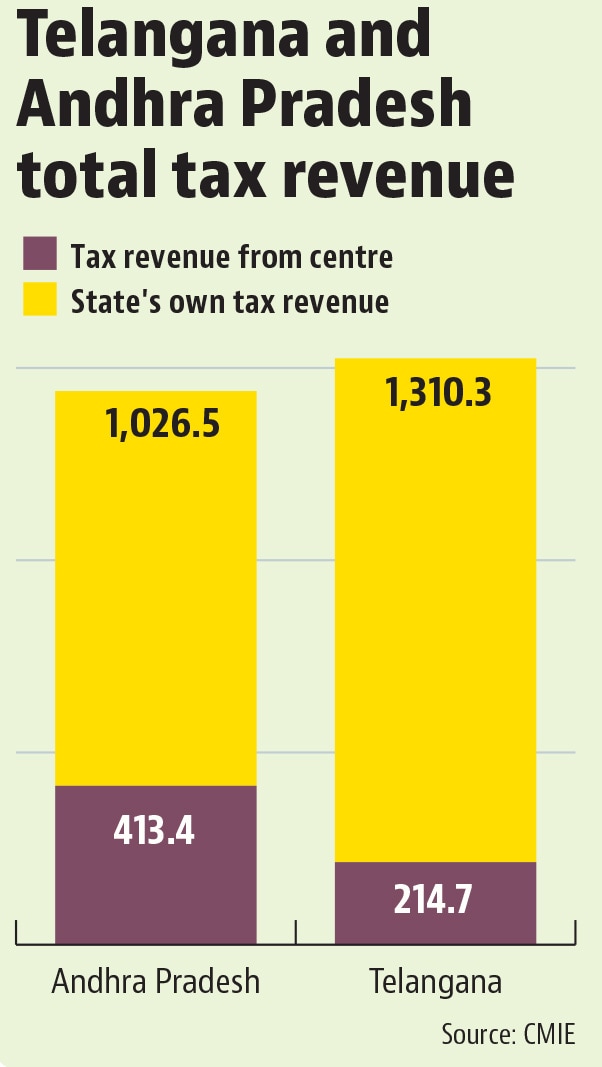
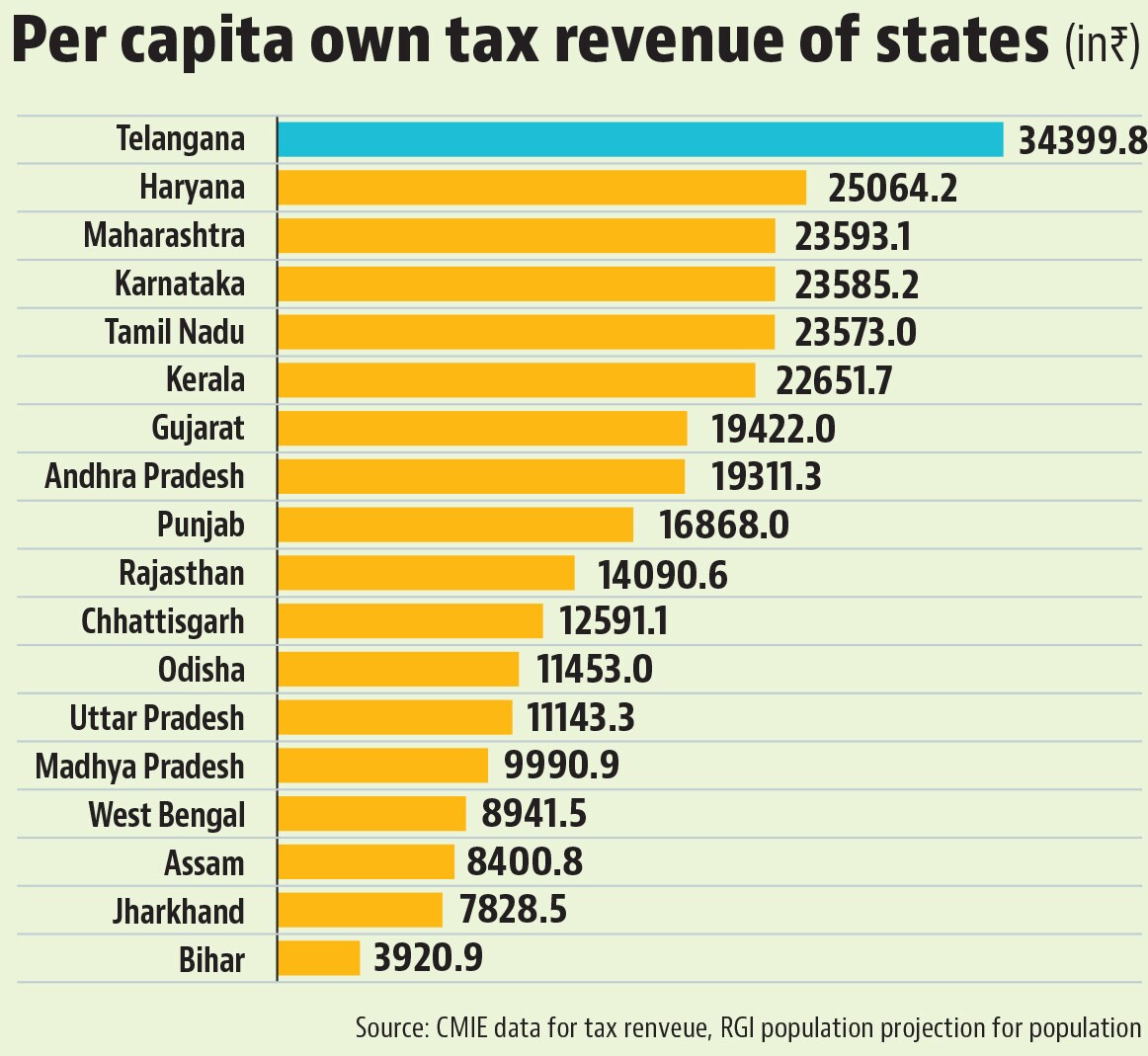
- Hyderabad’s real importance is to be seen in Telangana’s revenue numbersOnce again, the CMIE data base shows this clearly. Total tax revenue of Andhra Pradesh and Telangana for 2023-24 (budget estimates) is expected to be ₹1.43 trillion and ₹1.52 trillion respectively. The picture changes drastically if one compares the state’s own tax revenue – this primarily includes state GST, excise and stamp duties – for the two states. Telangana’s own tax revenue in 2023-24 is expected to be ₹1.3 trillion compared to ₹1.02 trillion for Andhra Pradesh. The gap increases further if one were to compare per capita tax own tax revenue for the two states. Telangana’s per capita own tax revenue is expected to be ₹34,400 in 2023-24 -- it is the second highest in the country after Goa’s ₹54,532 number. If one were to compare states with at least 10 Lok Sabha seats, Telangana’s per capita own tax revenue is the highest among states. Andhra Pradesh’s per capita own tax revenue was just ₹19,311, which is ranked eleventh in the country. What is the point of comparing state’s own tax revenue and per capita revenue when looking at welfare politics? The higher a state’s own tax revenue, the more fiscal room it has for designing welfare programmes over and above normal spending requirements. A per capita adjustment is necessary because it gives us an idea about what a government can spend for every voter in the state. Had Andhra Pradesh and Telangana still been united, the government would have had less fiscal space to spend money on welfare. See Chart 3: Telangana and Andhra Pradesh total tax revenue
- Per capita own tax revenue of statesThe numbers given above clearly show that a government ruling Telangana can exploit the revenues generated by Hyderabad’s new economy to fund welfare programmes to keep its political capital intact in poorer parts of the state. These elections, then, may be about two questions: how efficient are these welfare schemes? and should the BRS have done more of this redistribution?