E-Paper



Number Theory: Will caste-based redistribution pitch have political traction-I
.
Updated on: Apr 29, 2024, 19:17:22 IST


Share via


Copy link

The Congress has made the caste census its central political plank for the 2024 elections. What has made this pitch interesting is that the Congress has been arguing that such an exercise will inform policy making which will be able to bring down overall inequality in the country rather than just increase the share of Other Backward Classes (OBC) in government jobs. Will such a political plank gather traction in an election? HT has analysed the government’s latest data on asset inequality in India to address this question in a two-part data journalism series.
Will a caste-based redistribution pitch have political traction
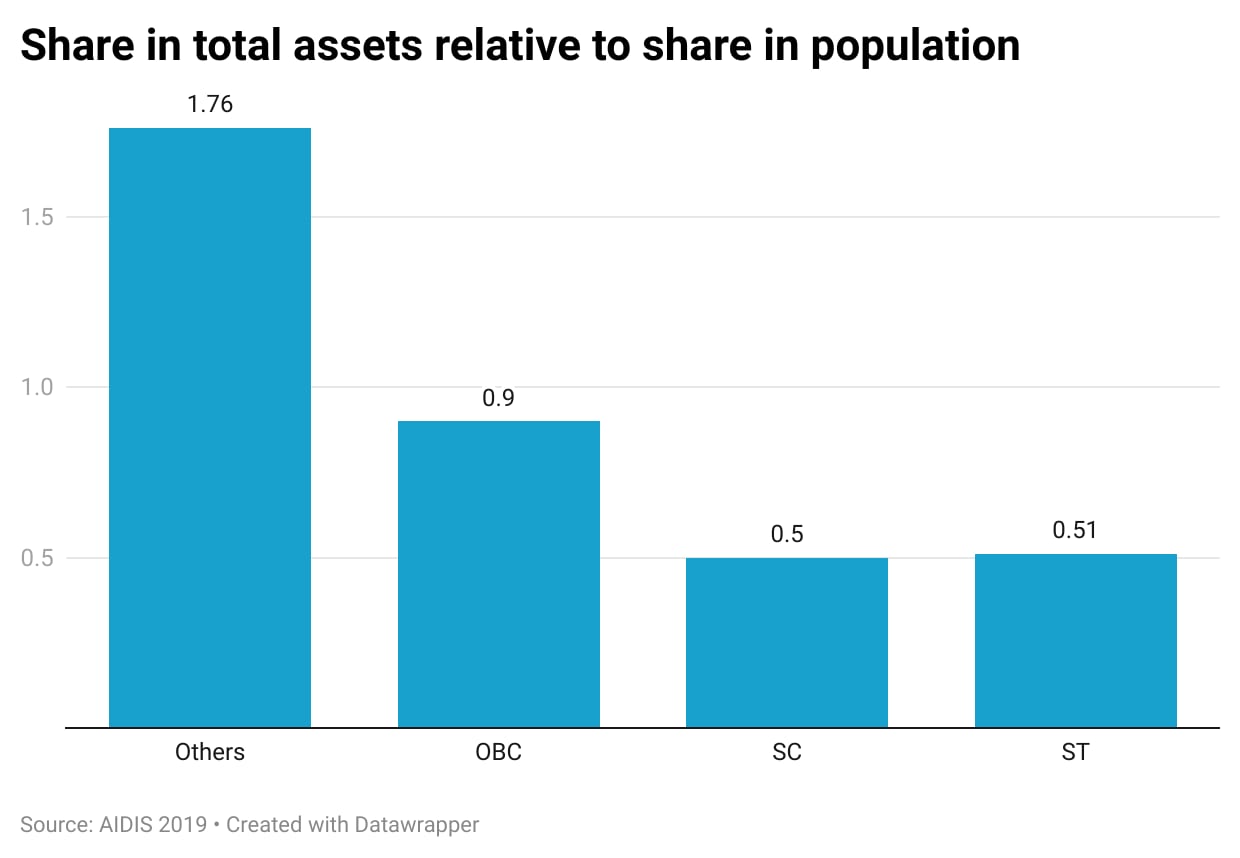
 Does caste play a role in asset inequality in India?National Sample Survey Office (NSSO) published the results of All India Debt and Investment Survey (AIDIS) for 2019 in 2021. This is the latest available data on asset inequality in India and gives the ownership of assets as on June 30, 2018. AIDIS data allows us to look at asset ownership by broad social groups – Scheduled Caste (SC), Scheduled Tribe (ST), Other Backward Classes (OBCs) and those who do not belong to any of these groups – in India. A comparison of relative shares – share in total assets divided by total population – of each of these groups shows social background does play a role in asset inequality in India. However, the advantage and disadvantage of the link between social background and asset ownership is more pronounced for SC-ST (asset poor) and population not belonging to SC-ST-OBC groups. While OBCs are relatively poor compared to non SC-ST-OBC population, they are not very far from the equality threshold which is relative share being equal to one.
- Are there no SC-ST-OBCs within the ranks of the rich in India?A good way to answer this question is to look at the composition of the top 10% of asset-rich Indians in the AIDIS data. Persons who do not belong to SC-ST-OBC groups have a share of almost 50% in the top 10% by value of assets. With an overall population of 26%, this makes their relative share among the richest 10% 1.8. This number is just 0.3 and 0.4 for SCs and STs. However, the OBCs are not seriously underrepresented within the ranks of the top 10% in India, with their relative share being 0.96. In fact, a decile-wise analysis of relative shares of OBCs shows that they are almost equally represented within the ranks of the asset rich and asset poor. This means that the intra-group inequality within OBCs is much higher than other social groups. This is something which was discussed in detail in these pages earlier.
- To be sure, the AIDIS data might not include the super-rich in the countryThis is an important caveat to keep in mind while looking at the AIDIS data on asset inequality. Because NSS surveys are meant to capture a broad-brush picture of the economy, they are prone to exclude the super-rich from their coverage. This becomes obvious when one looks at the absolute value of assets in the AIDIS data. The average value of assets in the top 10% of the households in the AIDIS is ₹1.04 crore. For the top 5%, this number increases to just ₹1.53 crore. It is not possible to calculate this number for the top 1% of households because the value of assets in the survey is a self-reported lump-sum figure, which does not vary much at the top. However, the survey’s inability to capture the really rich can be inferred from the fact that the richest household in the survey had total assets worth just ₹114.81 crore. Does the fact that AIDIS data does not really cover the super-rich make it useless to understand the link between asset inequality and caste in India? Not really. The AIDIS’s overall findings are not very counter-intuitive and it is entirely likely that the outliers in terms of asset value are also not representative of their social group. To be sure, there is another interesting question which can be asked with the help of AIDIS data. Is caste the only determinant of social inequality in India? This is what the second part of this series will look at. This is the first of a two-part data journalism series on the relationship between caste and asset inequality in India. The second part will answer whether caste is the only driver of inequality and political fortunes.