E-Paper



Number theory: OBC chief ministers in India; deep dive into social patterns
This piece will look at the data on OBC chief ministers in detail. It will focus on three key questions to examine this issue.
Updated on: Aug 18, 2023, 01:33:31 IST

 Prefer HTon Google
Share via


Copy link

The first of this two-part data journalism series looked at HT’s caste database of chief ministers to look at overall, intertemporal and state-wise trends in caste background of chief ministers in India. The second part will look at the data on OBC chief ministers in detail. It will focus on three key questions to examine this issue.
Read here: Number theory: A caste-wise analysis of all chief ministers in India
The charts that matter
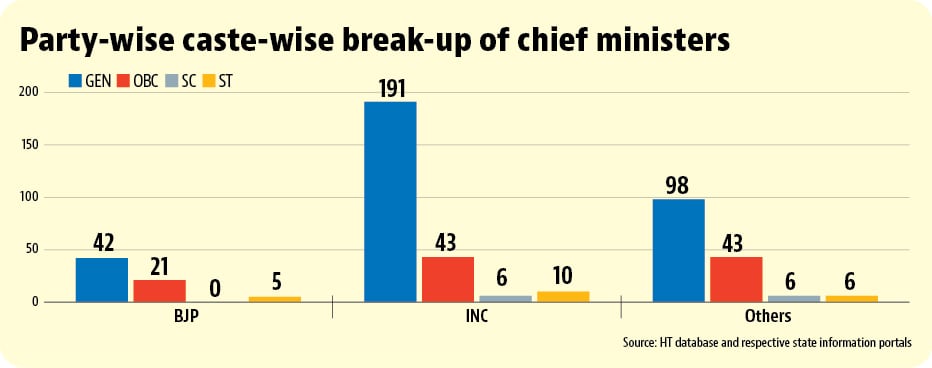
 Party-wise caste composition of chief ministers in IndiaAs was discussed in the first part of the series, the trends in share of OBC chief ministers in India broadly follows the evolution of the party system. It was lower during the era of Congress’s dominance, started increasing in the 1970s and 1980s when the Congress started losing ground and peaked in the period between 1990 and 2000s which was the era of coalition politics. Does this reflect in a party-wise break-up of OBC chief ministers as well? Out of the 471 chief ministers in HT’s caste database of chief ministers, 250 are from the Congress, 68 are from the BJP, and the remaining 153 are from parties other than the Congress and the BJP. A caste-wise party-wise breakup of the database shows that the BJP has had the highest share (30.9%) of OBC chief ministers so far, while this number is the lowest for Congress (17.2%). Share of non-Congress non-BJP parties among OBC chief ministers is 28%. While BJP’s high share in OBC chief ministers highlights its social engineering abilities, it needs to be kept in mind that the BJP’s political rise – its debut in the list of chief ministers only happens in 1990 – coincided with a time when OBCs were a rising force in politics.
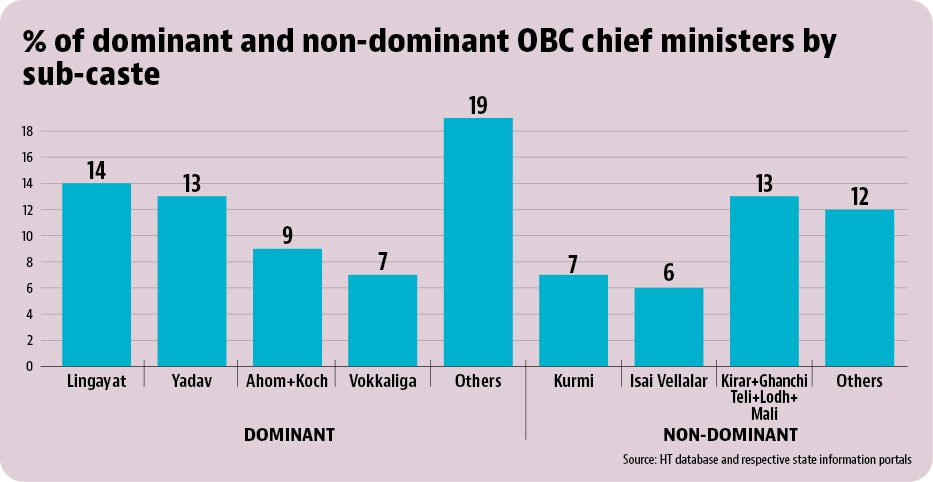
- Dominant OBCs account for 62% of OBC chief ministers so farWhile OBCs are the largest social group in India, they are far from homogeneous terms of demographic and social indicators. This difference often reflects itself in the dominant versus non-dominant contradiction in OBC politics. Dominant OBCs are described as subcastes belonging to the OBC group which have a disproportionately large share (and therefore political dominance) at the level of a state. Yadavs in Bihar and Uttar Pradesh and Vokkaligas in Karnataka are some examples of dominant OBCs. It is often argued that dominant OBCs have usurped most of the political gains of the rise of OBCs in Indian politics. An analysis of HT’s caste database of chief ministers shows that dominant OBCs account for 62% of all OBC chief ministers to have held office so far. Yadavs from Bihar and Uttar Pradesh, and Lingayatas and Vokkaligas from Karnataka, Ahoms and Koch from Assam alone account for 43% of all OBC chief ministers in the list.
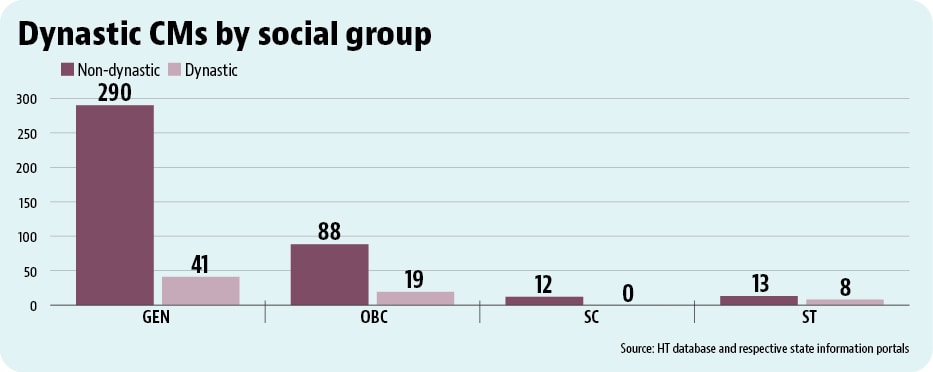
- 14% of all the CMs come from political dynastyThe politics of India has often been criticised for being too dynastic, where powerful political families serve as a pipeline for the entry of their family members/scions into the politics. It is not uncommon to see father/son, husband/wife, and uncle/nephew combinations that have served the state as chief ministers at different periods of time. Of the 471 chief ministers in the HT database, 68 (14.4%) are either father-son/son-in-law, uncle-nephew or husband-wife combinations. Of the 68 such cases, 41 (60%) come from categories other than OBC/SC/ST. OBCs constitute 19 (28%) of such total cases. Such cases are not restricted to a particular state but spread across the regions. Ravi Shankar Shukla and Shyama Charan Shukla, chief ministers of Madhya Pradesh, were the first father-son to have headed a state. Other such pairs include M Karunanidhi and MK Stalin (Tamil Nadu), Hemavati Bahuguna and Vijay Bahuguna (United Uttar Pradesh and Uttarakhand), HD Deve Gowda and HD Kumaraswamy (Karnataka), YSR Reddy and Jagan Mohan Reddy (United Andhra Pradesh, and Andnra Pradesh), Shibu Soren and Hemant Soren (Jharkhand), SR Bommai and Bassavaraj Bommai (again Karnataka), Biju and Navin Patnaik (Odisha), Devi Lal and OM Prakash Chautala (Haryana), Mulayam Singh Yadav and Akhilesh Yadav (Uttar Pradesh), and Shankar Rao Chavan and Ashok Chavan (Maharashtra), Vasantrao Naik and Sudhakar Rao Naik (Maharashtra) (Maharashtra). Lalu Yadav and Rabri Devi (Bihar), MG Ramachandran and Janaki Ramachandran (Tamil Nadu), are the instances of a husband-wife pair becoming chief ministers. HT’s database has not taken into account other such pairs from Arunachal Pradesh, Meghalaya, and the erstwhile state of Jammu and Kashmir.