
 E-Paper



Our collective federalism helped fight Covid: Modi at Niti Aayog meet
Making a case for modernising agriculture, animal husbandry and food processing to help the country become self-sufficient and a global leader in the agriculture sector, PM Narendra Modi also asked states to focus on promoting 3Ts — trade, tourism, technology — to reduce dependence on imports.

 Prefer HTon Google


Prime Minister Narendra Modi on Sunday said that collective efforts in the spirit of collective federalism helped India emerge from the Covid-19 pandemic, a remark he made at the seventh meeting of the governing council of the Niti Aayog.
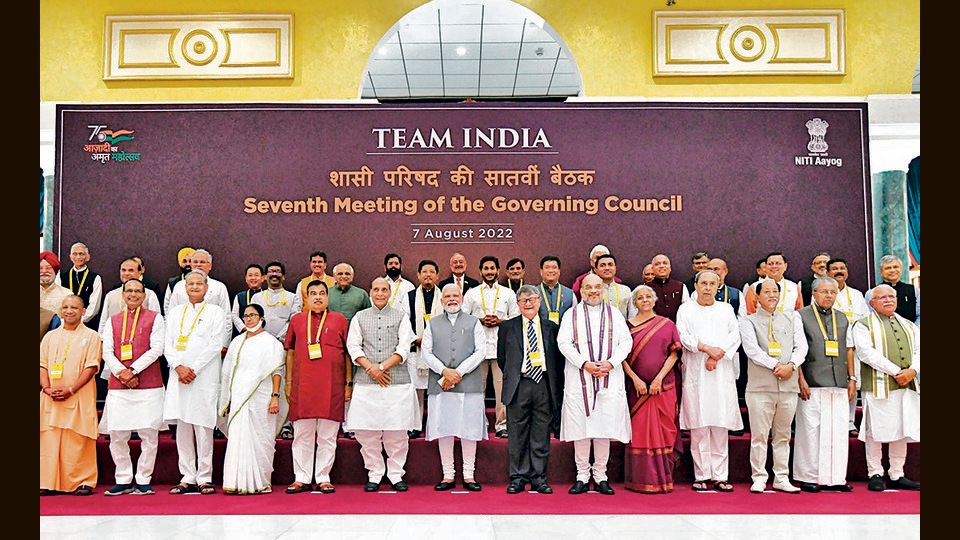
Making a case for modernising agriculture, animal husbandry and food processing to help the country become self-sufficient and a global leader in the agriculture sector, the PM also asked states to focus on promoting 3Ts — trade, tourism, technology — to reduce dependence on imports.
“Every state played a crucial role according to its strength and contributed to India’s fight against Covid. This led to India emerging as an example for the developing nations to look up to as a global leader,” an official release the meeting quoted Modi as saying.
This was the first physical meeting of the governing council since the onset of the Covid-19 pandemic, with the 2021 meeting held via video conferencing. The meeting was attended by 23 chief ministers, three lieutenant governors and two administrators of Union Territories, and Union ministers, including Rajnath Singh, Amit Shah and Nirmala Sitharaman.
Also Read | GST compensation, disaster fund states’ top demands at Niti Aayog meet
In his inaugural address, Modi said India had sent a powerful message to the developing nations of the world — that it is possible to overcome challenges with resilience despite resource limitations.
“For the first time in India’s 75 years of independence, all of India’s chief secretaries met together in one place and deliberated on issues of national importance for three days. This collective process led to the development of the agenda for this meeting,” he said.
The Prime Minister also underlined the need for collective action to increase the collection of the Goods and Services Tax (GST), saying that though the realisation has improved, “the potential is much more... and it is crucial for strengthening our economic position and becoming a USD 5 trillion economy”.
At the meeting, which went on for over six hours, the governing council discussed four key agenda items — crop diversification and achieving self-sufficiency in pulses, oilseeds and other agri-commodities; implementation of National Education Policy (NEP) in school education; implementation of NEP in higher education; and urban governance.
Chief ministers of some non-BJP ruled states asked the Centre not to “force” its policies but to strengthen cooperative federalism and also sought a five-year extension for the compensation paid to states for revenue shortfall due to GST implementation.
Delhi CM Arvind Kejriwal, Bihar CM Nitish Kumar, Telangana CM K Chandrashekar Rao, Tamil Nadu CM MK Stalin, Karnataka CM Basavaraj Bommai, Mizoram CM Zoramthanga and Puducherry CM N Rangasamy did not attend the meeting.
While West Bengal CM Mamata Banerjee, who skipped the meetings in 2019 and 2021, attended the meeting this time, Rao boycotted the meeting as a “mark of protest against the present trend of the Central government to discriminate against the states”.
Banerjee emphasised that the Centre should look into the demands of the state governments “more seriously”.
Speaking in the same vein, Kerala CM Pinarayi Vijayan said the Centre should not go against the federal structure of the Constitution and legislation on subjects listed in its concurrent list should be carried out in consultation with the states.
He also drew the attention of the council to the various GST-related issues and said there needs to be a review of the decision to impose the tax on essential items. He also requested that the GST compensation to the states be continued for another five years.
In his remarks, Chhattisgarh chief minister Bhupesh Baghel reiterated his demand to the Centre seeking a five-year extension for the compensation paid to states for revenue shortfall due to GST implementation and called for revising the rates of royalty for coal and other major minerals from the state.
Odisha chief minister Naveen Patnaik said India is at the crossroads of becoming a great economic superpower rooted in inclusive growth and Niti Aayog can play an important role in facilitating this.
“We all accept that the state and central governments are political entities and sometimes there are disputes in the implementation of central schemes. NITI Aayog can resolve these issues like an ombudsman,” Patnaik said.
The Prime Minister also spoke about India’s G20 presidency in 2023, saying “we should develop a mass movement around G20. This will allow us to identify the best talent available in the country.”
The PM said that G-20 is a “unique opportunity” to show the world that India is not just Delhi — it is every state and Union territory of the country.
He said that there should be a dedicated team for G20 in the states to derive the maximum possible benefit from this initiative. He also asked chief ministers to focus on promoting “3Ts” (Trade, Tourism, Technology) through Indian Mission across the world and increasing exports.
“We should encourage people to use local goods wherever possible,” he said. Vocal for local is not the agenda of an individual political party but a common goal, he said.
Education minister Dharmendra Pradhan spoke about the NEP and highlighted initiatives undertaken to boost learning outcomes, capacity-building of teachers, and skilling.
Among the BJP-ruled states, Haryana CM Manohar Lal Khattar said that the use of the latest technology and crop diversification is being promoted in the state. He said that an area of 46,249 hectares has been diversified in place of paddy under the ‘Mera Pani-Meri Virasat’ scheme.
Uttar Pradesh CM Yogi Adityanath said his state’s contribution to fulfilling the dream of India making a $5 trillion economy will be very important, and in the coming five years, it will achieve the target of becoming a $1 trillion economy.
Niti Aayog vice-chairman Suman Bery said that combined efforts of the Centre and States were needed to realize the vision of a resurgent India post the pandemic.
In his concluding remarks, Modi said the Niti Aayog will study the states’ concerns, challenges, and best practices and subsequently plan the way forward.
The issues discussed in this meeting will define the national priorities for the next 25 years, he said, adding, “the seeds we sow today will define the fruits reaped by India in 2047.”


