
 E-Paper



Our history has mark of colonial conspiracy: PM
India has many unsung heroes who were “deliberately” omitted from historical accounts, Prime Minister Narendra Modi said on Friday, citing the example of a 17th century Ahom general to underline that the country’s history is not only about slavery but also about victory and the valour of countless fighters.


India has many unsung heroes who were “deliberately” omitted from historical accounts, Prime Minister Narendra Modi said on Friday, citing the example of a 17th century Ahom general to underline that the country’s history is not only about slavery but also about victory and the valour of countless fighters.
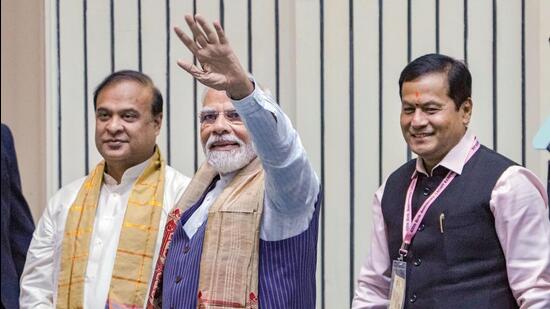
Speaking in a ceremony to mark the 400th birth anniversary of Ahom general Lachit Barphukan in the Capital, Modi also said that India’s history is about standing against tyranny with unprecedented valour and courage and hailed Barphukan for standing up to the Mughal army at the 1671 battle of Saraighat.
“Unfortunately, we were taught, even after Independence, the same history which was written as a conspiracy during the period of slavery. After Independence, it was needed to change the agenda of foreigners who made us slaves, however, that was not done,” Modi said at Vigyan Bhawan.
“The country is correcting those mistakes now. We are rectifying it. This programme today in the nation’s capital to commemorate heroes like Lachit Barphukan is part of that effort... Is Lachit Barphukan’s history not worth knowing? An agenda of slavery continued after Independence. Our real history was deliberately buried,” the PM added.
The event marked the end of a two-day ceremony organised by the Bharatiya Janata Party-led Assam government to mark the Ahom general’s birth anniversary.
Modi said historians had wrongly portrayed India as a land of the defeated and tortured, and emphasised that only when a nation knows its real past, can it learn from its experiences and tread the correct direction for its future. “It is our responsibility that our sense of history is not confined to a few decades and centuries,” he added.
His comments came a day after Union home minister Amit Shah called for historians and scholars to study 30 Indian empires and 300 freedom fighters, saying that no one could stop India from rewriting its history with pride to remove past distortions. He also called upon students and professors to correct history to get rid of “lies”, speaking on the first day of the two-day event in Delhi.
With the Azadi ka Amrit Mahotsav to mark 75 years of India’s Independence, the government aims to “bring alive stories of unsung heroes whose sacrifices have made freedom a reality” and revisit the milestones in the “journey to 15 August, 1947”.
Modi has repeatedly made clear that eradicating colonial influences is a priority for his government. During his Independence Day speech this year, he said that uprooting all signs of colonial slavery from mindset and habits was one of the five pledges the country needed to take to become a developed nation. He cited the national education policy as an example of this effort.
Earlier this week, HT reported that the Indian Council for Historical Research was undertaking a project to rewrite India’s history using local sources in vernacular languages and scripts with the aim to give “due credit” to dynasties that were “missed out” and correct texts that were written in a colonial and Eurocentric manner. On Thursday, Union education minister Dharmendra Pradhan released a new book on tracing India’s democratic history that argued that the democratic ethos was ingrained in the country since the beginning of civilisation.
A key figure in this attempt has emerged Ahom general Barphukan.
In 1671, Lachit Barphukan, a legendary military general of the Ahom kingdom and widely revered in Assam, defeated a powerful invading Mughal army led by Raja Ram Singh I in a battle over the Brahmaputra on the outskirts of Guwahati. Barphukan and his naval commander Islam Siddique, alias Bagh Hazarika, stopped the incursion despite being outnumbered, forcing the Mughal’s retreat from Assam during emperor Aurangzeb’s reign.
Modi said his government’s “nation first” policy was inspired by regional heroes such as Barphukan. “A king’s rule is not about promoting bhai bhatija-waad (nepotism). When Barphukan executed his own uncle because he found him lacking in his patriotic duty, he famously declared that ‘One’s uncle is not greater than one’s motherland’.” His apparent reference was at some Opposition parties that he has criticised for dynastic politics in the past.
“Our civilisation has assimilated diverse cultures, traditions and faiths. Bur whenever we were sought to be conquered by the tip of the sword, we know how to give a reply,” the PM added.
Assam CM Himanta Biswa Sarma said his government was working to fulfil Modi’s vision of “Ek rashtra, shresth rashtra (one country, best country)”.
The event was also attended by Union minister Sarbananda Sonowal, Assam governor Jagdish Mukhi and former chief justice of India Ranjan Gogoi, among others. “The North-east is always a central part of PM’s Modi vision of a developed India,” Sonowal said.
Later, Modi unveiled a book on Barphukan and watched a short documentary on the general’s life and times. “Human history saw birth of many civilizations. Time has destroyed many civilisations. But whenever Bharat faced challenges, great people like Barphukan took birth and fought those challenges. Those civilisations are the ones that survived,” the PM said, releasing the book.


